

White-tipped Dove vs White-winged Dove
Leptotila verreauxi versus Zenaida asiatica
Play a quiz with White-tipped Dove and White-winged Dove
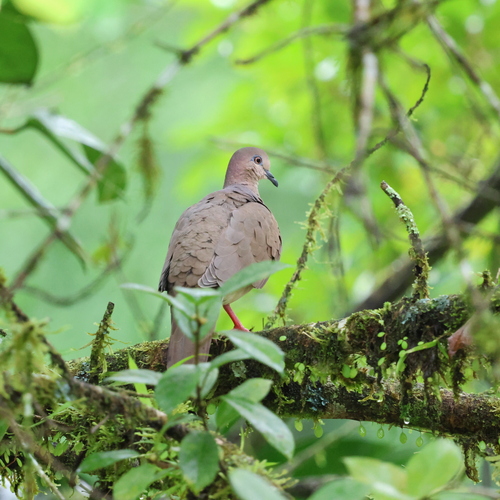 White-tipped Dove
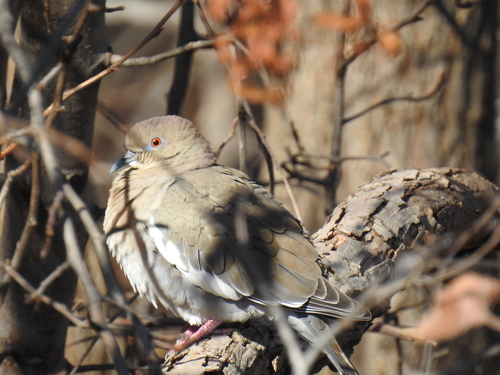 White-winged Dove
In short
The most reliable field mark to separate White-tipped Dove from White-winged Dove is the presence of a bold white edge on the folded wing and a brilliant white crescent in flight on the White-winged Dove, which is entirely absent in White-tipped Dove. Both species are similar in size and overall brownish-gray coloration, but White-tipped Dove shows a broad white tip to the tail (best seen from below or in flight), while White-winged Dove has a short, rounded tail and lacks this feature. Eye color and eye-ring can help: White-winged Dove always has a blue eye-ring and red eyes (brown in juveniles), while White-tipped Dove’s eye-ring is red or blue depending on region and age, and its iris is yellow. Juvenile White-winged Doves are duller and lack iridescence, but still show the white wing patch. In perched or ground views, focus on the wing and tail pattern for the quickest separation.
Identification tips
- White wing patch (all ages): Only White-winged Dove has a bold white edge on the folded wing and a brilliant white crescent in flight. If you see white on the wing at rest or in flight, it's a White-winged Dove, regardless of age or season.
- Tail pattern (all ages): White-tipped Dove has a broad white tip to the tail, best seen from below or in flight. White-winged Dove has a short, rounded tail with no white tip. In flight, look for the contrast at the tail end.
- Eye and eye-ring color (adults): White-winged Dove adults have a blue eye-ring and bright red (crimson) eyes. White-tipped Dove adults have a red or blue eye-ring (region-dependent) and a yellow iris. Juvenile White-winged Doves have brown eyes, but the blue eye-ring is still present.
- Underwing color (adults): White-tipped Dove shows rufous underwing coverts, visible in flight or if the bird stretches its wing. This is not a feature of White-winged Dove.
- Facial markings (adults): White-winged Dove shows a long, dark mark on the lower face and, in males, a slightly more iridescent purple crown/neck and a more distinctive ear spot (though these are subtle and unreliable in the field). White-tipped Dove lacks these marks.
- Overall coloration: Both species are brownish-gray above and pale below, but White-tipped Dove is paler on the forehead and throat, with a pinkish or buff tinge to the chest. White-winged Dove is more uniformly gray below.
- Juvenile confusion: Juvenile White-winged Doves are duller and grayer, with brown eyes, but still show the white wing patch. Juvenile White-tipped Doves look like adults but never show white on the wing.
- Tail shape: White-tipped Dove has a broader, more squared tail with a white tip; White-winged Dove has a short, rounded tail.
- Flight style: Both species have fast, direct flight, but White-winged Dove may be seen in larger flocks and more open airspace, while White-tipped Dove is more solitary and stays close to cover.
- Habitat context: In humid, dense woodland, White-tipped Dove is more likely; in open, urban, or arid areas, White-winged Dove is favored.
- Perched posture: White-tipped Dove often appears more hunched and stays low or in cover; White-winged Dove perches more upright and is often seen on wires or exposed branches.
- Voice: If you hear a deep, hollow two-note call (ooo-wooooo), it's likely White-tipped Dove. White-winged Dove’s call is not detailed here.
- Leg color: Both have red or pinkish-red legs, but White-winged Dove's are brighter.
- Bill color: Both have dark bills; not a useful field mark for separation.
- Sex differences: Both species are sexually monomorphic in the field; do not rely on sex for identification.
Size
Both doves are large for their family, with nearly identical lengths (about 28–29 cm) and weights (White-tipped Dove: ~155 g; White-winged Dove: ~153 g) [wikipedia][wikidata]. In the field, neither species is noticeably larger or bulkier than the other. Sexes are not reliably separable by size in either species, and daily weight changes make mass an unreliable field mark. Structural differences such as tail shape (White-tipped: broad, White-winged: short and rounded) are more useful than size.
Plumage
-
Juvenile/immature birds: Juvenile White-winged Doves are duller and grayer than adults, lack iridescence, and have brown eyes, but they still show the diagnostic white wing patch at rest and in flight. Juvenile White-tipped Doves resemble adults in overall pattern but may be less crisp; they never show a white wing patch, but do have a broad white tail tip visible from below or in flight.
-
Adults: White-winged Dove adults are brownish-gray above, gray below, with a bold white edge on the folded wing and a brilliant white crescent in flight. They have a blue eye-ring and red (crimson) eyes, plus a dark mark on the lower face. White-tipped Dove adults are gray-brown above, whitish below with pinkish or buff on the chest, and have a broad white tail tip but no white on the wing. Their eye-ring is usually red (sometimes blue in Amazon/northern South America), and their iris is yellow. Underwing coverts are rufous in White-tipped Dove, not noted in White-winged Dove.
-
Tail: White-tipped Dove has a broad white tip to the tail, best seen from below or in flight. White-winged Dove has a short, rounded tail lacking a white tip.
Behaviour
White-tipped Doves are generally solitary or in pairs, wary, and stay close to cover, foraging mainly on the ground. Their flight is fast and direct with regular wingbeats and some clattering. White-winged Doves are often seen in larger groups, especially outside breeding, and may perch conspicuously. Their flight is also direct and strong, but they are more likely to be seen in open areas or flying between feeding and roosting sites. Both species build stick nests in trees, but White-winged Doves may nest in a wider variety of trees and rarely on man-made structures.
Habitat
White-tipped Dove prefers woodland habitats, often humid or semi-open, and is more likely found in denser cover. White-winged Dove is more versatile, ranging from the Southwestern US through Mexico, Central America, and the Caribbean, and is often found in open woodlands, urban areas, and near water sources. In areas of overlap, White-tipped Dove tends to stick to more humid or forested patches, while White-winged Dove is more tolerant of open and urbanized habitats.
Voice
White-tipped Dove gives a deep, hollow two-note call: an introductory hoot followed by a longer, more audible, hollow note (ooo-wooooo). White-winged Dove’s call is not described in the provided notes, so vocalization is not a primary field mark for separation in this context.