

Motmot

White-throated Needletail vs Pacific Swift

Hirundapus caudacutus versus Apus pacificus

Play a quiz with White-throated Needletail and Pacific Swift
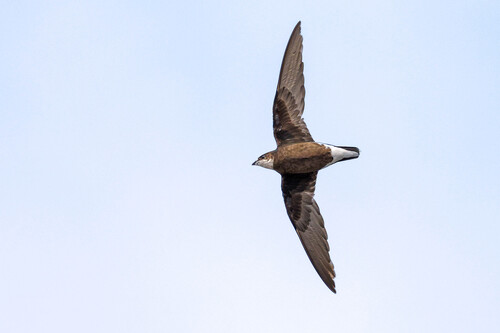
White-throated Needletail (Hirundapus caudacutus) White-throated Needletail
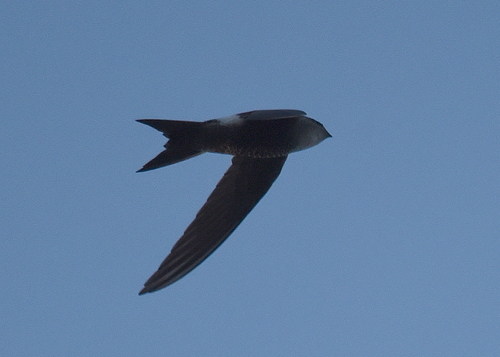
Pacific Swift (Apus pacificus) Pacific Swift

Media

Loading…

In short

The most reliable way to separate White-throated Needletail from Pacific Swift is by overall structure and plumage: the Needletail is much more robust and barrel-chested, with a distinctive white throat and a bold white patch from the tail base onto the flanks, while the Pacific Swift is slimmer, longer-winged, and shows a white rump band but lacks the Needletail’s white throat. In flight, the Needletail’s tail is spined and not forked, contrasting with the Pacific Swift’s deeply forked tail. Juvenile Pacific Swifts may show pale fringes on the wings, but no age of Pacific Swift ever shows the Needletail’s unique white flank patch. Both species are aerial, but the Needletail’s powerful, direct flight and chunky silhouette are unlike the more graceful, scythe-winged Pacific Swift.

Identification tips

  1. White throat and white flank patch (Needletail only): The Needletail always shows a bold white throat and a large white patch from the tail base onto the flanks—never present in Pacific Swift, which has a dark throat and no white on the flanks.
  2. White rump band (Pacific Swift only): Pacific Swift shows a clear white rump band (narrower in some subspecies), visible in flight and from below. Needletail lacks this feature entirely.
  3. Tail shape: Needletail has a squared-off tail with obvious spines at the tip (giving the 'needle-tailed' name), never forked. Pacific Swift has a deeply forked tail, with no spines.
  4. Body structure: Needletail is robust, barrel-chested, and heavy-bodied, often described as 'torpedo-shaped.' Pacific Swift is slimmer, with a proportionally larger head, longer wings, and a more streamlined look.
  5. Flight style: Needletail’s flight is fast, direct, and powerful, with rapid wingbeats and little gliding. Pacific Swift is more buoyant, often gliding and showing more flexible, scythe-shaped wings.
  6. Upperparts color: Needletail is greyish-brown above, while Pacific Swift is blackish above with a greyer head.
  7. Underparts: Needletail is mostly dark below except for the white throat and flank patch. Pacific Swift is blackish below, but close views may reveal a scaly look from pale feather fringes, especially in juveniles.
  8. Juvenile Pacific Swift: Shows pale fringes on wing feathers, but never any white on the throat or flanks. Juvenile Needletail looks like adult.
  9. Bill and legs: Both species have small bills and very short legs, not usually visible in the field.
  10. Perched posture: Rarely seen, but Needletail is extremely reluctant to perch except at nest; Pacific Swift may perch on wires or cliffs.
  11. Size impression: Needletail is much larger and heavier than Pacific Swift; this is especially obvious if seen together or with other swifts for scale.
  12. Tail spines (Needletail): Look for the spined tail tip in Needletail, especially when the tail is spread.
  13. White throat patch (Needletail): Even at distance, the white throat can be a giveaway when the bird banks or turns.
  14. White rump band (Pacific Swift): Best seen from above or behind; absence of this in a large swift points to Needletail.
  15. Vagrancy context: Both are rare in Europe, but Pacific Swift is a more regular vagrant; context may help but is not diagnostic.

Size

White-throated Needletail is substantially larger and heavier: about 20 cm long and weighing 110–120 g, with a notably barrel-shaped body. Pacific Swift is smaller and much lighter: 17–18 cm long, with a wingspan of 43–54 cm, and weighs about 43–45 g. The Needletail’s size and bulk are obvious in direct comparison, especially in flight.

Plumage

Juvenile Pacific Swifts can show pale fringes on the wing feathers, giving a slightly scaly look from below, but this is subtle and never produces the bold white patches seen on White-throated Needletail. All ages of Needletail show a white throat and a large, conspicuous white patch extending from the tail base onto the flanks—these are never present in Pacific Swift. Pacific Swift of all ages has a white rump band (narrower in some subspecies) and a generally blackish body with a greyer head and scaly underparts due to feather fringes. The Needletail’s upperparts are greyish-brown, not black, and it lacks the white rump band. The Needletail’s tail is spined and squared off, not forked, while Pacific Swift’s tail is deeply forked and lacks spines. Sexes are similar in both species.

Behaviour

Both species are almost always seen in flight, rarely perching except at the nest. However, White-throated Needletail is especially known for its powerful, direct, and fast flight, often described as bullet-like, with rapid, purposeful wingbeats and little gliding. Pacific Swift, while also a strong flier, appears more graceful, with longer, scythe-shaped wings and a more buoyant, gliding flight. Needletails rarely, if ever, land on the ground, while Pacific Swifts may sometimes be seen perched on wires or cliffs near breeding sites.

Habitat

Both are aerial insectivores and can be seen over a wide range of habitats while foraging. White-throated Needletail breeds in Central Asia and southern Siberia, nesting in cliffs or hollow trees, and winters in Southeast Asia and Australia. Pacific Swift breeds in eastern Asia and migrates to Southeast Asia and Australia for the northern winter. Both are rare vagrants to Europe, but Pacific Swift is more regularly recorded in the Western Palearctic. Habitat is not typically diagnostic in the field, but context may help with vagrancy.

Submit a better description

Use the same sections as the comparison. Your text is published immediately.

The most reliable way to separate White-throated Needletail from Pacific Swift is by overall structure and plumage: the Needletail is much more robust and barrel-chested, with a distinctive white throat and a bold white patch from the tail base onto the flanks, while the Pacific Swift is slimmer, longer-winged, and shows a white rump band but lacks the Needletail’s white throat. In flight, the Needletail’s tail is spined and not forked, contrasting with the Pacific Swift’s deeply forked tail. Juvenile Pacific Swifts may show pale fringes on the wings, but no age of Pacific Swift ever shows the Needletail’s unique white flank patch. Both species are aerial, but the Needletail’s powerful, direct flight and chunky silhouette are unlike the more graceful, scythe-winged Pacific Swift.

  1. White throat and white flank patch (Needletail only): The Needletail always shows a bold white throat and a large white patch from the tail base onto the flanks—never present in Pacific Swift, which has a dark throat and no white on the flanks.
  2. White rump band (Pacific Swift only): Pacific Swift shows a clear white rump band (narrower in some subspecies), visible in flight and from below. Needletail lacks this feature entirely.
  3. Tail shape: Needletail has a squared-off tail with obvious spines at the tip (giving the 'needle-tailed' name), never forked. Pacific Swift has a deeply forked tail, with no spines.
  4. Body structure: Needletail is robust, barrel-chested, and heavy-bodied, often described as 'torpedo-shaped.' Pacific Swift is slimmer, with a proportionally larger head, longer wings, and a more streamlined look.
  5. Flight style: Needletail’s flight is fast, direct, and powerful, with rapid wingbeats and little gliding. Pacific Swift is more buoyant, often gliding and showing more flexible, scythe-shaped wings.
  6. Upperparts color: Needletail is greyish-brown above, while Pacific Swift is blackish above with a greyer head.
  7. Underparts: Needletail is mostly dark below except for the white throat and flank patch. Pacific Swift is blackish below, but close views may reveal a scaly look from pale feather fringes, especially in juveniles.
  8. Juvenile Pacific Swift: Shows pale fringes on wing feathers, but never any white on the throat or flanks. Juvenile Needletail looks like adult.
  9. Bill and legs: Both species have small bills and very short legs, not usually visible in the field.
  10. Perched posture: Rarely seen, but Needletail is extremely reluctant to perch except at nest; Pacific Swift may perch on wires or cliffs.
  11. Size impression: Needletail is much larger and heavier than Pacific Swift; this is especially obvious if seen together or with other swifts for scale.
  12. Tail spines (Needletail): Look for the spined tail tip in Needletail, especially when the tail is spread.
  13. White throat patch (Needletail): Even at distance, the white throat can be a giveaway when the bird banks or turns.
  14. White rump band (Pacific Swift): Best seen from above or behind; absence of this in a large swift points to Needletail.
  15. Vagrancy context: Both are rare in Europe, but Pacific Swift is a more regular vagrant; context may help but is not diagnostic.

White-throated Needletail is substantially larger and heavier: about 20 cm long and weighing 110–120 g, with a notably barrel-shaped body. Pacific Swift is smaller and much lighter: 17–18 cm long, with a wingspan of 43–54 cm, and weighs about 43–45 g. The Needletail’s size and bulk are obvious in direct comparison, especially in flight.

Juvenile Pacific Swifts can show pale fringes on the wing feathers, giving a slightly scaly look from below, but this is subtle and never produces the bold white patches seen on White-throated Needletail. All ages of Needletail show a white throat and a large, conspicuous white patch extending from the tail base onto the flanks—these are never present in Pacific Swift. Pacific Swift of all ages has a white rump band (narrower in some subspecies) and a generally blackish body with a greyer head and scaly underparts due to feather fringes. The Needletail’s upperparts are greyish-brown, not black, and it lacks the white rump band. The Needletail’s tail is spined and squared off, not forked, while Pacific Swift’s tail is deeply forked and lacks spines. Sexes are similar in both species.

Both species are almost always seen in flight, rarely perching except at the nest. However, White-throated Needletail is especially known for its powerful, direct, and fast flight, often described as bullet-like, with rapid, purposeful wingbeats and little gliding. Pacific Swift, while also a strong flier, appears more graceful, with longer, scythe-shaped wings and a more buoyant, gliding flight. Needletails rarely, if ever, land on the ground, while Pacific Swifts may sometimes be seen perched on wires or cliffs near breeding sites.

Both are aerial insectivores and can be seen over a wide range of habitats while foraging. White-throated Needletail breeds in Central Asia and southern Siberia, nesting in cliffs or hollow trees, and winters in Southeast Asia and Australia. Pacific Swift breeds in eastern Asia and migrates to Southeast Asia and Australia for the northern winter. Both are rare vagrants to Europe, but Pacific Swift is more regularly recorded in the Western Palearctic. Habitat is not typically diagnostic in the field, but context may help with vagrancy.

Discard your changes?

You have unsaved edits. If you leave now, those changes will be lost.

White-throated Needletail · Pacific Swift · My Tricky Birds