

White-tailed Ptarmigan vs Rock Ptarmigan
Lagopus leucura versus Lagopus muta
Play a quiz with White-tailed Ptarmigan and Rock Ptarmigan
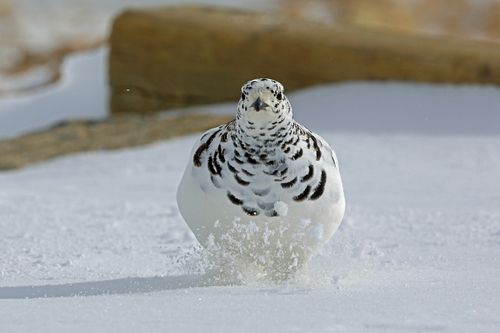 White-tailed Ptarmigan
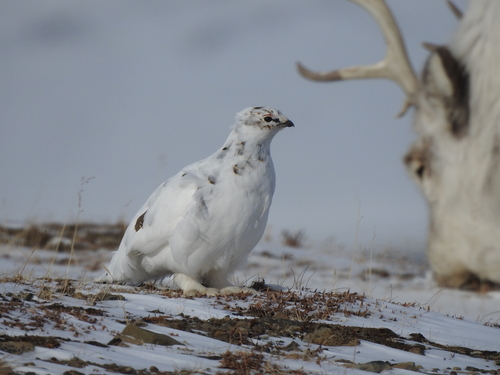 Rock Ptarmigan
In short
The most reliable field mark between White-tailed Ptarmigan and Rock Ptarmigan is the color of the tail in all plumages: White-tailed Ptarmigan always shows a completely white tail, while Rock Ptarmigan has black outer tail feathers visible except in deep snow or odd angles. In flight or perched, this tail difference is diagnostic for all ages and seasons. Structurally, White-tailed is distinctly smaller and more compact, with a shorter bill and rounder wings. Both species change plumage seasonally, but White-tailed is paler and more finely patterned in summer, while Rock Ptarmigan is bulkier and browner above. Habitat can help: White-tailed is found at higher, more alpine elevations, often above treeline, while Rock Ptarmigan is more widespread and can occur at slightly lower elevations.
Identification tips
- Tail color (all ages/seasons): White-tailed Ptarmigan always has a pure white tail; Rock Ptarmigan has black outer tail feathers visible in flight or when fanned, even in full winter plumage.
- Wing color (all ages/seasons): Both species have white wings in all plumages, so this is not diagnostic.
- Size and structure: White-tailed Ptarmigan is much smaller and more compact, with a shorter, stubbier bill and rounder wings. Rock Ptarmigan is bulkier, longer-tailed, and heavier-billed.
- Bill shape: White-tailed's bill is smaller and more delicate; Rock Ptarmigan's is longer and more robust.
- Summer upperparts: White-tailed is finely barred and pale gray-brown above, with a 'grass-pattern' of light brown bands and white belly; Rock Ptarmigan is browner and more mottled, lacking the fine barring.
- Male facial pattern (summer/winter): Male Rock Ptarmigan shows a black eye stripe (lores) in breeding and winter plumage; White-tailed males lack this but have reddish eyecombs.
- Eyecombs: Both males have reddish eyecombs, but this is not a strong separator.
- Winter plumage: Both are white, but only Rock Ptarmigan retains black in the tail and (in males) a black eye line.
- Feet: Both have feathered feet, but this is not easily seen in the field and not diagnostic.
- Habitat: White-tailed is strictly alpine, above treeline; Rock Ptarmigan can be found at lower elevations and in more vegetated tundra.
- Behavior: White-tailed is more likely to be seen crouching or walking slowly, rarely flying; Rock Ptarmigan is more active, often seen flying or displaying.
- Vocalizations: White-tailed is nearly silent; Rock Ptarmigan males are noisy in spring, giving croaking, rattling, or rasping calls.
- Flight jizz: White-tailed appears more compact and rounded in flight; Rock Ptarmigan looks bulkier and longer-tailed.
- Seasonal molt: Both species molt gradually, but White-tailed's transitions are paler and more cryptic, while Rock Ptarmigan becomes browner and more mottled in summer.
- Pitfalls: In winter, both can appear all-white at a distance, but the black tail of Rock Ptarmigan is usually visible in flight or when the tail is spread. In summer, beware of overlap in mottled brown plumage; rely on tail color and habitat for best separation.
Size
White-tailed Ptarmigan is the smallest grouse in North America, averaging about 325 g, while Rock Ptarmigan is nearly twice as heavy at 610 g on average [wikidata]. White-tailed is 31–34 cm long, Rock Ptarmigan 34–36 cm. In the field, White-tailed appears notably daintier, with a more compact, round-bodied look and shorter tail. Rock Ptarmigan is bulkier, with a longer, more prominent tail and a heavier build.
Plumage
-
Juvenile/immature/first-winter (flight and perched): Both species undergo gradual molts, but the key is the tail: White-tailed Ptarmigan always has a pure white tail and white wings, regardless of age or season. Rock Ptarmigan, even in full winter white, retains black outer tail feathers and a black eye line in males. No unique upperwing pattern is described for either species at these ages, but the tail is always reliable.
-
Adult breeding (summer): White-tailed Ptarmigan is finely barred and pale grayish-brown above, with a white belly, white wings, and white tail. Rock Ptarmigan is browner and darker above, with a more mottled gray-brown back, but also with white wings and underparts. Male Rock Ptarmigan shows a black eye stripe, absent in White-tailed.
-
Fall: White-tailed transitions to a reddish-brown with white feathers coming through; Rock Ptarmigan becomes grayish-brown but keeps black in the tail.
-
Winter: Both species are mostly white, but White-tailed Ptarmigan is entirely white including tail and wings, while Rock Ptarmigan is white with black outer tail feathers and, in males, a black eye line.
Behaviour
White-tailed Ptarmigan is extremely sedentary, often avoiding flight and preferring to roost in snowbanks to conserve energy. It tends to remain above treeline year-round. Rock Ptarmigan is also largely sedentary but may undertake more significant local movements, especially in the far north, and is more likely to be seen flying between patches of cover or displaying on open ground. Rock Ptarmigan males are more vocal and active in territorial and courtship displays, including aerial chases and ground posturing.
Habitat
White-tailed Ptarmigan is strictly alpine, found above treeline in the highest mountains of western North America, favoring rocky tundra and windswept slopes. Rock Ptarmigan also prefers open, barren habitats but is more flexible, occurring at slightly lower elevations, in tundra, rocky outcrops, and sometimes in more vegetated areas. In overlapping ranges, White-tailed is usually at higher, more exposed sites.
Voice
White-tailed Ptarmigan is generally silent, occasionally giving low hoots or soft clucking. Rock Ptarmigan males are much more vocal, especially in breeding season, producing guttural snores, rattles, and a distinctive rasping call during display flights. If you hear a loud, croaking or rattling call, it is more likely Rock Ptarmigan.