

White-tailed Kite vs Swallow-tailed Kite
Elanus leucurus versus Elanoides forficatus
Play a quiz with White-tailed Kite and Swallow-tailed Kite
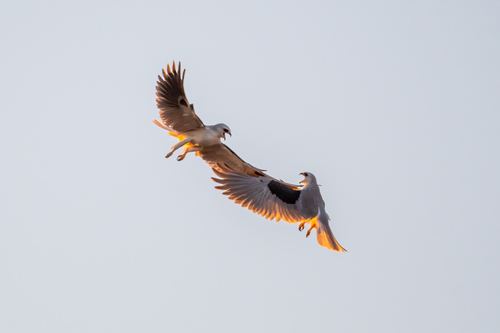 White-tailed Kite
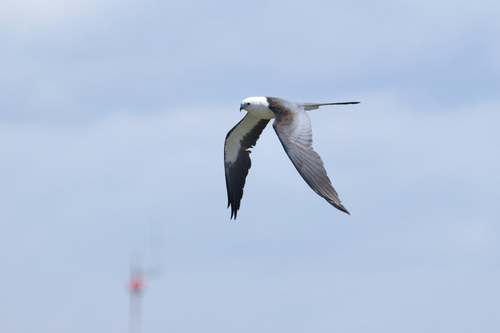 Swallow-tailed Kite
In short
The most reliable field mark to separate White-tailed Kite from Swallow-tailed Kite is the tail: Swallow-tailed Kite has a dramatically long, deeply forked black tail, while White-tailed Kite has a short, rounded, white tail. In flight, Swallow-tailed Kite appears larger, with long, narrow wings and a striking black-and-white contrast, whereas White-tailed Kite is smaller, with a more compact, gull-like shape and less dramatic contrast. Juvenile Swallow-tailed Kites have a less deeply forked tail and duller coloration, but still show the long tail and distinctive flight style. Both species are graceful in the air, but their structure and flight silhouette are unmistakably different.
Identification tips
- Tail shape is the single most reliable mark: Swallow-tailed Kite has a long, deeply forked black tail (even in juveniles, though less pronounced); White-tailed Kite has a short, rounded, white tail. This is visible in all field conditions and ages.
- Flight silhouette: Swallow-tailed Kite is larger, with long, narrow wings and a long, deeply forked tail, giving it a distinctive, elegant glide. White-tailed Kite is more compact, with shorter, broader wings and a rounded tail, and often hovers.
- Plumage contrast: Swallow-tailed Kite is sharply black-and-white, with black upperwings, tail, and flight feathers, and white head and underparts. White-tailed Kite is mostly pale gray and white, with black at the shoulder (not on the tail or flight feathers), and lacks the dramatic black-and-white contrast.
- Underwing pattern: Swallow-tailed Kite shows a bold division of black and white on the underwing; White-tailed Kite's underwing is mostly pale with a black patch at the wrist.
- Juvenile marks: Juvenile Swallow-tailed Kite is duller and the tail is less deeply forked, but still longer and more pointed than any White-tailed Kite. Juvenile White-tailed Kite does not have a forked tail or extensive black on the wings or tail.
- Perched posture: Swallow-tailed Kite is rarely seen perched, but when it is, the long forked tail is obvious. White-tailed Kite perches more often and shows a short, rounded tail.
- Behavior: White-tailed Kite frequently hovers ('kites') in place while hunting; Swallow-tailed Kite almost never hovers and is usually seen gliding or soaring.
- Habitat preference: White-tailed Kite favors open fields, grasslands, and agricultural areas; Swallow-tailed Kite prefers forested wetlands and is rarely seen far from tall trees or water.
- Relative size: Swallow-tailed Kite is nearly twice as heavy and much longer-winged than White-tailed Kite; in mixed company, the size difference is striking.
- Head and face: Both have white heads, but Swallow-tailed Kite's head appears smaller relative to its long wings and tail, while White-tailed Kite's head is proportionally larger and rounder.
- Feeding behavior: White-tailed Kite often eats prey on the wing or at a perch; Swallow-tailed Kite is almost always seen hunting in flight, rarely perching to eat.
- Vocalizations: Neither species is very vocal; Swallow-tailed Kite may give a high-pitched chirp, but this is not a reliable field mark.
- Seasonal context: In the US, Swallow-tailed Kite is a summer breeder in the Southeast and migrates out in winter; White-tailed Kite is resident year-round in its range.
- Geographic range: If you are in western North America, White-tailed Kite is expected; in the Southeast, especially near wetlands, Swallow-tailed Kite is more likely.
- Pitfalls: Do not rely on white head or underparts alone—focus on tail shape, flight style, and wing contrast for a confident identification.
Size
Swallow-tailed Kite is substantially larger and heavier, with an average body mass of 577 g compared to White-tailed Kite's 312 g [wikidata]. Swallow-tailed Kite also has a much longer wingspan (1.12–1.36 m) and overall length (50–68 cm), while White-tailed Kite is more compact. In the field, Swallow-tailed Kite's size is accentuated by its long wings and tail, making it appear even larger and more elegant in flight. White-tailed Kite is noticeably smaller and more compact, with a shorter tail and less elongated wings.
Plumage
Juvenile Swallow-tailed Kites are duller than adults and have a less deeply forked tail, but still show the long, black tail and contrasting black-and-white wings. Adults are strikingly black above and white below, with black flight feathers and a long, forked tail. White-tailed Kite, in all ages, has a white face, underparts, and tail, with gray upperparts and black patches at the shoulder (not on the tail or flight feathers). Its tail is always short and rounded, never forked. In flight, Swallow-tailed Kite's underwings are partly black and partly white, with a sharp division, while White-tailed Kite's wings are mostly pale with black at the wrist. The upperwing pattern of juvenile White-tailed Kite is not described as distinctive, so the tail and overall contrast are more reliable. Both species have white heads, but only Swallow-tailed Kite has a black tail and extensive black on the wings.
Behaviour
White-tailed Kite is famous for its 'kiting' behavior—hovering in place while hunting over open fields [wikipedia]. It often feeds on the wing, transferring prey from talons to bill in flight, but also perches to eat larger prey. Swallow-tailed Kite is an exceptionally graceful flier, rarely seen perched, and spends most of its time soaring and gliding over forests and wetlands, using its long tail for agile maneuvers. Swallow-tailed Kites are mostly silent and rarely hover. White-tailed Kites are more likely to be seen stationary or hovering, while Swallow-tailed Kites are almost always in smooth, buoyant flight.
Habitat
White-tailed Kite is typically found in open lowland scrub, grasslands, and agricultural areas in western North America and South America [wikipedia]. Swallow-tailed Kite is associated with large tracts of wetland forests, especially in the southeastern US, Central, and South America. It nests in tall trees, often near water, and is rarely seen in open country away from forest edges. If you see a kite over open grassland, White-tailed is more likely; over swampy forest, Swallow-tailed is expected.
Voice
Swallow-tailed Kite is mostly silent, occasionally giving a high-pitched chirp [wikipedia]. No distinctive vocalization is described for White-tailed Kite in the notes, and neither species is known for frequent or diagnostic calls in the field.