
White-spotted Flufftail vs African Thrush
Sarothrura pulchra versus Turdus pelios
Play a quiz with White-spotted Flufftail and African Thrush
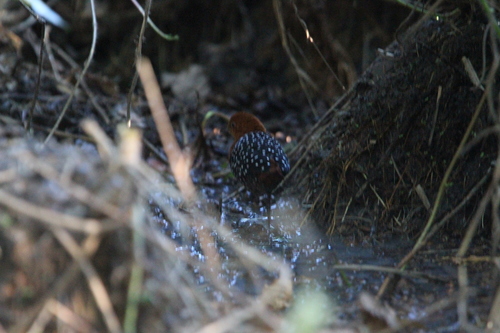 White-spotted Flufftail
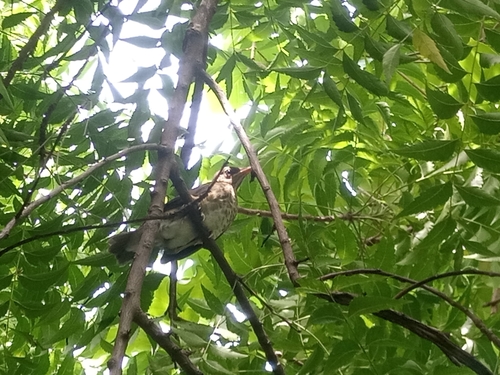 African Thrush
In short
The most reliable field mark to separate White-spotted Flufftail from African Thrush is overall structure and plumage: the flufftail is a small, compact, short-tailed rail with bold white spotting on a blackish body (male with rich red on head and breast), while the African Thrush is a larger, slim, long-tailed songbird with plain olive-grey upperparts and a streaked, pale underpart pattern. Flufftails are secretive ground-dwellers of dense rainforest, rarely venturing into the open, whereas African Thrushes are more likely to be seen foraging in leaf litter or at fruiting trees in woodland and gardens. In flight or perched, the thrush's longer tail, yellow-orange bill, and lack of bold spotting are clear contrasts. Juvenile-specific wing or flight patterns are not described for either species, so focus on structure and plumage.
Identification tips
- Structure is key: Flufftail is a compact, short-tailed rail, while African Thrush is a longer, slimmer, long-tailed songbird. Even in poor light, the thrush's longer tail and upright posture stand out.
- Plumage pattern: Male flufftail shows bold white spots on a black body with rich red on the head, neck, breast, and tail coverts. No thrush in the region has this combination. Female flufftail is darker overall but still lacks the thrush's streaked underparts.
- Bill color: African Thrush has a distinct yellow-orange bill, visible even at a distance. Flufftail's bill is not described as colorful and blends with its dark face.
- Underpart pattern: African Thrush has pale underparts with brown streaks on the throat, greyish-brown breast, buff-orange flanks, and a white belly/vent. Flufftail is much darker below, with bold white spots (male/female) and no streaking or orange flanks.
- No bold white spots on thrush: If you see clear white spots on a black or dark brown body, it is a flufftail, not a thrush.
- Tail shape and length: Flufftail's tail is very short and not obviously fluffy; thrush's tail is long and often fanned or cocked slightly when foraging.
- Habitat context: In dense rainforest undergrowth, especially near water, expect flufftail. In gardens, woodland, or at fruiting trees, expect thrush.
- Behavior: Flufftail is extremely secretive and rarely seen in the open; thrush can be seen foraging in open leaf litter or at fruiting trees, sometimes in the open.
- Feeding style: Flufftail probes for invertebrates; thrush flicks leaf litter and may be seen cracking snails on stones.
- Flight views: Both species are reluctant fliers, but thrush will fly up into trees or across open spaces, while flufftail usually runs for cover and only flies short distances low to the ground.
- Size impression: Thrush is noticeably larger and heavier-bodied than the flufftail.
- Sex differences: Male flufftail is more vividly colored (red and black with white spots); female is darker but still patterned. Thrush sexes are similar.
- Juvenile confusion: No detailed juvenile plumage for either, but young thrushes will still show the same structure and lack of bold spotting.
- Pairing and sociality: Flufftail is usually seen singly or in pairs, strictly territorial; thrush may be seen in loose groups at fruiting trees.
- Vocalizations: Not described here, so rely on visual marks.
Size
White-spotted Flufftail is distinctly smaller and more compact, measuring 16–17 cm in length and weighing about 45 g. The African Thrush is larger and more elongated, at 21–23 cm and 46–78 g. In the field, the thrush will appear noticeably bigger, with a longer body and tail, and a more upright stance compared to the squat, short-tailed flufftail.
Plumage
No age-specific upperwing or flight pattern is described for either species, so rely on general plumage. Adult male White-spotted Flufftail is striking, with a rich red head, neck, breast, and tail coverts, and black body heavily spotted with white. Females are similar but with darker body (black to dark brownish) and less vivid red. Both sexes have bold, contrasting patterns. African Thrush, by contrast, is much plainer: upperparts are dark olive-grey, underparts are pale with brown streaks on the throat, greyish-brown breast, buff-orange flanks, and white belly and vent. The thrush lacks any bold white spots or red coloration. Bill color is also a clue: thrush has a yellow-orange bill, while flufftail's bill is not described as colorful. Juvenile plumages are not detailed, but the structural and pattern differences are strong in all ages.
Behaviour
White-spotted Flufftail is highly secretive, diurnal, and prefers dense cover, rarely venturing into the open except when crossing gaps. It forages for invertebrates on the ground, is territorial, and forms strong pair bonds. African Thrush is also shy but more likely to be seen in the open, especially at fruiting trees or when foraging in leaf litter. Its foraging is crepuscular, and it may be seen cracking snails on stones. When undisturbed, thrushes can be quite bold in open spaces, unlike the flufftail.
Habitat
White-spotted Flufftail is a specialist of dense African tropical rainforest undergrowth, almost always near thick cover. African Thrush is common in well-wooded areas, including woodland edges, gardens, and secondary growth, and is less tied to dense forest interiors. Seeing a bird in deep, wet forest undergrowth strongly favors flufftail; in gardens or open woodland, thrush is far more likely.