

White-fronted Bee-eater vs European Bee-eater
Merops bullockoides versus Merops apiaster
Play a quiz with White-fronted Bee-eater and European Bee-eater
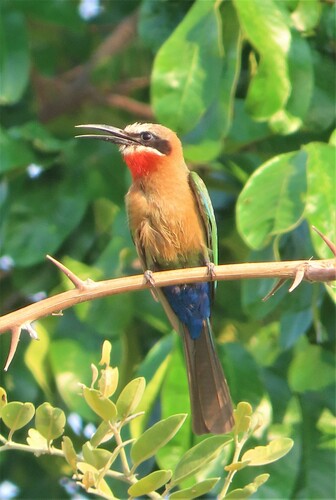 White-fronted Bee-eater
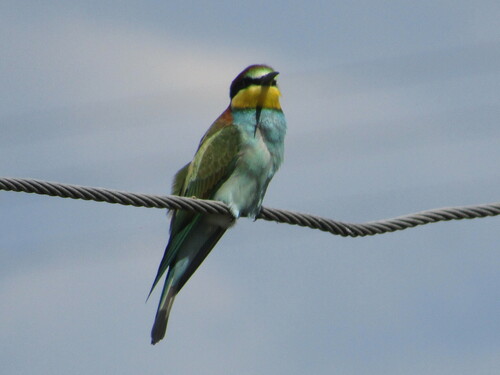 European Bee-eater
In short
The most reliable way to separate White-fronted Bee-eater from European Bee-eater is the combination of a bold white forehead and square tail in the former, versus the European Bee-eater’s rich chestnut-and-yellow upperparts and long, pointed central tail streamers. Both are colorful, slender bee-eaters, but White-fronted shows a striking red throat and black mask, while European has a more blended, multicolored look with no white forehead and a more elongated tail. Juveniles and non-breeding European Bee-eaters lose the tail streamers and become duller, but still lack the white forehead and red throat of White-fronted. Both species can overlap in southern Africa, but their field marks remain distinct.
Identification tips
- White Forehead (White-fronted only): Look for a bold white patch above the bill—unique to White-fronted and visible at all ages and seasons. European Bee-eater never shows a white forehead.
- Red Throat (White-fronted only): White-fronted always shows a bright red throat patch, sharply set off from the white forehead and black mask. European Bee-eater’s throat is yellow.
- Black Mask (White-fronted): A strong black line runs through the eye on White-fronted, contrasting with the white forehead and red throat. European Bee-eater’s mask is less defined and blends into the head pattern.
- Tail Shape: White-fronted has a square tail with no streamers; European Bee-eater has a deeply forked tail with long central feathers in adults, but juveniles and non-breeding birds lose these streamers and show a more rounded tail—still, the tail is never square as in White-fronted.
- Upperparts Color: European Bee-eater has chestnut-brown and yellow upperparts, with green wings and back. White-fronted is green above with cinnamon underparts, lacking the chestnut/yellow tones.
- Underparts: White-fronted shows cinnamon underparts; European Bee-eater’s underparts are more variable but never cinnamon.
- Size: European Bee-eater is larger and bulkier, especially with tail streamers. Size alone is not always reliable unless both are seen together.
- Bill: Both have slender, black, slightly decurved bills typical of bee-eaters; not a useful separator.
- Juvenile/Non-breeding European Bee-eater: Lacks tail streamers and is duller, but still has brown/yellow upperparts and no white forehead or red throat. Beware of confusing these with White-fronted, but the facial pattern always differs.
- Perched vs. Flight: In flight, European’s long tail streamers (if present) and multicolored upperparts stand out. White-fronted’s square tail and white forehead are visible when perched and often in flight.
- Habitat Context: In southern Africa, White-fronted is resident and tied to riverbanks and low woodland; European is a migrant and may be found in more open country during passage.
- Colony Behavior: Both nest colonially, but White-fronted is more likely to be seen in tight groups near nesting banks year-round.
- Voice: White-fronted gives a deep squeak; European’s call is not described here, so do not rely on voice unless familiar with both.
- Sexes: Both species are sexually alike; do not use sex for separation.
- Season: European Bee-eater’s plumage dulls and loses tail streamers outside breeding, but the absence of white forehead and red throat remains diagnostic.
Size
European Bee-eater is noticeably larger, at 27–29 cm in length (including long central tail feathers), compared to White-fronted Bee-eater’s 23 cm. European Bee-eater also averages heavier (44–78 g, mean 52 g) [wikipedia], while White-fronted’s weight is not specified but is smaller by length. The difference is most obvious when both species are seen together, but can be subtle at a distance or with lone birds, especially if the European lacks its tail streamers (juvenile or non-breeding).
Plumage
- Juvenile/Non-breeding European Bee-eater: Duller overall, with blue-green back and lacking the elongated central tail feathers, but still shows brown and yellow upperparts and no white forehead or red throat. Juvenile coloration is less varied, but the facial pattern remains distinct from White-fronted.
- Adult European Bee-eater: Rich brown and yellow upperparts, green wings, black beak, and long central tail streamers. No white on forehead, and throat is yellow (not red).
- White-fronted Bee-eater (all ages): Always shows a bright white forehead, black mask, square tail, and bright red throat. Upperparts are green, underparts cinnamon. Lacks the chestnut/yellow back and tail streamers of European. The white forehead and red throat are present year-round and in all plumages.
- Tail: European Bee-eater’s tail is deeply forked with long central feathers (except in juveniles/non-breeding), while White-fronted’s is square and lacks streamers.
Behaviour
Both species are aerial insectivores, often seen perched on exposed branches or wires and sallying out to catch insects in flight. White-fronted Bee-eaters are more likely to be seen in small colonies, especially near earthen banks or cliffs where they nest. European Bee-eaters are also colonial, but their migratory behavior means they may be seen in a wider variety of open habitats during migration. Both species use quick, agile flights to catch prey, but the overall jizz is similar except for the tail shape in flight.
Habitat
White-fronted Bee-eater is resident in sub-equatorial Africa, usually near cliffs or banks for nesting and in low trees for hunting. European Bee-eater breeds across southern/central Europe, parts of Africa, and western Asia, and winters in tropical Africa. In southern Africa, both may occur, but European is migratory and more likely in open country, farmland, or river valleys during migration. White-fronted is more tied to nesting banks and riverine woodland.
Voice
White-fronted Bee-eater gives a deep squeak. European Bee-eater’s call is not described in the notes, so vocalization is not a reliable separator with the provided information.
White-fronted Bee-eater · European Bee-eater · My Tricky Birds