

White-faced Ibis vs Bare-faced Ibis
Plegadis chihi versus Phimosus infuscatus
Play a quiz with White-faced Ibis and Bare-faced Ibis
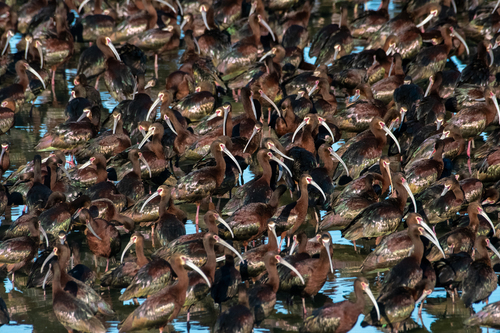 White-faced Ibis
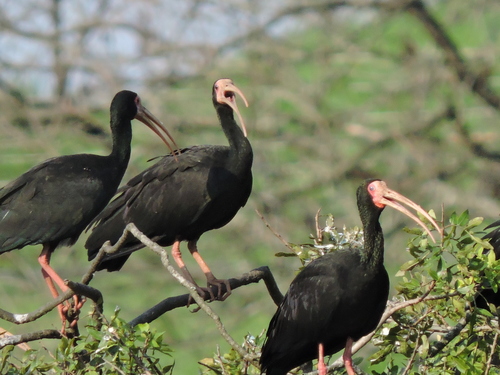 Bare-faced Ibis
In short
The most reliable field mark between White-faced Ibis and Bare-faced Ibis is the facial pattern in adults: White-faced Ibis in breeding plumage shows a pink bare face bordered with white feathers and red eyes, while Bare-faced Ibis has a featherless reddish face with no white border and dark eyes. Juveniles of White-faced Ibis are nearly identical to Glossy Ibis and lack the white facial border, making them very similar to Bare-faced Ibis at that age. Bill color and leg color can also help: White-faced Ibis has a gray bill and redder legs in breeding plumage, while Bare-faced Ibis has a pinkish to reddish-brown or orange bill and pink legs. Both species are dark, long-legged waders, but White-faced Ibis is slightly heavier and has a warmer plumage tone. Separation is most challenging in non-breeding and immature birds, where structure and subtle color differences become important.
Identification tips
- Facial pattern in adults (breeding): Look for the white feather border around the pink bare face in White-faced Ibis (breeding adult only). Bare-faced Ibis never shows a white border; its bare face is uniformly reddish.
- Eye color: White-faced Ibis adults have red eyes year-round, while Bare-faced Ibis has dark eyes. This is best seen at close range or in good light.
- Bill color: White-faced Ibis has a gray bill, especially in breeding plumage. Bare-faced Ibis has a pinkish to reddish-brown or orange bill, often brighter than White-faced Ibis.
- Leg color: Breeding White-faced Ibis has brighter, redder legs. Bare-faced Ibis has pink legs, which may appear less intensely colored.
- Plumage warmth: White-faced Ibis tends to have a warmer, more chestnut or reddish gloss to its dark plumage, especially in breeding condition. Bare-faced Ibis is more uniformly dark brown to blackish.
- Juvenile confusion: Juvenile and non-breeding White-faced Ibis lack the white facial border and have dark eyes, making them extremely similar to Bare-faced Ibis. In these ages, separation is unreliable without close study or range context.
- Bill shape and size: Both species have long, decurved bills, but Bare-faced Ibis males have relatively larger bills for their body size. This is subtle and not usually diagnostic in the field.
- Flock behavior: Bare-faced Ibis is often in large, mixed-species flocks and may be seen near domestic animals. White-faced Ibis is colonial but not described as associating with livestock.
- Habitat context: If seen in North America, especially the western US or Canada, it is almost certainly White-faced Ibis. In South America, both species may overlap, so facial and bill features become critical.
- Nesting sites: White-faced Ibis nests in dense marsh vegetation, often in bushes or low trees. Bare-faced Ibis may nest in more open wetland areas and sometimes shares nests with other species.
- Flight views: No distinctive upperwing or flight marks separate these species; focus on facial pattern and bill color if visible.
- Aggression and sociality: Bare-faced Ibis is less territorial and more tolerant of close neighbors, sometimes sharing nests. White-faced Ibis is colonial but not noted for this behavior.
- Seasonal changes: Only White-faced Ibis shows a dramatic change to a white-bordered face and redder legs in breeding season; Bare-faced Ibis does not change seasonally.
- Geographic range: Use location as a strong clue—White-faced Ibis is the only one expected in North America, while both may occur in parts of South America.
- When in doubt: If the bird lacks a white facial border and has a reddish bare face with a pink or orange bill, especially in South America, Bare-faced Ibis is likely. If the bird shows a white-bordered pink face and red eyes, it is a breeding adult White-faced Ibis.
Size
White-faced Ibis is slightly larger and heavier, with an average body mass of 612.5 g [wikidata] and a length of 46–56 cm [wikipedia]. Bare-faced Ibis is a bit smaller, with a length of 45–50 cm [wikipedia], but no mass data is available. In the field, this size difference is subtle and not usually diagnostic unless both species are seen side by side. Both have similar wingspans and overall proportions typical of ibises.
Plumage
- Juvenile/immature birds: Juvenile White-faced Ibis lacks the white facial border and has dark eyes, making it very similar to Bare-faced Ibis at this age. Both are overall dark, with no strong facial pattern, so age-specific separation is extremely difficult and may not be reliable in the field.
- Adult non-breeding: White-faced Ibis in non-breeding plumage is very similar to Glossy Ibis and thus to Bare-faced Ibis, but tends to have a slightly warmer overall color. Bare-faced Ibis remains dark brown to blackish with a bare reddish face and pink legs.
- Adult breeding: White-faced Ibis develops a pink bare face with a distinct white feather border, red eyes, a gray bill, and brighter, redder legs. Bare-faced Ibis never shows a white facial border; its face is featherless and reddish, with a pinkish to orange bill and pink legs. The eye color remains dark in Bare-faced Ibis.
- Upperwing pattern: No distinctive age-specific upperwing marks are described for either species, so flight separation relies on body and facial features.
Behaviour
Bare-faced Ibis is typically seen in large flocks, often with other ibis species or even domestic animals, and is not very territorial. It is rarely found alone and is less aggressive than other ibises, sometimes sharing nests with other species. White-faced Ibis also breeds colonially in marshes but is not described as associating with domestic animals or as being particularly non-territorial. Both species feed by probing for invertebrates and small vertebrates in wet habitats, and their foraging behavior is similar.
Habitat
White-faced Ibis breeds in marshes with dense vegetation, nesting in bushes or low trees, and is found in the Americas from southwestern Canada and the western US south through Mexico, as well as in parts of South America. Bare-faced Ibis is found in South America, often in open wet habitats, and is known for living in close proximity to other ibis flocks, sometimes as close as 100 meters. Both species are strongly associated with wetlands, but White-faced Ibis may prefer denser, more vegetated marshes for nesting.