

White-breasted Wood-Wren vs Grey-breasted Wood-Wren
Henicorhina leucosticta versus Henicorhina leucophrys
Play a quiz with White-breasted Wood-Wren and Grey-breasted Wood-Wren
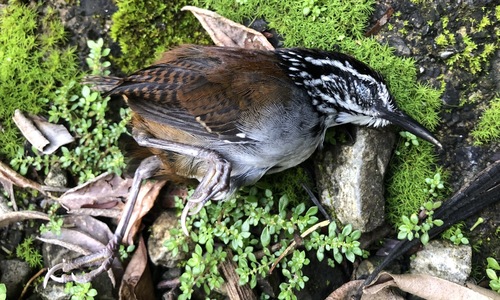 White-breasted Wood-Wren
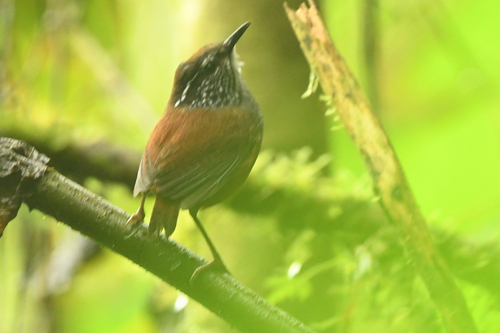 Grey-breasted Wood-Wren
In short
The most reliable field mark for separating White-breasted and Grey-breasted Wood-Wrens is the color and extent of the underparts: White-breasted shows crisp white underparts (becoming buff on the lower belly), while Grey-breasted has a uniformly gray breast and belly with only the chin and throat paler. Both are small, short-tailed wrens with similar structure and overlapping ranges, so careful attention to head pattern and underpart color is key. Juveniles of both are duller, but the underpart contrast remains useful. In perched or fleeting views, focus on the supercilium and the color of the chest and belly. Both species can be found in similar habitats, so visual cues are crucial for confident identification.
Identification tips
- Underpart color is the single best field mark: White-breasted Wood-Wren has crisp white underparts (turning buff on the lower belly), while Grey-breasted Wood-Wren is gray from breast through belly, with only the chin and throat paler. This works for adults and is still helpful in juveniles, though both are duller when young.
- Head pattern differences: Grey-breasted has a long, gray-white supercilium, a wide black stripe behind the eye, and black cheeks streaked with pale gray, giving a more contrasting and 'masked' look. White-breasted has a pale supercilium and black-and-white streaking on the sides of the head and neck, but the effect is subtler.
- Upperpart coloration: Both species have chestnut brown upperparts and barred tails, but Grey-breasted's crown is dull black with dark brown tips, and its nape and shoulders are dark olive brown, creating a slightly more contrasting mantle-to-back transition than White-breasted's more uniformly chestnut upperparts.
- Tail and wing barring: Both show black barring on the wings and very short tail, so this is not a separator. In flight, neither shows unique wing panels or trailing edges, so focus on underpart color if you glimpse the belly or undertail.
- Juvenile confusion: Juvenile White-breasted Wood-Wren has gray underparts, potentially resembling Grey-breasted, but the latter's gray is more extensive and uniform, while White-breasted juveniles may still show a hint of white or buff on the lower belly. Always check for the brightest area on the underparts.
- Supercilium length and boldness: Grey-breasted's supercilium is longer and more sharply defined, often extending well behind the eye, while White-breasted's is paler and less extensive.
- Facial streaking: The black-and-white streaking on the sides of the head and neck is more prominent in White-breasted, but Grey-breasted's black cheeks with pale gray streaks can look more 'masked.'
- Behavioral context: If you see a wood-wren following an army ant swarm, Grey-breasted is more likely, but not exclusive. Both species forage low and move quickly with short tail flicks.
- Habitat overlap: Do not rely on habitat alone; both species occur in similar forest types and elevations within their overlapping ranges.
- Size and structure: Both are nearly identical in size and shape; do not use overall size or tail length as a separator.
- Seasonal and sex differences: No strong seasonal or sex-based plumage differences are noted for either species; the main differences are between age classes (adult vs. juvenile).
- Pitfalls in poor light: In shadowy understory, the white underparts of White-breasted can appear duller, and the gray of Grey-breasted can look paler. Always try to get a clear, well-lit view of the belly and chest.
- Mixed flocks: Both may join mixed-species flocks, so do not assume only one species is present based on flock composition.
- Range overlap: Both occur from Mexico through Central America and into South America; do not use range alone for identification in overlap zones.
- Summary tip: When in doubt, prioritize underpart color and head pattern—these are the most consistently reliable field marks across all ages and seasons.
Size
Both species are very similar in size and mass, with White-breasted Wood-Wren averaging about 10 cm in length and 16 g in weight, and Grey-breasted Wood-Wren ranging from 10 to 11.5 cm and 13.5 to 17.7 g. In the field, size is not a reliable separator between these two; both appear as small, compact wrens with short tails and rounded bodies. Any perceived difference is likely due to posture or viewing angle rather than true size.
Plumage
Juvenile and immature birds of both species are duller than adults, but the key difference is in the underparts: juvenile White-breasted Wood-Wrens have gray underparts, while adults are white below (becoming buff on the lower belly). Grey-breasted Wood-Wren, even as an adult, has gray underparts throughout, with only the chin and throat paler. For all ages, check the extent and purity of white on the underparts—White-breasted is much cleaner and brighter below. Both species have chestnut brown upperparts and black-barred tails, but Grey-breasted shows a more complex head pattern with a long gray-white supercilium, a wide black post-ocular stripe, and black cheeks streaked with pale gray. White-breasted has a pale supercilium and black-and-white streaked sides of the head and neck, but the effect is less bold than in Grey-breasted. In flight, both show barred wings and tails, but there are no unique wing panel or trailing edge marks to separate them. Juveniles of both are duller, but the underpart color contrast still applies.
Behaviour
Both species forage low in dense vegetation, often near the ground. Grey-breasted Wood-Wren is noted for following army ant swarms in some regions, sometimes in small groups, while White-breasted is more often seen singly or in pairs. Both are secretive and quick-moving, often flicking their short tails. Behavior alone is not a strong separator, but if you observe a bird closely following ant swarms, Grey-breasted is more likely (though not exclusive).
Habitat
Habitat overlap is significant: both species occur in humid forests from Mexico through Central America and into South America. Local abundance may vary, but both can be found in similar understory habitats, often near water or in dense thickets. Habitat is not a reliable field mark for separating these two species.
White-breasted Wood-Wren · Grey-breasted Wood-Wren · My Tricky Birds