

White-bellied Wren vs White-breasted Wood-Wren
Uropsila leucogastra versus Henicorhina leucosticta
Play a quiz with White-bellied Wren and White-breasted Wood-Wren
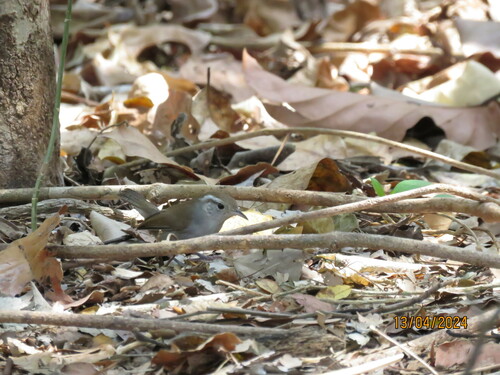 White-bellied Wren
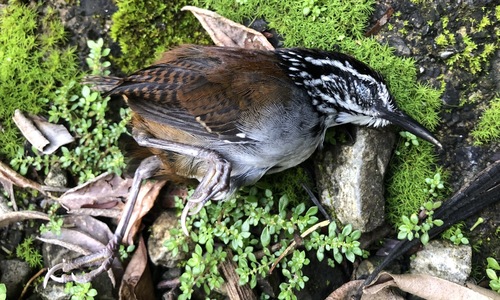 White-breasted Wood-Wren
In short
The most reliable field mark to separate White-bellied Wren from White-breasted Wood-Wren is the head and underpart pattern: White-breasted Wood-Wren shows bold black-and-white streaking on the sides of the head and neck, and its underparts are bright white sharply contrasting with rich chestnut upperparts, while White-bellied Wren has a plainer face with a gray-white supercilium, mottled gray cheeks, and a grayish to buffy belly. Size is also helpful: White-breasted Wood-Wren is noticeably heavier and chunkier. In perched or foraging birds, look for the Wood-Wren’s short tail and strong contrast between white breast and chestnut back, versus the White-bellied Wren’s more uniform brown upperparts and less crisp belly demarcation. Both species have barred tails, but the Wood-Wren’s tail is shorter and its wings and tail are more strongly barred.
Identification tips
- Head pattern: White-breasted Wood-Wren always shows bold black-and-white streaking on the sides of the head and neck, a strong pale supercilium, and a darker crown. White-bellied Wren has a gray-white supercilium but lacks bold streaking, with gray cheeks mottled brown and a medium brown crown. This is the most reliable field mark at all ages.
- Underpart contrast: The Wood-Wren’s underparts are bright white with a sharp transition to chestnut upperparts, while White-bellied Wren’s underparts are grayish on the throat/chest and buffy on the flanks and vent, with a less distinct boundary from the brown upperparts.
- Tail length and barring: White-breasted Wood-Wren has a very short tail, strongly barred with black, often held cocked. White-bellied Wren’s tail is longer, with many thin dark bars, and is not as strongly marked or as short.
- Body size and shape: The Wood-Wren is nearly twice as heavy as White-bellied Wren and looks much more robust and compact, with a rounder body and shorter tail. White-bellied Wren appears slimmer and longer-tailed.
- Wing pattern in flight: No distinctive upperwing panels or flight marks are described for either species, so focus on tail length and barring, and overall jizz in flight.
- Juvenile confusion: Young Wood-Wrens are duller and grayer below, which can resemble White-bellied Wren, but the head streaking is usually still visible, though less crisp. White-bellied Wren immatures are not described in detail, but are not expected to show the Wood-Wren’s head pattern.
- Plumage pitfalls: Both species have some form of supercilium and barred tail, but only the Wood-Wren has the bold head streaking and sharp white underparts. Do not rely on supercilium alone.
- Habitat context: In dry, open woodland or Bromelia thickets in Mexico, suspect White-bellied Wren. In humid, dense forest or forest edge throughout Central and South America, White-breasted Wood-Wren is more likely.
- Behavior: Wood-Wren is more secretive, often in pairs or family groups, and moves with quick, jerky hops and a cocked tail. White-bellied Wren is more likely to forage at a range of heights and may join mixed flocks.
- Voice: If you hear a short, rapid, bubbly series of notes descending at the end, it may be White-bellied Wren, but do not use voice as the sole separator unless you know the local repertoire.
- Geographic range: If you are outside the range of White-bellied Wren (e.g., South America), you are almost certainly seeing White-breasted Wood-Wren. In western or northeastern Mexico, check for White-bellied Wren.
- Sex and season: No significant sexual or seasonal plumage differences are described for either species, so use structural and head/underpart pattern marks year-round.
- Mixed flocks: White-bellied Wren may join mixed-species flocks with army ants, especially in the south of its range. Wood-Wren is less likely to do so.
- Nest and breeding context: If you find a nest shaped like a chemical retort (oval ball with a funnel entrance) in a spiny Bromelia or Acacia, it likely belongs to White-bellied Wren, but this is rarely diagnostic in the field.
- When in doubt: Focus on the head pattern (streaked vs. plain), underpart contrast, and tail length/shape for the most reliable separation in all seasons and ages.
Size
White-breasted Wood-Wren is distinctly larger and heavier: about 10 cm long and 16 g, compared to White-bellied Wren’s 9.5–10 cm and 8–10.5 g [wikipedia][avonet]. This makes the Wood-Wren nearly twice as heavy, giving it a more robust, chunky appearance in the field. The difference is especially apparent when seen side-by-side or when judging the relative bulk of the body and head. The Wood-Wren’s short tail further emphasizes its round, compact look, while White-bellied Wren appears slimmer and longer-tailed.
Plumage
- Juvenile/immature birds: Young White-breasted Wood-Wrens have duller upperparts and grayish underparts, which can reduce the contrast with White-bellied Wren, but the Wood-Wren still shows black-and-white streaking on the sides of the head and neck (albeit less crisply). White-bellied Wren immatures are not described in detail, but adults and likely immatures lack the bold head streaking of Wood-Wren.
- Adults: White-breasted Wood-Wren has chestnut brown upperparts with a darker crown, bold pale supercilia, and black-and-white streaked sides of the head and neck. Its underparts are bright white, becoming buff on the lower belly, with strong contrast to the upperparts. Wings and very short tail are barred with black. White-bellied Wren is medium brown above with a slightly reddish rump, gray-white supercilium, gray cheeks mottled with brown, and a gray throat, chest, and upper belly, with buff flanks and vent. Its tail is longer and finely barred, but the overall look is plainer, lacking the Wood-Wren’s sharp contrasts and head streaking.
- Wing/tail pattern in flight: Both species have barred tails, but the Wood-Wren’s tail is much shorter and more strongly barred, while White-bellied Wren’s tail is longer with thinner bars. No distinctive upperwing panels or flight marks are described for either species.
Behaviour
Both species forage in dense vegetation, but White-bellied Wren is more likely to be seen at a range of heights, including low in thickets or even near the ground, and sometimes joins mixed-species flocks following army ants. White-breasted Wood-Wren is typically seen in pairs or family groups, often skulking in dense undergrowth, and is less likely to join mixed flocks. The Wood-Wren’s short tail is often cocked, and it tends to move with quick, jerky hops, while White-bellied Wren may appear more active and less secretive. Both are more often heard than seen.
Habitat
White-bellied Wren has a patchy range in Mexico, Belize, Guatemala, and Honduras, occupying a variety of woodland types from semi-arid forests to humid rainforests, and is especially associated with thickets of wild pineapple (Bromelia) in northeastern Mexico. White-breasted Wood-Wren is much more widespread, ranging from central Mexico south to northeastern Peru and Suriname, and is typically found in dense lowland and foothill forests, especially near water or in thick undergrowth. If you are in a dry, open woodland or Bromelia thicket in western or northeastern Mexico, White-bellied Wren is more likely; in humid, dense forest throughout Central America and into South America, White-breasted Wood-Wren is the default.
Voice
White-bellied Wren’s song is a short series of 6 rapid up-and-down notes, descending at the end, described as bubbly in the east of its range. Calls include a low 'chek', scolding chatter, and a hard, dry, cracking rattle. White-breasted Wood-Wren’s song and calls are not described in the provided notes, so voice is not a reliable separator based on current information. If you hear a bubbly, descending series of notes, consider White-bellied Wren, but do not rely solely on voice for separation.
White-bellied Wren · White-breasted Wood-Wren · My Tricky Birds