

Whinchat vs Northern Wheatear
Saxicola rubetra versus Oenanthe oenanthe
Play a quiz with Whinchat and Northern Wheatear
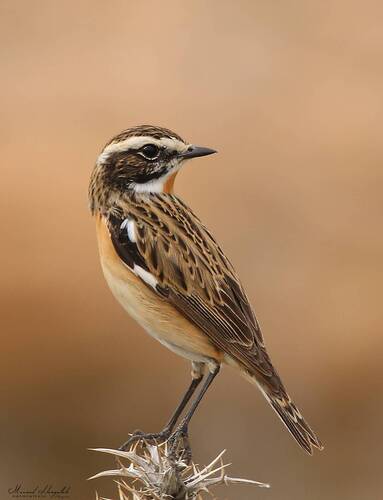 Whinchat
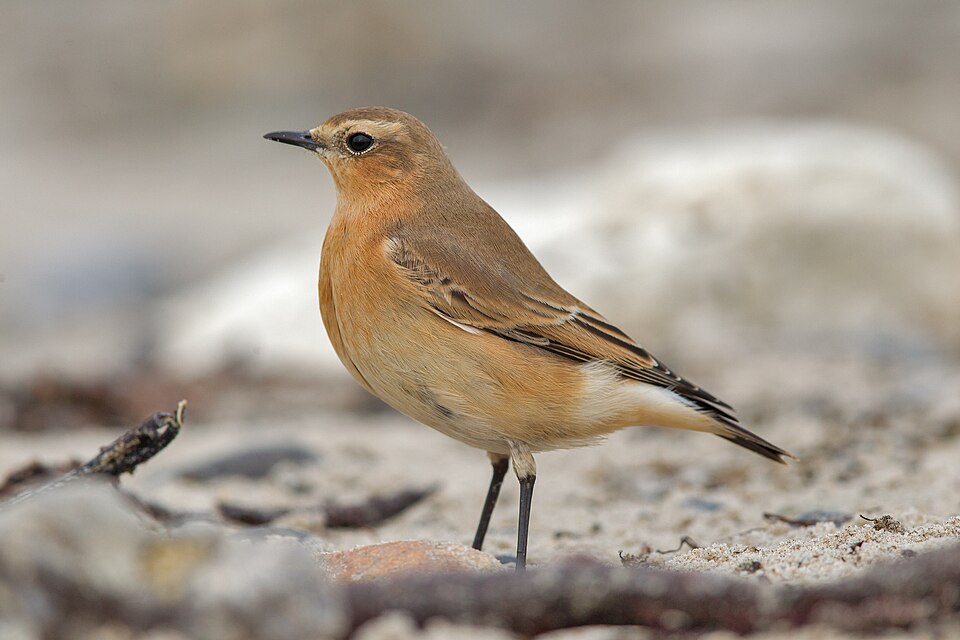 Northern Wheatear
In short
The most reliable field mark to separate Whinchat from Northern Wheatear in any plumage is the supercilium (eyebrow stripe): Whinchat always shows a strong pale supercilium, while Northern Wheatear’s face is plain or masked but lacks this feature. In flight, both species show white in the tail, but Wheatear has a bold white rump and tail with a black 'T' tip, while Whinchat’s tail is darker with white only at the bases of the outer feathers. Whinchat is slimmer, with longer wingtips and a more upright stance, while Wheatear is larger and bulkier. Female and immature Whinchats can be confused with female Wheatears, but the supercilium and overall paler, more mottled appearance of Whinchat are key. Both species flick their tails, but Wheatear’s white rump is much more prominent when it does so.
Identification tips
- Supercilium (eyebrow stripe): Whinchat always shows a strong pale supercilium, even in juveniles and females; Wheatear lacks this, having a plain or masked face. This is the single most reliable field mark at all ages.
- Tail pattern in flight: Wheatear shows a white rump and tail with a bold black inverted 'T' at the tip (black terminal band and central shaft); Whinchat’s tail is dark with only the bases of the outer feathers white, and the rump is mottled brown, not white. This is best seen when the bird flicks its tail or flies.
- Rump color: Whinchat’s rump is brown and mottled like the back; Wheatear’s is always white and stands out in flight or when tail is flicked.
- Wing patches: Adult male Whinchat has small white wing patches on the greater and inner median coverts, visible when perched or flicking wings; Wheatear never shows these.
- Overall build: Whinchat is slimmer, more upright, and less 'dumpy' than Wheatear, with longer wingtips relative to body size. Wheatear is bulkier and more robust.
- Breast and belly color: Whinchat has a pale buff to whitish belly and, in males, a bright orange-buff throat and breast; Wheatear is buff below, but the color is less rich and more uniform, especially in females.
- Upperparts: Whinchat is brownish and heavily mottled above; Wheatear is plain grey (male) or pale brown (female) above, with less mottling.
- Face mask: Male Whinchat in breeding plumage has a blackish face mask nearly surrounded by white; Wheatear male has a black face mask but without the strong white supercilium and malar stripe.
- Wing color: Wheatear has black wings in all plumages; Whinchat’s wings are brownish with possible white patches in males.
- Perching behavior: Whinchat prefers to perch on shrubs or tall weeds; Wheatear is often seen on rocks or the ground.
- Habitat: Whinchat is more likely in grassy, shrubby fields; Wheatear in open, rocky, or bare ground.
- Size: Wheatear is larger and bulkier; Whinchat is smaller and slimmer, but size can be hard to judge without direct comparison.
- Tail flicking: Both species flick their tails, but Wheatear’s white rump and tail pattern are much more obvious.
- Seasonal confusion: Female and immature Whinchats are most likely to be confused with female Wheatears in autumn; always check for the supercilium and rump color.
- White in wing: Only Whinchat (mainly males) shows white wing patches; Wheatear never does.
Size
Northern Wheatear is noticeably larger, measuring 14.5–16 cm in length and weighing 17–30 g [wikipedia], compared to Whinchat’s 12–14 cm and 13–26 g [wikipedia]. Wheatear also has a proportionally longer wingspan (26–32 cm) and a bulkier, less delicate build. Whinchat appears slimmer and less 'dumpy', with longer primary projection relative to body size, reflecting its long-distance migration strategy.
Plumage
- Juvenile/immature and female birds: Whinchat and Northern Wheatear can look similar in dull plumages, but Whinchat always shows a strong pale supercilium (eyebrow), even in immatures and females, while Wheatear lacks this and has a plain or masked face. Whinchat’s upperparts are brownish and heavily mottled, with a similarly mottled rump, while Wheatear’s upperparts are plainer brown or grey, and the rump is always strikingly white.
- Tail pattern in flight: Wheatear of all ages shows a white rump and tail with a bold black inverted 'T' at the tip (black terminal band and central shaft), while Whinchat’s tail is dark with only the bases of the outer feathers white—never a full white rump or 'T'.
- Adult males (breeding): Whinchat males have a blackish face mask nearly encircled by a strong white supercilium and malar stripe, orange-buff throat and breast, and small white wing patches. Wheatear males have grey upperparts, a black face mask, black wings, buff throat, and white rump/tail.
- Females and non-breeding birds: Whinchat females are duller but still show the supercilium and mottled upperparts; Wheatear females are pale brown above and buff below, with plain faces and white rumps.
- Wing patches: Whinchat males (all year) and some females show small white wing patches; Wheatear never shows these.
Behaviour
Both species perch upright on exposed posts or shrubs and sally to the ground for insects, but Whinchat is more likely to be seen flicking both tail and wings, often to display its white tail and wing flashes. Wheatear is more terrestrial, often seen running on open ground or rocks, and its tail flicking shows off the striking white rump and tail pattern. Whinchat tends to move with small, rapid hops and is more likely to perch for extended periods on low vegetation.
Habitat
Whinchat prefers rough grassland, meadows, and areas with scattered shrubs or low perches, often in upland or less intensively farmed areas. Northern Wheatear favors open, stony ground, rocky slopes, and bare earth, including coastal headlands, quarries, and even urban rubble. Overlap can occur on migration, but Whinchat is more closely tied to grassy, shrubby habitats, while Wheatear is a classic bird of open, rocky terrain.
Voice
Wheatear’s song is a whistling, crackly series of notes, and its call is a sharp 'chack' or 'chat', with a distinctive flight call. Whinchat’s vocalizations are not described in detail in these notes, but both species have typical chat-like calls. Voice is not the most reliable separator unless the song is heard well.