

Whinchat vs European Stonechat
Saxicola rubetra versus Saxicola rubicola
Play a quiz with Whinchat and European Stonechat
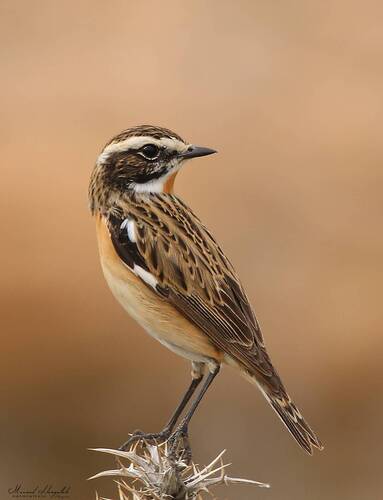 Whinchat
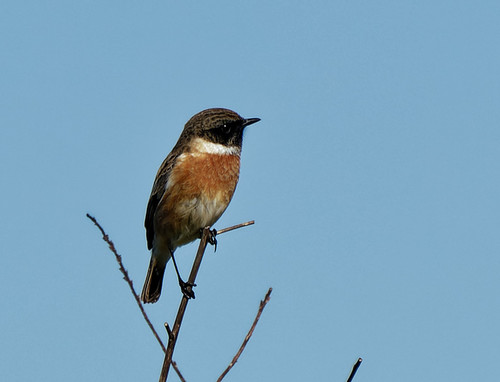 European Stonechat
In short
The most reliable field mark to separate Whinchat from European Stonechat is the Whinchat’s bold pale supercilium (eyebrow), which is always present and obvious in all ages and sexes, while European Stonechat lacks this feature. In addition, Whinchat is slimmer with longer wings, and shows a paler, whiter belly and more prominent white in the tail when flicked. European Stonechat is more compact and darker overall, especially in western populations, and has a much less distinct or absent supercilium. Immature and female Whinchats can look similar to female/immature Stonechats, but the strong supercilium and paler underparts are consistent clues. In flight or when perched, look for the Whinchat’s longer primary projection and more upright stance compared to the dumpier, shorter-winged Stonechat.
Identification tips
- Supercilium (eyebrow): Whinchat always shows a strong pale supercilium, obvious in all ages and sexes; European Stonechat lacks this, or at best shows a faint, poorly defined eyebrow in some females/immatures.
- Belly color: Whinchat has a pale buff to whitish belly, often contrasting with the orange-buff breast; European Stonechat’s belly is usually darker, sometimes white in males but less extensive and often streaked in females/immatures.
- Overall tone: Whinchat is paler and less saturated, especially compared to the dark, rich tones of western European Stonechat (S. r. hibernans). Stonechat is generally darker and more 'sooty' above, especially in humid Atlantic regions.
- Rump color: Whinchat’s rump is mottled brown, matching the back; European Stonechat’s rump is small, white, and often streaked with black, but never as pale or unmarked as Siberian Stonechat.
- Wing patches: Male Whinchat shows small white wing patches (greater and inner median coverts) all year; female Whinchat may show smaller or no wing patches. European Stonechat males have a small white scapular patch, females only a buffy or faint patch.
- Face pattern: Male Whinchat in breeding plumage has a blackish mask bordered by white; male Stonechat has an all-black head with a white half-collar but no supercilium.
- Primary projection: Whinchat has longer, more pointed wings (adapted for migration), visible as a longer primary projection beyond the tertials when perched; Stonechat’s wings are shorter and rounder.
- Structure/jizz: Whinchat appears slimmer, longer-winged, and less 'dumpy'; Stonechat is more compact and round-bodied.
- Tail pattern: Whinchat’s tail is blackish with prominent white bases to the outer feathers, often flashed when flicked; Stonechat’s tail is darker with less obvious white.
- Behavior: Whinchat often flicks both tail and wings, showing white flashes; Stonechat is less likely to flick wings and appears more static.
- Habitat/season: In western and northern uplands, Whinchat is more likely in summer; Stonechat is more widespread year-round, especially in lowlands and coastal areas in winter.
- Sex/age pitfalls: Female and immature Whinchats can look like female/immature Stonechats, but the supercilium and paler belly are consistent clues. Male Stonechat is darker and more contrasting, with a black head and white collar.
- Subspecies confusion: Pale southern Stonechats (S. r. rubicola) can approach Whinchat in overall tone, but still lack the strong supercilium and have a different rump pattern.
- Flight views: In flight, Whinchat shows longer wings and more white in the tail; Stonechat appears shorter-winged and less contrasting.
- Molt timing: Not usually field-diagnostic, but note that Whinchat adults have a complete post-breeding molt, while juveniles have a partial molt, which may affect the crispness of plumage edges late in summer.
Size
Both species are similar in size, close to European Robin. Whinchat is slightly larger and slimmer (12–14 cm long, 13–26 g) compared to European Stonechat (11.5–13 cm, 13–17 g) [wikipedia][avonet]. The difference is subtle and rarely diagnostic in the field, but Whinchat often appears more elongated and less compact, partly due to its longer wing projection.
Plumage
-
Juvenile/immature birds: Whinchat immatures and females can look similar to those of European Stonechat, but Whinchat always shows a strong pale supercilium and a whiter, less streaked belly. European Stonechat immatures/females are duller, lack a strong supercilium, and have darker, more streaked underparts. Both can show some white in the wings, but Whinchat males (even in non-breeding plumage) retain small white wing patches, while female Stonechats often have only a buffy-white scapular patch.
-
Adults (breeding plumage): Male Whinchat has a blackish face mask bordered by a strong white supercilium and malar stripe, orange-buff throat and breast, and white wing patches. Male European Stonechat has a black head, orange throat and breast, white belly, and a white half-collar, but lacks the strong supercilium and has a much smaller white rump and wing patch. Female Whinchat is paler, with a buff supercilium and less contrast overall; female Stonechat is browner and lacks the supercilium, with only a faint or buffy-white scapular patch.
-
In flight: Whinchat shows longer, more pointed wings and a more obvious white base to the outer tail feathers, while Stonechat’s wings are shorter and the tail pattern is less striking.
Behaviour
Both species perch upright on shrubs or tall stems and sally for insects, but Whinchat often appears more active, flicking both tail and wings to show white flashes, especially males. Whinchat’s movements are a bit more agile and less 'dumpy' than Stonechat, which tends to look rounder and more compact when perched. Both may use similar foraging strategies, but Whinchat’s longer wings are more apparent in flight and when stretching.
Habitat
Both species overlap in open country with scattered shrubs, but Whinchat is more likely in rough grassland, meadows, and upland pastures, especially in western and northern Europe. European Stonechat is more catholic, found in heathland, coastal dunes, and rough grassland with brambles or gorse, and is more likely in lowland and coastal areas, especially outside the breeding season. Whinchat is a long-distance migrant (breeds in Europe/Asia, winters in Africa), while European Stonechat is mostly resident or a short-distance migrant, so Stonechat is more likely in Europe in winter.