

Western Subalpine Warbler vs Dartford Warbler
Curruca iberiae versus Curruca undata
Play a quiz with Western Subalpine Warbler and Dartford Warbler
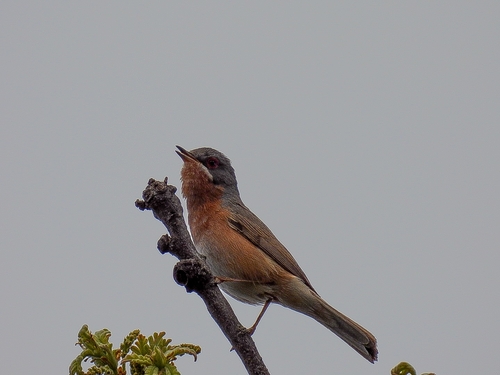 Western Subalpine Warbler
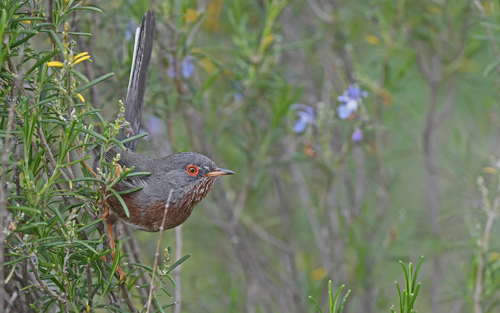 Dartford Warbler
In short
The most reliable field mark to separate Western Subalpine Warbler from Dartford Warbler is the presence of bold white malar streaks ('moustaches') on the male Subalpine, which are absent in Dartford. Dartford Warbler is structurally distinct with a noticeably longer, thinner tail and a more slender, pointed bill, while Subalpine Warbler appears more compact. Males of both species show reddish underparts, but Subalpine Warbler males have brick-red underparts with a clear white malar, whereas Dartford males are duller reddish-brown below, with a dirty white belly patch and white-spotted throat. Females and immatures are trickier, but Dartford always shows a longer tail and a red eye, while Subalpine females have a pink flush below and lack the red eye. Both species overlap in southern Europe and NW Africa, but Dartford is more tied to heathland and scrub.
Identification tips
- White malar streak (male Subalpine only): Look for a bold white 'moustache' on the face of adult male Subalpine Warbler. Dartford Warbler never shows this feature; its throat is reddish with white spots instead.
- Tail length and shape: Dartford Warbler has a distinctly long, thin tail, often held cocked or flicked. Subalpine Warbler's tail is shorter and less prominent; this is especially useful when birds are perched or in flight.
- Eye color: Dartford Warbler (all ages/sexes) has a red eye and red eye-ring, a feature never shown by Subalpine Warbler.
- Underpart color (males): Subalpine males have brick-red underparts, while Dartford males are duller reddish-brown with a dirty white patch on the belly.
- Throat pattern: Dartford Warbler has a reddish throat with white spots (more obvious in males), while Subalpine Warbler males have a plain brick-red throat with a white malar; females of both are plainer, but Dartford females still show some white throat spots.
- Female/immature underparts: Subalpine females are whitish below with a pink flush, while Dartford females are paler and less colorful, lacking the pinkish tone.
- Upperparts: Subalpine males are clean grey above; Dartford males are grey-brown or brownish-grey. Females of both are browner, but Dartford is always duller and more muted.
- Bill shape: Dartford Warbler has a longer, thinner, and more pointed bill, reflecting its insectivorous habits in heathland; Subalpine's bill is shorter and less fine.
- Jizz: Dartford Warbler often appears elongated due to its long tail and slim build, especially when perched upright on gorse or heather. Subalpine Warbler is more compact and less likely to show its tail so prominently.
- Habitat context: In open heathland with gorse or heather, Dartford is more likely; in dense Mediterranean scrub or maquis, Subalpine is favored. Use habitat as a supporting clue, not a primary separator.
- Song: If heard, Subalpine's fast, rattling song is similar to Lesser Whitethroat, but this is not diagnostic without more details on Dartford's song.
- Sexual dimorphism: Both species show male/female differences, but the white malar in Subalpine males and the red eye in Dartford of both sexes are key.
- Juvenile/immature birds: Both are similar to females, but Dartford's long tail and red eye remain useful. No distinctive upperwing patterns are described for either species in young birds.
- Pitfalls: Beware of dull male Subalpine Warblers in worn plumage, which may appear less colorful; check for the white malar and overall structure. Dartford Warblers in strong light may appear greyer, but the tail and eye remain reliable.
- Seasonal context: Dartford is resident in much of its range; Subalpine is a migrant, so timing may help in some regions but is not diagnostic on its own.
Size
Both species are small warblers, but Dartford Warbler is slightly larger and more elongated in appearance, mainly due to its proportionally longer, thinner tail. Subalpine Warbler is more compact overall. No precise length or mass figures are given in the notes, but the Dartford's tail is a clear structural difference in the field.
Plumage
There are no distinctive juvenile or first-winter upperwing patterns described for either species, so separation relies on overall plumage and head pattern.
-
Adult males: Subalpine Warbler males have a clean grey back and head, brick-red underparts, and a striking white malar streak. Dartford Warbler males are grey-brown above, dull reddish-brown below with a dirty white belly patch, and have a reddish throat with white spots and a red eye.
-
Females and immatures: Subalpine females are brown above with a greyer head, whitish below with a pink flush, and lack the red eye. Dartford females are browner-grey above, paler below (especially on the throat), and have smaller white throat spots; juveniles resemble females. Dartford's underparts are less vivid, and the white throat spots are a subtle but consistent feature.
-
Shared features: Both have some degree of reddish underparts and sexual dimorphism, but only Subalpine males have the bold white malar. Dartford always has a red eye, which Subalpine lacks.
Behaviour
Dartford Warbler is more likely to be seen skimming low over heath or perched atop gorse or heather, often with its long tail cocked or flicked. Subalpine Warbler is more likely to be seen in Mediterranean scrub, moving quickly and less likely to display its tail so prominently. Both are active and skulking, but Dartford's tail and jizz are distinctive in the open.
Habitat
Subalpine Warbler breeds in southernmost Europe and NW Africa, favoring Mediterranean scrub and maquis. Dartford Warbler also occurs in western/southern Europe and NW Africa but is more closely tied to dry heathland, gorse, and low scrub, especially in western Europe. In overlapping areas, Dartford is more likely in open heath or gorse, Subalpine in denser, more Mediterranean-type scrub.
Voice
Subalpine Warbler's song is described as fast and rattling, similar to Lesser Whitethroat. Dartford Warbler's vocalizations are not detailed in the notes, so song is not a reliable separator with the information provided.
Western Subalpine Warbler · Dartford Warbler · My Tricky Birds