

Western Marsh Harrier vs Montagu's Harrier
Circus aeruginosus versus Circus pygargus
Play a quiz with Western Marsh Harrier and Montagu's Harrier
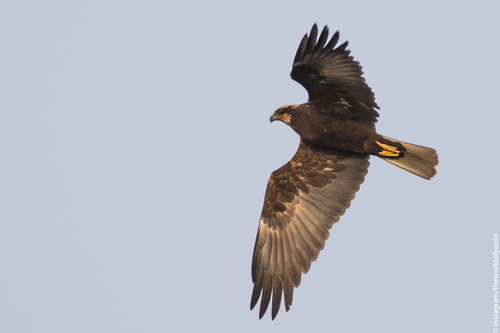 Western Marsh Harrier
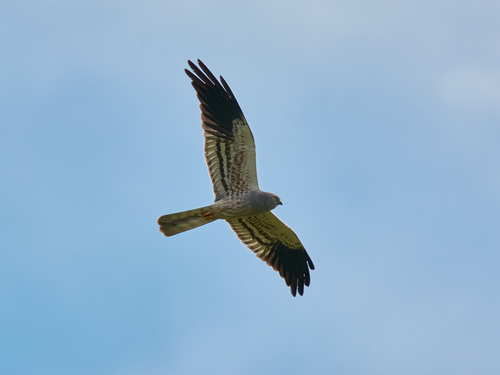 Montagu's Harrier
In short
The most reliable field mark to separate Western Marsh Harrier from Montagu's Harrier is overall structure and flight style: Marsh Harrier is bulkier with broader wings and a heavier, less buoyant flight, while Montagu's is more slender, with longer, narrower, and more pointed wings and a more elegant, tern-like flight. Adult males are easier to distinguish by plumage, but females and juveniles can be tricky—look for the Marsh Harrier's pale head and shoulders (especially in females) versus the more uniform brown of Montagu's, and note that Montagu's juveniles have unspotted, rufous underparts. In flight, check for the Marsh Harrier's three-toned male wing and the absence of a pale collar (which is diagnostic for Pallid but not present in either of these two). Size and jizz are often the best clues at a distance.
Identification tips
- Overall structure in flight: Marsh Harrier is bulkier with broader wings and a heavier, less buoyant flight; Montagu's is slimmer, with longer, narrower, and more pointed wings. This is often the fastest separation at a distance or in poor light.
- Wing shape: Montagu's Harrier has more pointed 'hands' (outer wing), while Marsh Harrier's wings are broader and more paddle-shaped, especially in females and juveniles.
- Flight style: Montagu's has a smoother, more elastic, almost tern-like flight with buoyant wingbeats; Marsh Harrier is steadier, heavier, and sometimes flies with legs dangling.
- Adult male plumage: Marsh Harrier males show a three-toned wing (brown forewing, grey secondaries/tail, black primaries) and a pale head/shoulder; Montagu's males are pale grey with black wingtips and black secondary bands, and rusty streaks on the belly/flanks.
- Female/juvenile head pattern: Marsh Harrier females and juveniles have a pale, often sharply contrasting head, throat, and shoulders (though this can be faint in worn birds); Montagu's females/juveniles lack this, with a more uniform brown head and only a white rump as a strong pale mark.
- Underpart pattern in juveniles: Montagu's juveniles have unspotted, rufous underparts and underwing coverts, while Marsh Harrier juveniles are darker brown with less yellow and sometimes a paler head.
- Upperwing pattern: Marsh Harrier males show a strong contrast between brown forewing and grey secondaries/tail; Montagu's males have black bands on the secondaries above and below, but not the same three-color effect.
- Eye area: Female Marsh Harrier has a darker eye area, making the pale iris stand out; Montagu's does not show this feature as strongly.
- Melanistic morphs: Both species can be melanistic, but these birds are rare and not reliably separated in the field.
- Perched structure: Marsh Harrier perches more upright and appears heavier; Montagu's is more slender and delicate.
- Habitat context: In extensive reedbeds or marshes, Marsh Harrier is more likely; in dry open fields or steppe, especially in breeding season, Montagu's is more probable.
- Sexual dimorphism: Both species are sexually dimorphic, but the pale head/shoulder of Marsh Harrier females is a key mark; Montagu's females are more uniformly brown above.
- White rump: Both species show a white rump, but this is more prominent in Montagu's and not as useful for separating these two as for distinguishing from Hen Harrier.
- Size impression: Marsh Harrier is noticeably larger and heavier; if two harriers are seen together, the size difference is obvious, but beware lone birds as overlap with large female Montagu's and small male Marsh Harrier can occur.
- Pitfalls: Do not rely on the presence or absence of a pale collar (diagnostic for Pallid Harrier, not for these two); beware worn or abraded birds, as pale head/shoulder contrast in Marsh Harrier females can fade.
Size
Western Marsh Harrier is significantly larger and heavier than Montagu's Harrier. Marsh Harrier measures 48–56 cm in length with a wingspan of 115–130 cm and females weighing up to 800 g, while Montagu's Harrier is smaller at 43–47 cm length, 97–115 cm wingspan, and average adult mass around 315 g (female up to 345 g). In the field, Marsh Harrier appears bulkier and broader-winged, while Montagu's is slimmer and more delicate, with a proportionally longer tail and narrower, more pointed wings.
Plumage
- Juveniles/immatures: Juvenile Western Marsh Harriers resemble females but with less yellow on the shoulders and head; they are generally dark brown with a paler head and throat, but this can be faint in worn birds. Montagu's Harrier juveniles are more uniformly rufous below, lacking the spots and streaks of adults, and do not show the pale head or shoulders of Marsh Harrier. Both species have melanistic morphs, but these are rare and not reliable for separation.
- Adult males: Marsh Harrier males are three-toned in flight: brown forewing, grey secondaries and tail, and black primaries. The head and shoulders are pale, but not sharply contrasting. Montagu's male is overall pale grey with black wingtips and distinctive black bands along the secondaries, plus rusty streaks on the belly and flanks; the upperwing is more mottled and darker than Hen or Pallid Harrier males, but not as contrasting as Marsh Harrier.
- Adult females: Marsh Harrier females are dark chocolate-brown with a conspicuously paler head, throat, and shoulders (though this can be washed out in worn birds), and a dark eye area. Montagu's females are mostly dark brown above, pale yellow-brown below with longitudinal stripes and spotted wing coverts, and a white rump. The pale head/shoulder contrast is much less pronounced than in Marsh Harrier. Montagu's lacks the sharply pale head and the grey wing/tail patches of Marsh Harrier females.
Behaviour
Both species hunt low over open ground with wings held in a shallow V, but Western Marsh Harrier often appears heavier, with slower, steadier wingbeats and sometimes dangling legs. Montagu's Harrier is more buoyant and graceful, with elastic, tern-like wingbeats and a more agile, floating flight. Perched, Marsh Harrier looks bulkier and more upright; Montagu's is slimmer and more delicate.
Habitat
Both species can be found in open country, but Western Marsh Harrier is more closely tied to wetlands, reedbeds, and marshes. Montagu's Harrier prefers drier open habitats such as grasslands, heath, and agricultural fields, especially during breeding. Overlap occurs in migration and winter, but context can help: a harrier quartering over extensive reeds is more likely Marsh Harrier, while one over dry steppe or farmland may well be Montagu's.