

Western Cattle-Egret vs Thekla's Lark
Ardea ibis versus Galerida theklae
Play a quiz with Western Cattle-Egret and Thekla's Lark
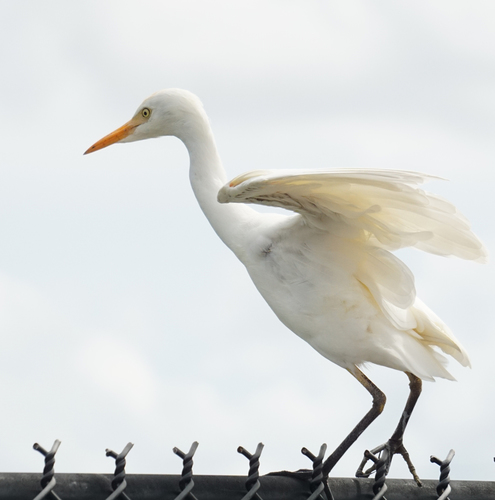 Western Cattle-Egret
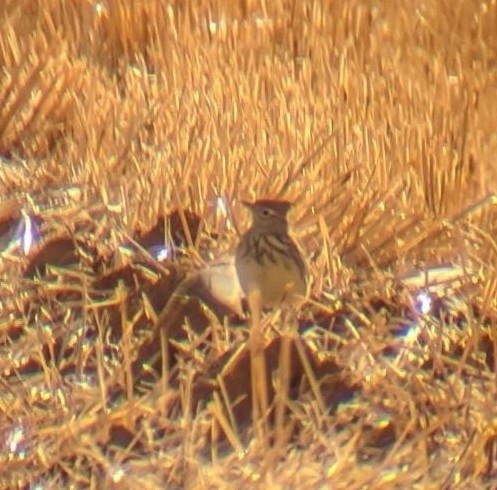 Thekla's Lark
In short
The most reliable separation between Western Cattle Egret and Thekla's Lark is overall structure and size: Cattle Egret is a stocky, medium-sized white heron with a short, thick neck, while Thekla's Lark is a small, streaky brown songbird with a prominent spiky crest. In flight, Cattle Egret shows broad, rounded wings and all-white plumage (except for seasonal buff patches in breeding adults), whereas Thekla's Lark shows grey underwings and a streaked, brownish-grey upperbody. Juvenile Cattle Egrets are also white, but with a black bill, while Thekla's Lark juveniles resemble adults. Habitat and behavior further separate them: Cattle Egret is often seen in open fields with livestock, moving deliberately, while Thekla's Lark prefers dry, open country and is often perched on rocks or singing in display flight.
Identification tips
- Size and shape: Cattle Egret is much larger and heavier, with a thick neck and robust body; Thekla's Lark is a small, compact songbird. This is obvious even at a distance.
- Plumage color: Cattle Egret is all white in all plumages except for buff-orange patches in breeding adults; Thekla's Lark is brownish-grey and streaked, never white.
- Bill color and shape: Adult Cattle Egret has a sturdy yellow bill (black in juveniles); Thekla's Lark has a shorter, finer bill, never yellow or black-tipped in the same way.
- Crest: Thekla's Lark has a long, spiky, erectile crest, visible when perched or alert; Cattle Egret lacks any crest.
- Wing pattern in flight: Cattle Egret shows broad, rounded, all-white wings; Thekla's Lark shows grey underwings, streaked upperparts, and no white in wings or tail.
- Breeding plumage: Only Cattle Egret develops orange-buff plumes on head, breast, and back in breeding season; Thekla's Lark shows no such color change.
- Juvenile marks: Juvenile Cattle Egret is white with a black bill; Thekla's Lark juveniles are like adults, brownish-grey and streaked.
- Leg color: Cattle Egret has greyish-yellow legs (turning bright red briefly in breeding adults); Thekla's Lark has typical passerine legs, not brightly colored.
- Posture: Cattle Egret often stands hunched, with neck retracted; Thekla's Lark stands upright, often with crest raised.
- Behavior: Cattle Egret walks slowly, often among livestock; Thekla's Lark forages on the ground, often runs or hops, and sings from rocks or in flight.
- Habitat: Cattle Egret is usually in wet or grassy fields, often with cattle; Thekla's Lark is in dry, open country, often rocky or sandy, never with livestock.
- Vocalizations: Cattle Egret is silent except at colonies; Thekla's Lark is a frequent singer, with complex lark song.
- Groupings: Cattle Egret may be seen in loose flocks or colonies; Thekla's Lark is usually solitary or in small groups.
- Flight style: Cattle Egret has slow, deep wingbeats and a direct flight; Thekla's Lark has bounding, undulating flight typical of larks, often with song.
- Confusion risk: Mistakes are most likely with distant, perched birds in bright light, or with juvenile Cattle Egrets (black bill), but overall structure and color should quickly resolve the ID.
Size
Western Cattle Egret is substantially larger: 46–56 cm in length with an 88–96 cm wingspan and weighing 270–512 g [wikipedia]. Thekla's Lark is a smallish lark, smaller than Eurasian Skylark, with no precise measurements given here, but it is much smaller and lighter than any heron. In the field, the egret will appear as a medium-sized, robust bird, while the lark is a small, compact passerine.
Plumage
Juvenile and adult non-breeding Western Cattle Egrets are all white, with juveniles showing a black bill and adults a yellow one. In breeding season, adult Cattle Egrets develop orange-buff plumes on the head, breast, and back, with bill, legs, and irises briefly turning bright red. Thekla's Lark, by contrast, is never white: it is brownish-grey above with dark streaks, a streaked breast, and grey underwings in flight. Thekla's Lark juveniles are similar to adults, lacking any white or orange tones. In flight, Cattle Egret shows entirely white wings, while Thekla's Lark shows grey underwings and lacks any white in the wings or tail. Thekla's Lark also has a prominent spiky crest, visible both perched and sometimes in flight, which is absent in Cattle Egret.
Behaviour
Cattle Egret is often seen walking slowly and deliberately in open fields, frequently near cattle or other large mammals, sometimes in loose flocks or colonies. It has a hunched posture and forages on land, rarely correcting for water refraction like other herons. Thekla's Lark is more likely to be seen perched on rocks, fence posts, or singing in display flight over dry, open country. Its behavior is typical of larks: ground-foraging, short flights, and frequent singing from exposed perches. Cattle Egret is largely silent away from colonies, while Thekla's Lark is a vocal songbird.
Habitat
Cattle Egret is found in open fields, grasslands, and agricultural areas, often in association with livestock, and sometimes near wetlands or water bodies, especially at nesting colonies. Thekla's Lark prefers dry, open country, often at some altitude, and is not associated with water or livestock. It is a resident species in arid and semi-arid regions, often found in rocky or sandy areas with sparse vegetation.
Voice
Cattle Egret is largely silent except for a quiet, throaty 'rick-rack' call at breeding colonies. Thekla's Lark, like most larks, is a frequent and varied singer, often delivering its song in flight or from a perch. Vocalizations are not similar and are unlikely to cause confusion.