
Western Bonelli's Warbler vs Willow Warbler
Phylloscopus bonelli versus Phylloscopus trochilus
Play a quiz with Western Bonelli's Warbler and Willow Warbler
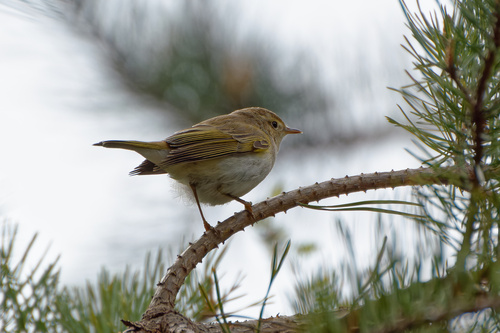 Western Bonelli's Warbler
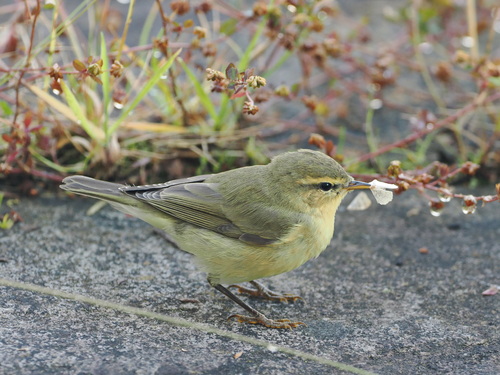 Willow Warbler
In short
The most reliable way to separate Western Bonelli's Warbler from Willow Warbler is by overall plumage tone and leg color: Western Bonelli's is plainer, with a grey-green to brownish back and brown legs, while Willow Warbler is greener above, often with yellowish tones below and paler, pinkish-yellow legs. Juvenile Willow Warblers are distinctly yellower below than any Bonelli's. In the field, Willow Warbler also shows a longer primary projection (wingtip) and a more elegant, slender shape. Voice is a strong clue: Western Bonelli's has a fast monotone trill for song and a disyllabic 'hu-it' call, while Willow Warbler's song is a descending whistle and its call is a soft 'hoo-eet'.
Identification tips
- Juvenile underparts: In late summer and autumn, look for yellowish underparts—if present, it's a Willow Warbler juvenile; Bonelli's is always whitish below.
- Overall plumage tone: Western Bonelli's is plainer, with grey-green to brownish upperparts and little to no yellow below. Willow Warbler is greener above and often yellowish below, especially in fresh plumage.
- Leg color: Check the legs: brown in Western Bonelli's, paler pinkish-yellow in Willow Warbler. This is reliable in good light and close views.
- Bill structure: Willow Warbler has a longer, paler bill; Bonelli's has a shorter, pointed bill. Subtle, but visible in side-by-side comparison or good photos.
- Primary projection: Willow Warbler shows a longer primary projection (wingtip extends further beyond tertials) than Bonelli's. This gives Willow Warbler a more elegant, long-winged look, especially when perched.
- General shape (jizz): Willow Warbler appears more slender and graceful, with a longer tail and wings; Bonelli's is more compact.
- Wingbars: Neither species shows wingbars—if you see clear wingbars, reconsider your ID.
- Song: Western Bonelli's sings a fast, monotone trill; Willow Warbler's song is a descending, sweet whistle. If you hear the song clearly, this is usually diagnostic.
- Call: Bonelli's call is a sharp, disyllabic 'hu-it'; Willow Warbler's is a soft, musical 'hoo-eet.' Calls are especially useful in migration or when birds are not singing.
- Habitat and range: In northern and central Europe, Willow Warbler is abundant; Bonelli's is a rare vagrant. In southwest Europe and North Africa, Bonelli's is possible in suitable woodland.
- Sex: Both species are sexually monomorphic—do not use sex for ID.
- Season: In autumn, Willow Warbler juveniles are yellower below; Bonelli's remains whitish.
- Confusion with chiffchaff: Willow Warbler can be confused with chiffchaff, but Bonelli's is less likely to be confused due to its plainer, less yellowish appearance and brown legs.
- Flight views: In flight, Willow Warbler's longer wings may be apparent, but both species lack distinctive wing patterns or panels that would allow separation at a distance.
- Pitfalls: Beware of lighting and wear: Willow Warbler can appear duller in worn plumage, and Bonelli's may look slightly greener in fresh plumage, but the leg color and underpart tone remain reliable.
Size
Both species are small leaf warblers and are very similar in size, with Willow Warbler averaging 11–12.5 cm in length and 7–15 g in weight [wikipedia]. There is no meaningful size difference in the field between Western Bonelli's and Willow Warbler; both are small, slim, and active birds.
Plumage
- Juveniles: Willow Warbler juveniles are noticeably yellower below than adults or any age of Western Bonelli's, which always shows whitish underparts. This yellow wash is a key mark in late summer and early autumn.
- Adults: Western Bonelli's Warbler is plainer, with a grey-green to brownish back, green-toned rump and wings, and clean whitish underparts. Willow Warbler is greener above, with off-white to yellowish underparts. The Willow Warbler's upperparts can vary from greenish to browner or even greyish depending on subspecies and region, but it usually appears more colorful than Bonelli's. Both lack wingbars and have plain wings.
- Leg color: Western Bonelli's has brown legs, while Willow Warbler has paler, pinkish-yellow legs (never dark brown or blackish as in chiffchaff).
- Bill: Willow Warbler has a longer, paler bill than Western Bonelli's, which has a small, pointed bill.
- Sexes: Both species are sexually monomorphic in plumage.
Behaviour
Both species are active, insectivorous leaf warblers, often foraging in foliage. Willow Warbler tends to appear more delicate and graceful, often flicking its wings and tail, and may seem more restless. Western Bonelli's is also active but does not show the same degree of elegance or long-winged jizz as Willow Warbler. Both can be seen flitting through trees and shrubs, but Willow Warbler's longer primary projection may be noticeable in flight or when perched.
Habitat
Western Bonelli's Warbler breeds in southwest Europe and North Africa, favoring forests and woodlands, and is a rare vagrant further north. Willow Warbler is much more widespread and common, breeding throughout northern and temperate Europe and the Palearctic, especially in open woodlands with birch, alder, and willow. If you are in northern or central Europe, Willow Warbler is far more likely, especially outside the limited breeding range of Bonelli's.
Voice
Western Bonelli's Warbler sings a fast, monotone trill, and its call is a disyllabic 'hu-it.' Willow Warbler's song is a simple, repetitive descending whistle, and its contact call is a soft, disyllabic 'hoo-eet.' The songs are quite different in rhythm and tone, and the calls are diagnostic if heard well. Bonelli's call is sharper and more abrupt, while Willow Warbler's is softer and more musical.
Western Bonelli's Warbler · Willow Warbler · My Tricky Birds