

Wedge-billed Woodcreeper vs Cocoa Woodcreeper
Glyphorynchus spirurus versus Xiphorhynchus susurrans
Play a quiz with Wedge-billed Woodcreeper and Cocoa Woodcreeper
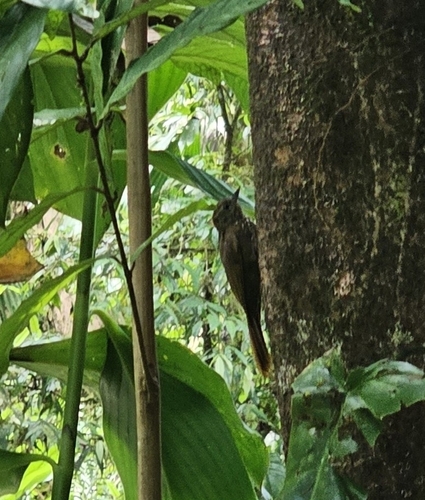 Wedge-billed Woodcreeper
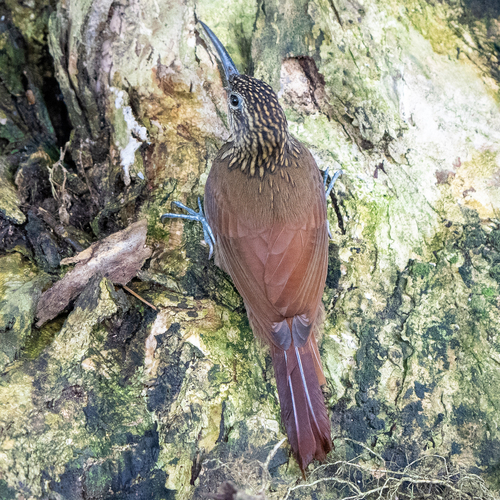 Cocoa Woodcreeper
In short
The most reliable field mark is size and bill shape: Wedge-billed Woodcreeper is much smaller and has a short, stubby, distinctly wedge-shaped bill, while Cocoa Woodcreeper is nearly twice as long, with a long, heavy, slightly downcurved bill. In flight or perched, Wedge-billed often shows a pale buffy band on the underside of the wing (all ages), while Cocoa’s underwing is cinnamon but lacks a contrasting pale band. Both are brown woodcreepers with streaked or spotted underparts, but the Wedge-billed is compact and often forages low or at mid-levels, whereas Cocoa is larger, bulkier, and more likely to be seen higher up or on thicker trunks. Juvenile Cocoa Woodcreeper is overall darker and has a shorter, blacker bill, but even then, it is much larger than any Wedge-billed.
Identification tips
- Size is the fastest check: If the bird looks small and compact, it is Wedge-billed; if it is medium-large and robust, it is Cocoa. This works for all ages and sexes.
- Bill shape is diagnostic: Wedge-billed has a short, stubby, wedge-shaped bill that is upturned and reminiscent of a Xenops. Cocoa has a long, heavy, slightly decurved bill. Bill shape is visible even in poor light or partial views.
- Underwing pattern in flight: Wedge-billed of all ages shows a pale buff to buff-white band on the underside of the wing, visible as a stripe in flight. Cocoa’s underwing is cinnamon but lacks a pale band; its primaries have dusky tips but no pale panel. Use this especially for birds flushed from perches.
- Tail length and shape: Wedge-billed has a short tail relative to body size; Cocoa’s tail is longer and more robust, matching its overall size.
- Face pattern: Wedge-billed has a thin buff supercilium and eyering, grayish forehead, and light lores. Cocoa’s face is dusky with buff streaks and a whitish supercilium, but the face is larger and less delicate.
- Crown and nape: Wedge-billed’s crown is rich brown to russet, sometimes with a grayish forehead. Cocoa’s crown and nape are dark brown to blackish with longish buff spots, streakier on the nape.
- Upperparts: Wedge-billed is rich brown to russet above, with cinnamon-rufous tail and uppertail coverts. Cocoa is olive-brown to brown above, with blackish-edged buff streaks on the back that fade out lower down.
- Breast and underparts: Wedge-billed has large round fulvous spots on the upper breast and narrow streaks below; underparts are olive-brown to russet-brown. Cocoa’s underparts are reddish brown, with buffy spots or streaks (pattern varies by subspecies), and become redder on the undertail coverts. Cocoa’s breast spots/streaks are usually bolder and more extensive.
- Throat: Wedge-billed’s throat is whitish buff to buff, sometimes with dusky spots. Cocoa’s is whitish to pale buff with thin black scaling; some subspecies have a deeper buff or scaly pattern.
- Juvenile confusion: Juvenile Cocoa is darker overall, with a shorter, blacker bill and wider underpart streaks, but is still much larger than Wedge-billed. Juvenile Wedge-billed is similar to adult.
- Leg color: Wedge-billed’s legs and feet are pinkish gray to dark greenish or brownish black. Cocoa’s are dark blue-gray, greenish gray, or yellowish gray. This is subtle but may help in close views.
- Foraging behavior: Wedge-billed is quick, agile, and often low or at mid-levels, moving along thin trunks and branches. Cocoa is slower, bulkier, and often higher or on thicker trunks.
- Habitat context: In dense, mature forest interior, Wedge-billed is more likely. In edge, secondary growth, mangroves, or open woodland, Cocoa is more likely. Both can overlap, but context can tip the balance.
- Vocalizations: Not detailed in the sources, so do not rely on song/call for separation in this context.
- Subspecies variation: Both species have variable underpart patterns (spots vs. streaks), but size and bill shape remain diagnostic throughout their ranges.
Size
Wedge-billed Woodcreeper is the smallest woodcreeper, measuring 13–16 cm and weighing 10.5–21 g. Cocoa Woodcreeper is much larger, at 21–25.5 cm and 43–58 g—about double the size and mass. Even at a distance, Cocoa appears bulkier and longer, with a proportionally longer tail and bill. Size alone can rule out confusion in most binocular views.
Plumage
- Juvenile/immature birds: Juvenile Cocoa Woodcreeper is darker overall, with a shorter, blacker bill, less bold crown spots, and wider underpart streaks, but remains much larger than any Wedge-billed. Wedge-billed juveniles are similar to adults, with the same compact shape and wedge bill.
- Wing pattern in flight: Wedge-billed of all ages shows a pale buff to buff-white band on the underside of the wing, visible in flight. Cocoa has cinnamon underwing coverts but lacks a pale band; its flight feathers and tail are rufous-chestnut with dusky tips.
- Adults: Wedge-billed is rich brown to russet above, cinnamon-rufous tail, and has large round fulvous spots on the upper breast and narrow streaks below. Cocoa is olive-brown to brown above, with blackish-edged buff streaks on the back, and underparts that are reddish brown with buffy spots or streaks (pattern varies by subspecies, but always bolder than Wedge-billed). Wedge-billed’s throat is whitish buff to buff, sometimes spotted; Cocoa’s is whitish to pale buff with thin black scaling. Both have rufous tails, but Cocoa’s is longer and more robust.
- Face: Wedge-billed has a thin buff supercilium and eyering, light lores, and a grayish forehead; Cocoa has a dusky face with buff streaks and a whitish supercilium.
Behaviour
Wedge-billed is often seen foraging low or at mid-levels, moving quickly and nimbly along thin trunks and branches, sometimes behaving almost like a Xenops. It is more active and agile, reflecting its small size. Cocoa Woodcreeper is bulkier, moves more deliberately, and is often seen on thicker trunks or higher up in the forest, sometimes following army ant swarms. Its foraging is slower and more methodical.
Habitat
Wedge-billed occurs in a wide range of humid forests from Mexico to South America, often in primary and mature secondary forest, and is more likely to be found in the forest interior. Cocoa Woodcreeper is found from Central America to northern South America and Trinidad, favoring humid evergreen forest but also occurring in gallery forest, woodland edges, mangroves, and even arid scrub on Isla Margarita. Cocoa is more likely in edge, secondary growth, and open woodland contexts, while Wedge-billed prefers denser, older forest.
Wedge-billed Woodcreeper · Cocoa Woodcreeper · My Tricky Birds