

Motmot

チビオニキバシリ 対 ココアオニキバシリ

Glyphorynchus spirurus 対 Xiphorhynchus susurrans

チビオニキバシリとココアオニキバシリのクイズ
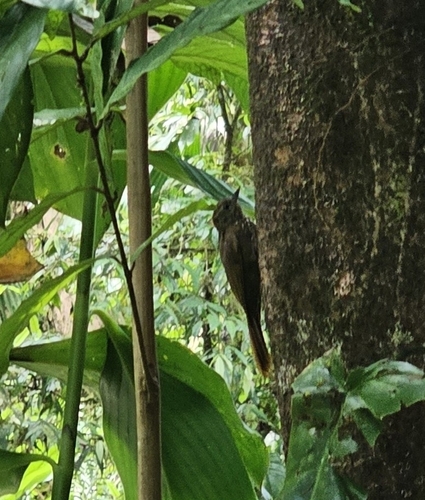
チビオニキバシリ (Glyphorynchus spirurus) チビオニキバシリ
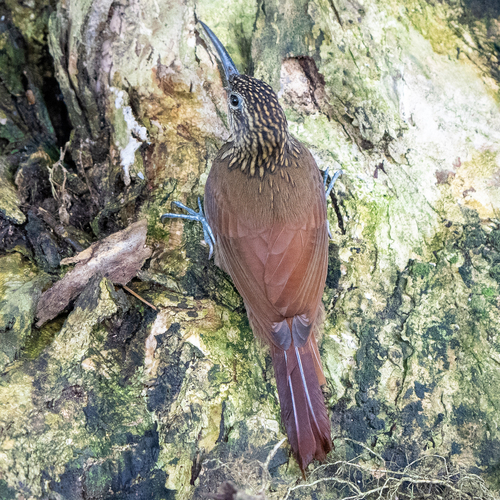
ココアオニキバシリ (Xiphorhynchus susurrans) ココアオニキバシリ

メディア

読み込み中…

要点

最も信頼できるフィールドマークはサイズとくちばしの形です:チビオニキバシリはずっと小さく、短くて太く、明確にくさび形のくちばしを持っていますが、ココアオニキバシリはほぼ2倍の長さで、長くて重く、わずかに下向きのくちばしを持っています。飛んでいるときや止まっているとき、チビオニキバシリはしばしば翼の裏側に淡いバフ色の帯を示します(すべての年齢)、一方ココアの翼の下はシナモン色ですが、対照的な淡い帯はありません。両者はストライプまたは斑点のある下部を持つ茶色のオニキバシリですが、チビオニキバシリはコンパクトで、しばしば低い位置または中間の高さで餌を探しますが、ココアはより大きく、ずっしりとしており、より高い位置や太い幹で見られる可能性が高いです。幼鳥のココアオニキバシリは全体的に暗く、短くて黒いくちばしを持っていますが、それでもチビオニキバシリよりもはるかに大きいです。

識別のコツ

  1. サイズは最も早いチェックです: 鳥が小さくてコンパクトに見える場合はチビオニキバシリです;中型から大型で頑丈に見える場合はココアです。これはすべての年齢と性別に当てはまります。
  2. くちばしの形は診断的です: チビオニキバシリは短くて太く、くさび形のくちばしを持ち、上向きでXenopsを思わせます。ココアは長くて重く、わずかに下向きのくちばしを持っています。くちばしの形は、暗い光や部分的な視界でも見ることができます。
  3. 飛行中の翼の下のパターン: すべての年齢のチビオニキバシリは、翼の裏側に淡いバフからバフホワイトの帯を示し、飛行中にストライプとして見えます。ココアの翼の下はシナモン色ですが、淡い帯はありません;その一次羽は暗い先端を持っていますが、淡いパネルはありません。特に止まり木から飛び立った鳥に対してこれを使用してください。
  4. 尾の長さと形: チビオニキバシリは体のサイズに対して短い尾を持っています;ココアの尾は長くて頑丈で、全体のサイズに合っています。
  5. 顔のパターン: チビオニキバシリは薄いバフ色のスーペリキリウムとアイリング、灰色がかった額、明るいロアを持っています。ココアの顔は暗く、バフ色のストライプがあり、白っぽいスーペリキリウムを持っていますが、顔は大きくて繊細さが少ないです。
  6. 頭頂部と後頭部: チビオニキバシリの頭頂部は濃い茶色から赤褐色で、時には灰色がかった額があります。ココアの頭頂部と後頭部は暗い茶色から黒っぽく、長めのバフ色の斑点があり、後頭部はよりストライプ状です。
  7. 上面: チビオニキバシリは上面が濃い茶色から赤褐色で、シナモン色の尾と上尾覆羽を持っています。ココアはオリーブ茶色から茶色で、背中には黒っぽい縁のバフ色のストライプがあり、下に行くにつれて消えます。
  8. 胸部と下部: チビオニキバシリは上胸部に大きな丸い黄褐色の斑点を持ち、下部には狭いストライプがあります;下部はオリーブ茶色から赤褐色です。ココアの下部は赤褐色で、バフ色の斑点やストライプがあります(パターンは亜種によって異なります)、そして下尾覆羽ではより赤くなります。ココアの胸の斑点/ストライプは通常より大胆で広範囲です。
  9. 喉: チビオニキバシリの喉は白っぽいバフからバフで、時には暗い斑点があります。ココアの喉は白っぽいから淡いバフで、薄い黒い鱗状の模様があります;いくつかの亜種はより深いバフまたは鱗状のパターンを持っています。
  10. 幼鳥の混乱: 幼鳥のココアは全体的に暗く、短くて黒いくちばしと広い下部のストライプを持っていますが、それでもチビオニキバシリよりもはるかに大きいです。幼鳥のチビオニキバシリは成鳥に似ています。
  11. 脚の色: チビオニキバシリの脚と足はピンクがかった灰色から暗い緑がかったまたは茶色がかった黒です。ココアの脚は暗い青灰色、緑がかった灰色、または黄褐色の灰色です。これは微妙ですが、近くで見ると役立つかもしれません。
  12. 餌を探す行動: チビオニキバシリは速く、敏捷で、しばしば低い位置または中間の高さで、細い幹や枝に沿って移動します。ココアはより遅く、ずっしりとしており、しばしば高い位置や太い幹で見られます。
  13. 生息地の文脈: 密集した成熟した森林の内部では、チビオニキバシリがより可能性があります。エッジ、二次成長、マングローブ、または開けた森林では、ココアがより可能性があります。両者は重なることがありますが、文脈がバランスを傾けることがあります。
  14. 鳴き声: ソースには詳細が記載されていないため、この文脈での分離に歌や呼び声に頼らないでください。
  15. 亜種の変異: 両種は変動する下部のパターン(斑点対ストライプ)を持っていますが、サイズとくちばしの形はその範囲全体で診断的です。

大きさ

チビオニキバシリは最も小さなオニキバシリで、13〜16 cmの大きさで、10.5〜21 gの重さです。ココアオニキバシリははるかに大きく、21〜25.5 cmで43〜58 g—サイズと質量は約2倍です。距離があっても、ココアはずっしりとして長く見え、相対的に長い尾とくちばしを持っています。サイズだけでほとんどの双眼鏡の視界で混乱を排除できます。

羽色

行動

チビオニキバシリはしばしば低い位置または中間の高さで餌を探しているのが見られ、細い幹や枝に沿って素早く敏捷に移動し、時にはほとんどXenopsのように振る舞います。小さいサイズを反映して、より活発で敏捷です。ココアオニキバシリはずっしりとしており、より慎重に動き、しばしば太い幹や森林の高い位置で見られ、時にはアリの群れを追いかけることがあります。餌を探す行動はより遅く、より計画的です。

生息環境

チビオニキバシリはメキシコから南アメリカまでの広範囲の湿った森林に生息し、主に原生林や成熟した二次林に生息し、森林の内部で見つかる可能性が高いです。ココアオニキバシリは中央アメリカから南アメリカ北部およびトリニダードに生息し、湿った常緑樹林を好みますが、ギャラリー森林、森林のエッジ、マングローブ、さらにはイサ・マルガリータの乾燥した低木地にも生息します。ココアはエッジ、二次成長、開けた森林の文脈でより可能性が高く、チビオニキバシリはより密集した古い森林を好みます。

より良い説明を送る

比較と同じ項目を使ってください。文章はすぐに公開されます。

The most reliable field mark is size and bill shape: Wedge-billed Woodcreeper is much smaller and has a short, stubby, distinctly wedge-shaped bill, while Cocoa Woodcreeper is nearly twice as long, with a long, heavy, slightly downcurved bill. In flight or perched, Wedge-billed often shows a pale buffy band on the underside of the wing (all ages), while Cocoa’s underwing is cinnamon but lacks a contrasting pale band. Both are brown woodcreepers with streaked or spotted underparts, but the Wedge-billed is compact and often forages low or at mid-levels, whereas Cocoa is larger, bulkier, and more likely to be seen higher up or on thicker trunks. Juvenile Cocoa Woodcreeper is overall darker and has a shorter, blacker bill, but even then, it is much larger than any Wedge-billed.

  1. Size is the fastest check: If the bird looks small and compact, it is Wedge-billed; if it is medium-large and robust, it is Cocoa. This works for all ages and sexes.
  2. Bill shape is diagnostic: Wedge-billed has a short, stubby, wedge-shaped bill that is upturned and reminiscent of a Xenops. Cocoa has a long, heavy, slightly decurved bill. Bill shape is visible even in poor light or partial views.
  3. Underwing pattern in flight: Wedge-billed of all ages shows a pale buff to buff-white band on the underside of the wing, visible as a stripe in flight. Cocoa’s underwing is cinnamon but lacks a pale band; its primaries have dusky tips but no pale panel. Use this especially for birds flushed from perches.
  4. Tail length and shape: Wedge-billed has a short tail relative to body size; Cocoa’s tail is longer and more robust, matching its overall size.
  5. Face pattern: Wedge-billed has a thin buff supercilium and eyering, grayish forehead, and light lores. Cocoa’s face is dusky with buff streaks and a whitish supercilium, but the face is larger and less delicate.
  6. Crown and nape: Wedge-billed’s crown is rich brown to russet, sometimes with a grayish forehead. Cocoa’s crown and nape are dark brown to blackish with longish buff spots, streakier on the nape.
  7. Upperparts: Wedge-billed is rich brown to russet above, with cinnamon-rufous tail and uppertail coverts. Cocoa is olive-brown to brown above, with blackish-edged buff streaks on the back that fade out lower down.
  8. Breast and underparts: Wedge-billed has large round fulvous spots on the upper breast and narrow streaks below; underparts are olive-brown to russet-brown. Cocoa’s underparts are reddish brown, with buffy spots or streaks (pattern varies by subspecies), and become redder on the undertail coverts. Cocoa’s breast spots/streaks are usually bolder and more extensive.
  9. Throat: Wedge-billed’s throat is whitish buff to buff, sometimes with dusky spots. Cocoa’s is whitish to pale buff with thin black scaling; some subspecies have a deeper buff or scaly pattern.
  10. Juvenile confusion: Juvenile Cocoa is darker overall, with a shorter, blacker bill and wider underpart streaks, but is still much larger than Wedge-billed. Juvenile Wedge-billed is similar to adult.
  11. Leg color: Wedge-billed’s legs and feet are pinkish gray to dark greenish or brownish black. Cocoa’s are dark blue-gray, greenish gray, or yellowish gray. This is subtle but may help in close views.
  12. Foraging behavior: Wedge-billed is quick, agile, and often low or at mid-levels, moving along thin trunks and branches. Cocoa is slower, bulkier, and often higher or on thicker trunks.
  13. Habitat context: In dense, mature forest interior, Wedge-billed is more likely. In edge, secondary growth, mangroves, or open woodland, Cocoa is more likely. Both can overlap, but context can tip the balance.
  14. Vocalizations: Not detailed in the sources, so do not rely on song/call for separation in this context.
  15. Subspecies variation: Both species have variable underpart patterns (spots vs. streaks), but size and bill shape remain diagnostic throughout their ranges.

Wedge-billed Woodcreeper is the smallest woodcreeper, measuring 13–16 cm and weighing 10.5–21 g. Cocoa Woodcreeper is much larger, at 21–25.5 cm and 43–58 g—about double the size and mass. Even at a distance, Cocoa appears bulkier and longer, with a proportionally longer tail and bill. Size alone can rule out confusion in most binocular views.

  • Juvenile/immature birds: Juvenile Cocoa Woodcreeper is darker overall, with a shorter, blacker bill, less bold crown spots, and wider underpart streaks, but remains much larger than any Wedge-billed. Wedge-billed juveniles are similar to adults, with the same compact shape and wedge bill.
  • Wing pattern in flight: Wedge-billed of all ages shows a pale buff to buff-white band on the underside of the wing, visible in flight. Cocoa has cinnamon underwing coverts but lacks a pale band; its flight feathers and tail are rufous-chestnut with dusky tips.
  • Adults: Wedge-billed is rich brown to russet above, cinnamon-rufous tail, and has large round fulvous spots on the upper breast and narrow streaks below. Cocoa is olive-brown to brown above, with blackish-edged buff streaks on the back, and underparts that are reddish brown with buffy spots or streaks (pattern varies by subspecies, but always bolder than Wedge-billed). Wedge-billed’s throat is whitish buff to buff, sometimes spotted; Cocoa’s is whitish to pale buff with thin black scaling. Both have rufous tails, but Cocoa’s is longer and more robust.
  • Face: Wedge-billed has a thin buff supercilium and eyering, light lores, and a grayish forehead; Cocoa has a dusky face with buff streaks and a whitish supercilium.

Wedge-billed is often seen foraging low or at mid-levels, moving quickly and nimbly along thin trunks and branches, sometimes behaving almost like a Xenops. It is more active and agile, reflecting its small size. Cocoa Woodcreeper is bulkier, moves more deliberately, and is often seen on thicker trunks or higher up in the forest, sometimes following army ant swarms. Its foraging is slower and more methodical.

Wedge-billed occurs in a wide range of humid forests from Mexico to South America, often in primary and mature secondary forest, and is more likely to be found in the forest interior. Cocoa Woodcreeper is found from Central America to northern South America and Trinidad, favoring humid evergreen forest but also occurring in gallery forest, woodland edges, mangroves, and even arid scrub on Isla Margarita. Cocoa is more likely in edge, secondary growth, and open woodland contexts, while Wedge-billed prefers denser, older forest.

変更を破棄しますか?

保存していない編集があります。今離れると失われます。

チビオニキバシリ · ココアオニキバシリ · 苦手な鳥