

Water Rail vs Common Moorhen
Rallus aquaticus versus Gallinula chloropus
Play a quiz with Water Rail and Common Moorhen
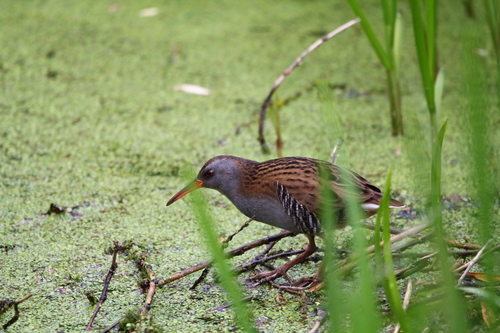 Water Rail
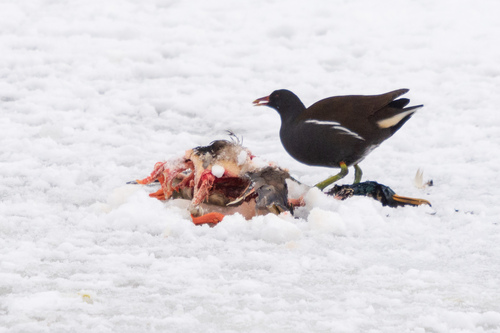 Common Moorhen
In short
The most reliable difference between Water Rail and Common Moorhen is the bill and face: Water Rail shows a long, slender, slightly down-curved red bill and a dark slate-blue face, while Common Moorhen has a shorter, thicker red bill with a yellow tip and a prominent red frontal shield above the bill. In flight or on water, Water Rail is slimmer, with brown upperparts and strong black-and-white flank barring, while Moorhen is bulkier, darker, and shows bold white streaks along the flanks and a bright white undertail. Juvenile Water Rails can be confusing, as their undertail is buff and their plumage is less contrasting, but they lack the Moorhen’s facial shield and yellow legs. Both species occur in similar wetland habitats, but Moorhen is far more likely to be seen openly swimming, while Water Rail is secretive and rarely leaves cover.
Identification tips
- Bill shape and color: Water Rail has a long, slender, slightly down-curved red bill; Moorhen’s bill is shorter, thicker, red with a yellow tip, and topped by a prominent red frontal shield. This is the most reliable mark at any age.
- Facial pattern: Water Rail shows a dark slate-blue face and underparts (adult), while Moorhen’s face is darker brownish-black with a bright red shield above the bill.
- Flank markings: Adult Water Rail has strong black-and-white barring on the flanks; Moorhen has bold white streaks along the flanks but no barring.
- Undertail coverts: Both show white undertail, but Water Rail’s is white with variable dark streaks (especially in adult males), while Moorhen’s is pure white (except in some subspecies, where it may be buffish).
- Leg color: Moorhen has bright yellow legs (sometimes tinged green); Water Rail’s legs are flesh-brown and never yellow.
- Body shape and posture: Water Rail is slim, laterally compressed, and moves with a hunched, furtive gait; Moorhen is bulkier, more upright, and often seen swimming.
- Juvenile confusion: Juvenile Water Rail has a buff undertail and brown-and-buff flank markings, not the black-and-white barring of adults. Juvenile Moorhen lacks the red shield and is browner overall but still shows white undertail and some white flank streaks. In both, bill color is duller than adult, but only Moorhen ever shows a yellow bill tip.
- Swimming behavior: Moorhen is frequently seen swimming in open water; Water Rail almost never swims and prefers to run or walk through dense vegetation.
- Tail flicking: Both species flick their tails, exposing the undertail, but Moorhen’s is more conspicuous and often seen in open settings.
- Size impression: Moorhen is much larger and heavier than Water Rail. If seen together, the size difference is obvious.
- Habitat context: Water Rail is almost always in dense reedbeds or marshes, rarely venturing into open water or lawns. Moorhen is adaptable and often found in open, even urban, wetlands.
- Flight views: Both are reluctant fliers, but if flushed, Water Rail shows a slim, rail-like profile with trailing legs and rounded wings; Moorhen is bulkier and flies with legs dangling, often for short distances only.
- Voice: A pig-like squeal from cover is Water Rail; a variety of gargling, clucking, or hissing calls are Moorhen.
- Sex and season: Sexes are similar in both species; Water Rail males may have stronger black streaks on the undertail. After breeding, Water Rail undergoes a full moult and is flightless for about three weeks, but this is rarely observed in the field.
- Pitfalls: Juvenile Water Rail can be confused with Moorhen due to buff undertail and less contrasting plumage, but lacks the Moorhen’s facial shield, yellow legs, and white flank streaks. Always check bill shape and color for confirmation.
Size
Common Moorhen is substantially larger and heavier than Water Rail. Moorhen averages 348 g, with a length of 30–38 cm and a wingspan of 50–62 cm. Water Rail is much lighter at about 111.5 g, measuring 23–28 cm in length with a 38–45 cm wingspan. In the field, Moorhen appears bulkier and more robust, while Water Rail is slimmer and more laterally compressed, adapted for slipping through dense reeds.
Plumage
-
Juveniles and immatures: Juvenile Water Rails have a blackish crown, white chin and throat, buff or white underparts with darker bars, and brown-and-buff (not black-and-white) flank markings. Their undertail is buff, and their bill, eye, and leg colors are duller than adults. Juvenile Moorhens are browner overall, lack the red shield, and have a less contrasting face, but still show the white undertail and some white flank streaks.
-
Adults: Adult Water Rail has olive-brown upperparts with black streaks, dark slate-blue face and underparts, black-and-white barred flanks, a white undertail with some dark streaks, and a long red bill. Moorhen adults are mostly dark brownish-black with a white undertail, bold white streaks on the flanks, yellow legs, and a red bill with a yellow tip and a prominent red frontal shield. Moorhen’s undertail is pure white (except in some subspecies, where it can be buffish), while Water Rail’s undertail is white with variable dark streaks (strongest in adult males).
Behaviour
Water Rail is secretive, typically skulking in dense reed beds and rarely venturing into the open. It moves with a hunched, furtive gait, often flicking its short tail to reveal the white undertail. Moorhen is much bolder, frequently seen swimming in open water, walking on floating vegetation, or feeding at the water’s edge. Moorhen also flicks its tail, showing the white undertail, and is more likely to be seen in groups or family parties. Water Rail is rarely seen swimming and almost never in open water.
Habitat
Both species inhabit well-vegetated wetlands, including reedbeds, marshes, and pond margins. However, Water Rail is more strictly tied to dense cover and is less likely to be seen in open areas. Moorhen tolerates a wider range of wetland habitats, including urban ponds, canals, and even small ditches, and is much more likely to be seen in open, disturbed, or human-modified sites.
Voice
Water Rail gives a distinctive pig-like squeal, often heard from deep cover and rarely accompanied by visual sightings. Moorhen has a wide range of gargling calls and loud hisses, especially when alarmed or during territorial disputes. In the field, hearing a pig-like squeal is a strong clue for Water Rail, while a variety of cackling, clucking, or hissing calls suggest Moorhen.