

Water Rail vs Brown-cheeked Rail
Rallus aquaticus versus Rallus indicus
Play a quiz with Water Rail and Brown-cheeked Rail
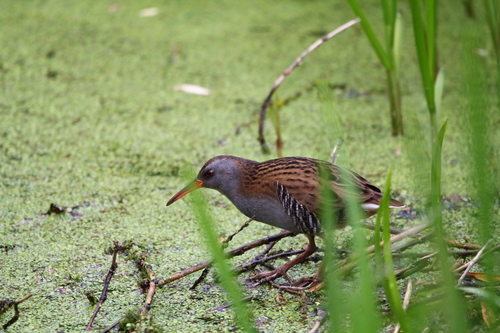 Water Rail
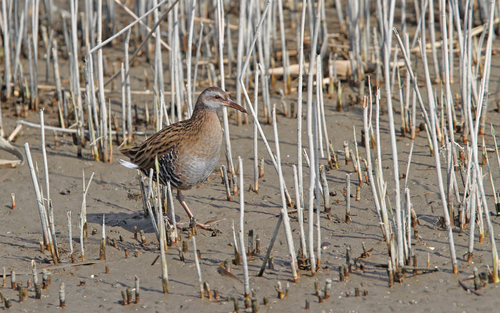 Brown-cheeked Rail
In short
The most reliable field mark between Water Rail and Brown-cheeked Rail is the color and pattern of the underparts and face: Water Rail shows blue-grey underparts and face with a red bill, while Brown-cheeked Rail has brown-tinged underparts and a distinct brown eyestripe. Juveniles of both are duller, but Water Rail juveniles have buff underparts and less contrast, whereas Brown-cheeked Rail juveniles retain the brown facial stripe. Both species are similar in size and shape, but Brown-cheeked Rail is slightly larger on average. Vocalizations are distinctly different, with Brown-cheeked Rail giving sharper, clearer calls. In the field, focus on the face pattern, underpart color, and bill color for the most consistent separation.
Identification tips
- Face pattern: Water Rail has a dark slate-blue face and underparts, with a blackish area between bill and eye; Brown-cheeked Rail shows a distinct brown eyestripe and paler, brown-tinged underparts. This is often the fastest field check in good light.
- Bill color and shape: Water Rail has a long, red, slightly down-curved bill (longer than the rest of the rail's head, about 55–58% of total head length); Brown-cheeked Rail's bill is less vividly red and not as long proportionally. This is reliable in adults, less so in juveniles.
- Underpart color: Adult Water Rail has blue-grey underparts, especially on the sides of the head and belly; Brown-cheeked Rail is brown-tinged below, with a white throat and browner breast. In juveniles, Water Rail is buff or white below with darker bars, while Brown-cheeked Rail remains browner.
- Flank barring: Water Rail adults have black and white barred flanks; Brown-cheeked Rail's flanks are less strongly barred and more brownish. In juveniles, Water Rail's flanks are brown and buff, not black and white.
- Undertail coverts: Both have a white undertail, but Water Rail often shows dark streaks, especially in males; Brown-cheeked Rail's undertail is less streaked. This is subtle and best seen when the tail is flicked.
- Upperparts: Water Rail has olive-brown upperparts with black streaks, especially on the shoulders; Brown-cheeked Rail is paler above, with less streaking. This is subtle and best used in direct comparison.
- Juvenile confusion: Juvenile Water Rail lacks blue-grey tones and has buff underparts and a blackish crown; Brown-cheeked Rail juveniles are browner overall and retain the brown eyestripe. If you see a juvenile with a brown facial stripe, suspect Brown-cheeked Rail.
- Voice: Water Rail's call is a pig-like squeal; Brown-cheeked Rail gives a sharp 'kyu' and metallic 'shrink, shrink' notes. If you hear the bird, use this as a primary separator.
- Size: Brown-cheeked Rail can be slightly larger and heavier, but the overlap is substantial; do not rely on size unless you have direct comparison.
- Leg color: Water Rail has flesh-brown legs; Brown-cheeked Rail's leg color is not described as distinctive, so this is not a reliable separator.
- Sex differences: Both sexes are similar in both species; female Water Rail is slightly smaller with a more slender bill, but this is not reliable in the field.
- Flight views: Both species are reluctant fliers and show similar structure in flight. No distinctive upperwing pattern is described for either, so focus on body and face color if seen in flight.
- Habitat and range: Use range as a context clue—Water Rail in Europe/North Africa, Brown-cheeked Rail in northeast Asia and wintering in Southeast Asia. In areas of overlap, rely on plumage and voice.
- Moult and flightlessness: Water Rail is flightless for about three weeks after breeding due to moult; Brown-cheeked Rail likely has a similar moult period, but this is not a field mark.
- Individual undertail patterns: Water Rail adults have unique undertail markings, but this is not useful for species separation—more for individual identification in studies.
Size
Both species are medium-sized rails, with Water Rail measuring 23–28 cm in length and Brown-cheeked Rail 23–29 cm. Brown-cheeked Rail can be slightly heavier (recorded range 75–190 g) compared to Water Rail (males 114–164 g, females 92–107 g, average 111.5 g). However, this overlap means size alone is not a reliable field mark. Both are laterally compressed for moving through reeds, and their overall proportions are very similar.
Plumage
Juvenile and immature plumage is the main pitfall: Water Rail juveniles have buff or white underparts with darker bars and a blackish crown, lacking the blue-grey tones of adults; their flanks are marked brown and buff, not black and white. Brown-cheeked Rail juveniles are not described in detail, but the key feature is the presence of a brown eyestripe and generally browner underparts, even in young birds. In adults, Water Rail shows olive-brown streaked upperparts, dark slate-blue face and underparts, black and white barred flanks, and a white undertail with dark streaks. Brown-cheeked Rail adults have paler, less streaked upperparts, brown-tinged underparts, a brown eyestripe, and a white throat. The bill of Water Rail is longer and redder, while Brown-cheeked Rail's bill is less vividly colored. In both, the undertail is white, but Water Rail's is more likely to show black streaks, especially in males.
Behaviour
Both species are secretive, moving through dense reedbeds and wetland vegetation. Their behavior, nest structure, and feeding habits are essentially the same, as noted in the sources. Both can be seen creeping along the water's edge or making short flights when flushed. There are no reliable behavioral differences for field separation.
Habitat
Habitat is not a strong separator in the field, as both occupy well-vegetated wetlands, reedbeds, and marshes. Water Rail is found across Europe, North Africa, and western Asia, while Brown-cheeked Rail breeds in northeast Asia (Mongolia, Siberia, China, Korea, Japan) and winters in Southeast Asia. In areas of overlap (e.g., migration vagrancy), habitat alone will not distinguish them.
Voice
Vocalizations are a strong separator: Water Rail gives a pig-like squeal, while Brown-cheeked Rail's calls are sharper and clearer, including a piping 'kyu' and metallic slurred 'shrink, shrink' notes. Brown-cheeked Rail does not respond to Water Rail recordings, and vice versa. If you hear the call well, this is a reliable way to separate them.