

Wandering Tattler vs Black-naped Tern
Tringa incana versus Sterna sumatrana
Play a quiz with Wandering Tattler and Black-naped Tern
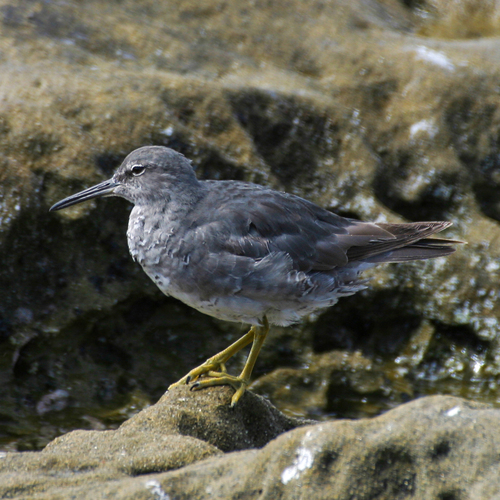 Wandering Tattler
 Black-naped Tern
In short
The most reliable way to separate Wandering Tattler from Black-naped Tern is by overall structure and wing pattern: Wandering Tattler is a stocky, grayish shorebird with unpatterned wings and a scaly-barred underpart pattern in breeding plumage, while Black-naped Tern is a slim, white seabird with a striking black nape band and a deeply forked tail. In flight, the tern’s long, pointed wings and tail streamers are distinctive, whereas the tattler shows broad, unmarked gray wings and a shorter, square-tipped tail. If you see a bird perched, note the tattler’s yellow legs and gray upperparts versus the tern’s all-white plumage with black legs and bill. Habitat is also a strong clue: tattlers are found on rocky shores and riverbanks, while Black-naped Terns are strictly oceanic, rarely seen inland.
Identification tips
- Wing and tail shape in flight: Black-naped Tern has long, pointed wings and a deeply forked tail that extends beyond the wingtips when perched; Wandering Tattler has shorter, broader wings and a square-tipped tail. This is most obvious in flight or side-on perched views.
- Plumage color: Tattler is gray above and white below (with scaly barring in breeding adults); Black-naped Tern is pure white with pale silvery wings and a black nape band.
- Head pattern: Black-naped Tern has a distinctive black line from the eye across the nape, forming a 'cap' effect; Wandering Tattler has a prominent supercilium (eyebrow) but lacks any black nape band.
- Bill and leg color: Tattler has a dark gray bill and short, dark yellow legs; Black-naped Tern has a black bill and black legs. Leg color is best seen on perched birds.
- Underpart pattern: In breeding season, Wandering Tattler shows heavy barring or scaly pattern on the breast and belly; Black-naped Tern is always clean white below.
- Upperwing pattern: Both species have relatively plain wings, but the tern’s wings are paler and silvery, with a narrow black edge on the outermost primary; tattler’s wings are plain gray with no black edge.
- Tail projection: On perched birds, the tern’s tail streamers extend well past the wingtips; the tattler’s tail is shorter and does not project beyond the wings.
- Body shape: Tattler is compact and stocky; tern is slim and elongated, especially in flight.
- Habitat context: If the bird is on a rocky shore, riverbank, or mudflat, suspect tattler. If it’s on an offshore rock, island, or over open ocean, suspect Black-naped Tern.
- Behavior: Tattler walks or bobs along shorelines; tern is often seen flying, hovering, or plunge-diving over water.
- Juvenile confusion: Juvenile Black-naped Tern is mottled brown, unlike any tattler plumage. Young tattlers are duller gray but never brown and mottled.
- Vocalization: A rapid trill points to Wandering Tattler; sharp, squeaky calls are more typical of terns.
- Size in context: If seen together, the tern will appear longer and more slender, with a larger wingspan, but both are similar in mass.
- Season: Wandering Tattler’s underpart barring is only present in breeding adults; in non-breeding, both species become plainer, so rely more on structure and habitat.
- Supercilium vs. nape band: Tattler’s eyebrow is never as bold or as dark as the tern’s black nape band—look for this contrast in head pattern.
Size
Both species are similar in mass (Wandering Tattler: 108.5g, Black-naped Tern: 106g [wikidata]), but the tern is slightly longer (30–35 cm vs. tattler’s 26–30 cm) and has a noticeably longer wingspan (66 cm vs. 50–55 cm). In the field, Black-naped Tern appears more elongated and slender, with longer wings and a tail that extends well beyond the wingtips when perched. Wandering Tattler is more compact and stocky, with shorter wings and tail relative to its body.
Plumage
-
Juvenile/immature birds: No detailed age-specific upperwing pattern is described for either species, but both lack the bold wing markings typical of many shorebirds and terns. Juvenile Black-naped Terns are mottled brown, while young tattlers resemble adults but may be duller.
-
Adults, breeding plumage: Wandering Tattler shows a scaly, barred pattern extending from the breast onto the belly, with plain gray upperparts and wings. Black-naped Tern is pure white overall except for pale silvery-gray wings and mantle, and a sharp black line from the eye across the nape. The tern’s wings are paler, and the outermost primary has a narrow black edge, but otherwise the wings are clean and silvery. Tattler’s wings are unpatterned gray, lacking any black edge or contrast.
-
Adults, non-breeding: Both species become plainer, but the tattler retains gray upperparts and loses much of the underpart barring, while the tern remains white with the black nape band.
Behaviour
Wandering Tattler is typically seen walking or bobbing along rocky shores, riverbanks, or mudflats, often alone or in small groups. It feeds by picking at invertebrates and may be wary, flushing with a rapid, direct flight. Black-naped Tern is almost always seen flying gracefully over open ocean or perched on offshore rocks and islands, rarely coming to land except to breed. Its flight is buoyant, with long, pointed wings and a deeply forked tail, often seen plunge-diving for fish or hovering briefly above the water.
Habitat
Habitat is a major separator: Wandering Tattler frequents rocky coastlines, riverbanks, and sometimes mudflats—almost always close to shorelines or freshwater. Black-naped Tern is strictly oceanic, breeding and roosting on offshore islands and rocks, and is rarely, if ever, found inland. If you see a bird inland or on a river, it is almost certainly not a Black-naped Tern.
Voice
Wandering Tattler gives a rapid trill of accelerating, staccato notes, often heard when flushed. Black-naped Tern’s voice is not described in the provided notes, but terns typically have high-pitched, sharp calls, quite different from the tattler’s trill. If you hear a trill, suspect tattler; if you hear a sharp, squeaky call, consider tern.