

Violet Cuckoo vs Banded Bay Cuckoo
Chrysococcyx xanthorhynchus versus Cacomantis sonneratii
Play a quiz with Violet Cuckoo and Banded Bay Cuckoo
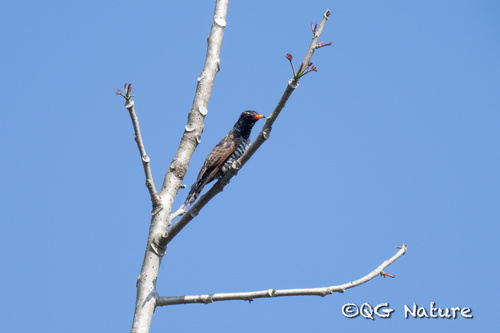 Violet Cuckoo
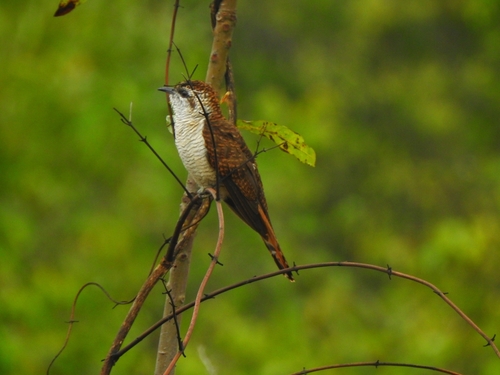 Banded Bay Cuckoo
In short
The most reliable field mark is the overall color and barring pattern: adult male Violet Cuckoo is strikingly glossy violet above with a bright iridescent violet chin and upper breast, while Banded Bay Cuckoo is a warm rufous-brown above with bold dark barring and a prominent white supercilium. Juvenile Violet Cuckoo is mottled rufous and greenish-bronze with a rufous crown and barred tail, while juvenile Banded Bay Cuckoo is paler with white fringes on upperparts and a more uniform rufous-brown tone. In flight or perched, Violet Cuckoo (both sexes) shows a shorter, more compact jizz and a white belly with broad dark bars, while Banded Bay Cuckoo is longer-billed, longer-tailed, and has a white underside with fine striations. Both are small cuckoos, but their structure, face pattern, and tail markings are key in the field.
Identification tips
- Juvenile/immature contrast: Juvenile Violet Cuckoo has a bright rufous crown, greenish-bronze upperparts, and a barred rufous-and-brown tail, while juvenile Banded Bay Cuckoo is paler, lacks the rufous crown, and shows white fringes on upperparts.
- Adult male Violet Cuckoo: Look for glossy violet head and upperparts, iridescent violet chin and upper breast, and a white belly with broad dark bars. No other small cuckoo in the region is this vividly violet.
- Banded Bay Cuckoo face pattern: White supercilium (eyebrow) above a dark eye-line is always present and diagnostic. Violet Cuckoo never shows a strong supercilium.
- Upperparts color: Banded Bay Cuckoo is bright rufous or bay above with broad dark barring; Violet Cuckoo males are glossy violet, females greenish-bronze and mottled.
- Tail pattern: Banded Bay Cuckoo has a dark brown, graduated tail with a subterminal black band and white tips. Violet Cuckoo males have a blackish tail with white tip and barred outers; females/juveniles have greenish and rufous barred tails.
- Bill shape: Banded Bay Cuckoo has a noticeably longer, slightly curved bill; Violet Cuckoo's bill is shorter and less curved.
- Belly and underparts: Violet Cuckoo (male) has a white belly with broad dark bars; Banded Bay Cuckoo has a white underside with fine striations, never broad bars.
- Eye color: Adult male Violet Cuckoo has a red eye-ring; Banded Bay Cuckoo has a yellow iris.
- Crown color: Banded Bay Cuckoo's crown matches its rufous upperparts; Violet Cuckoo female has a dark brown crown, juvenile a bright rufous crown.
- Sexual dimorphism: Violet Cuckoo is sexually dimorphic (male vs female/juvenile very different); Banded Bay Cuckoo sexes are alike.
- Flight jizz: Violet Cuckoo is more compact with a shorter tail; Banded Bay Cuckoo is longer-tailed and more slender in flight.
- Voice: Only Banded Bay Cuckoo has a distinctive, repeated four-note whistle; Violet Cuckoo's song is not described here.
- Habitat context: Banded Bay Cuckoo is more likely in open woodland and hilly areas, especially in the Indian subcontinent; Violet Cuckoo is more often in denser forest or edge.
- Seasonal context: Banded Bay Cuckoo is migratory in parts of its range and may be more common in monsoon or breeding season; Violet Cuckoo's seasonality is less pronounced.
- Common pitfalls: Hepatic/plumage variants of other Cacomantis can resemble Banded Bay Cuckoo, but the white supercilium and strongly barred tail are reliable. Female/juvenile Violet Cuckoo may be confused with small rufous cuckoos, but the greenish-bronze tones and rufous crown are distinctive.
Size
Both species are similar in overall length, with Banded Bay Cuckoo about 22 cm long [wikipedia]. Violet Cuckoo is not given a precise length here, but both are described as small cuckoos. Structure is more useful than absolute size: Banded Bay Cuckoo has a noticeably longer, slightly curved bill and a more graduated tail, while Violet Cuckoo is more compact with a shorter bill and tail.
Plumage
- Juveniles: Juvenile Violet Cuckoo is rufous-crowned, with barred rufous and greenish-bronze upperparts, a barred brown and rufous tail, and brown-barred white underparts. Juvenile Banded Bay Cuckoo is similar to adult but paler, with a pale lower mandible and white fringes to upper body feathers, lacking the strong rufous crown and greenish tones of Violet Cuckoo.
- Adult males: Violet Cuckoo males are unmistakable with glossy violet head and upperparts, iridescent violet chin and upper breast, white belly with broad black/green/violet bars, and a red eye-ring. Banded Bay Cuckoo adults (sexes alike) are bright rufous above with broad dark brown barring, a white supercilium, dark eye-line, and a white underside with fine striations.
- Adult females: Female Violet Cuckoo is mottled greenish-bronze above with a dark brown crown, white around the eye, and a tail with greenish central feathers and rufous, green-barred outers. Female Banded Bay Cuckoo is similar to male, with no strong sexual dimorphism.
- Tail: Violet Cuckoo has a blackish tail with white tip and barred outers (male), or greenish and rufous barred tail (female/juvenile). Banded Bay Cuckoo has a dark brown tail with a subterminal black band and white tips, and a more graduated shape.
Behaviour
Both species are brood parasites and largely insectivorous, sometimes taking fruit (Violet Cuckoo). Violet Cuckoo forages by creeping along branches and occasionally flycatching; Banded Bay Cuckoo gleans insects and also sallies for prey. Male Banded Bay Cuckoos sing from exposed perches, often in the open, while Violet Cuckoo males are active and vocal during breeding but females are secretive. Both may be chased by host species. Banded Bay Cuckoo is often migratory or partially migratory, especially in India, while Violet Cuckoo's movements are not described here.
Habitat
Both species occur in Southeast Asia, but Banded Bay Cuckoo is more associated with well-wooded areas and lower hills, often in the Indian subcontinent. Violet Cuckoo's habitat is not described in detail here, but it is generally found in forested or wooded areas. Banded Bay Cuckoo is more likely in hilly, open woodland, while Violet Cuckoo may be found in denser forest or edge.
Voice
Banded Bay Cuckoo has a distinctive, high-pitched four-note whistle, transcribed as "wee-ti wee-tee" or "smoke-yer-pepper," each note falling in pitch. Violet Cuckoo's vocalizations are not described here, so voice is only diagnostic for Banded Bay Cuckoo.