

Violet-backed Starling vs Pale-winged Starling
Cinnyricinclus leucogaster versus Onychognathus nabouroup
Play a quiz with Violet-backed Starling and Pale-winged Starling
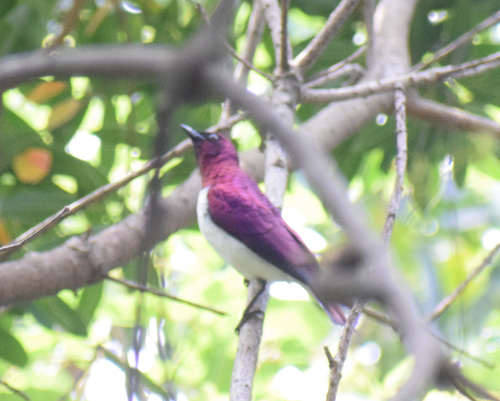 Violet-backed Starling
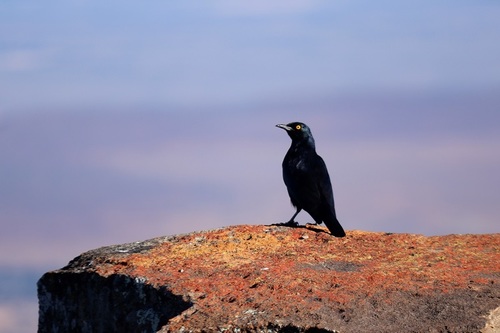 Pale-winged Starling
In short
The most reliable field mark to separate Violet-backed Starling from Pale-winged Starling is the strong sexual dimorphism of the Violet-backed: adult males are strikingly iridescent violet above with pure white underparts, while females are brown and heavily streaked, resembling a thrush. In contrast, Pale-winged Starling lacks this dimorphism and is overall much larger and heavier-bodied. Juvenile and female Violet-backed Starlings are easily mistaken for other streaky starlings, but the Pale-winged never shows such strong streaking. If you see a starling with pale wings, check for body size and overall coloration; if you see a small, thrush-like, streaky starling, it's almost certainly a female or immature Violet-backed. Habitat and behavior can also help: Violet-backed is more arboreal and rarely on the ground, while Pale-winged is more generalist.
Identification tips
- Adult male Violet-backed Starling is unmistakable: Look for an iridescent violet head and back with pure white underparts. No other starling in the region, including Pale-winged, shows this combination. Works for adult males only.
- Females and immatures of Violet-backed are thrush-like: Brown above, heavily streaked above and below. If you see a small, streaky, thrush-like starling, it's almost certainly a female or immature Violet-backed. Pale-winged never shows this pattern.
- Pale-winged Starling lacks strong streaking: Both sexes are similar and do not show the heavy streaking or thrush-like pattern of female/immature Violet-backed. If the bird is plain or only faintly marked, consider Pale-winged.
- Size and build: Pale-winged is much heavier and bulkier (~103 g) than the relatively small Violet-backed (17–18 cm, but lighter). In mixed flocks or with experience, this size difference is obvious.
- Iris color: Violet-backed has yellow irises (both sexes); Pale-winged iris color not specified, so use with caution.
- Bill and legs: Both have black bills and legs; not useful for separation.
- Sexual dimorphism: Only Violet-backed shows strong sexual dimorphism (males and females look very different); Pale-winged sexes are similar.
- Habitat preference: Violet-backed is more arboreal, feeding high in the canopy and rarely on the ground. Pale-winged is a generalist and may be seen at various heights, possibly more often on the ground.
- Geographic range: If you are in southern Africa (Angola, Botswana, Namibia, South Africa), both are possible, but Pale-winged is more likely in arid/open country; Violet-backed is more widespread in woodland and forest edge.
- Behavior: Watch for flycatcher-like insect hawking in Violet-backed; Pale-winged is a generalist omnivore.
- Wing pattern: No specific age-related upperwing or flight pattern marks are described in the notes for either species, so do not rely on this feature.
- Perched vs. flight views: Size, plumage, and streaking are best assessed when perched. In flight, use size and overall coloration, but beware that female/immature Violet-backed can look plain at a distance.
- Mistaking females/immatures: The most common pitfall is confusing female/immature Violet-backed (streaky, thrush-like) for other plain or pale-winged starlings. Always check for heavy streaking and small size.
- Male Violet-backed never resembles Pale-winged: If the bird is violet and white, it's not Pale-winged.
- If in doubt, use a combination: Combine size, plumage (especially streaking and color), habitat, and behavior for the most reliable ID, especially for females and immatures.
Size
Pale-winged Starling is substantially heavier (body mass ~103 g) than Violet-backed Starling (no precise mass in notes, but described as 'relatively small' and 17–18 cm in length) [wikipedia][wikidata]. Violet-backed is noticeably smaller and more delicate, especially compared to the robust, heavyset Pale-winged. This size difference is often apparent in direct comparison or with experience, especially in flight or when perched side by side.
Plumage
- Juvenile/Immature/Female: Violet-backed Starling females and immatures are brown above with bold streaking and white, heavily streaked underparts, resembling a small thrush. Pale-winged Starling never shows such strong streaking or thrush-like patterning at any age or sex.
- Adult Male: Violet-backed adult males are unmistakable: iridescent violet head and back, with pure white underparts. No similar plumage in Pale-winged.
- Adult Pale-winged: Lacks strong sexual dimorphism; both sexes have similar plumage, with no mention of violet or white contrast, and no heavy streaking. The key feature (from name and sources) is the pale wing, but details are not provided in the notes.
- Iris and bare parts: Both have dark bills and legs, but Violet-backed has yellow irises in both sexes; iris color in Pale-winged not specified in notes.
Behaviour
Violet-backed Starling is mostly arboreal, feeding high in the canopy and rarely coming to the ground. It sometimes hawks insects flycatcher-style. Pale-winged Starling is a generalist omnivore, feeding on fruit and insects, but no specific foraging height or style is noted. Violet-backed is more likely to be seen in trees, while Pale-winged may be encountered at various heights and possibly more often on the ground.
Habitat
Violet-backed Starling is widespread in woodlands and savannah forest edges across sub-Saharan Africa, favoring arboreal habitats. Pale-winged Starling is found in Angola, Botswana, Namibia, and South Africa, with no precise habitat details in the notes, but its range is more southern and possibly more arid or open. If you are in dense woodland or forest edge, Violet-backed is more likely; in open or southern habitats, Pale-winged is more probable.
Violet-backed Starling · Pale-winged Starling · My Tricky Birds