

Motmot

Veery vs Swainson's Thrush

Catharus fuscescens versus Catharus ustulatus

Play a quiz with Veery and Swainson's Thrush
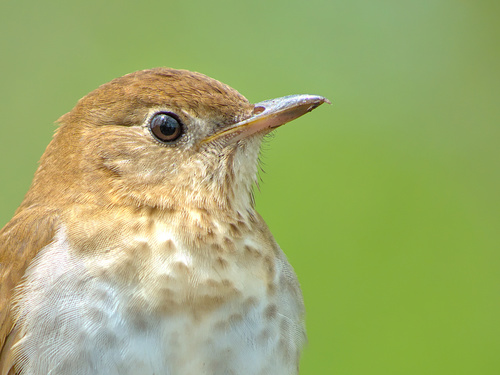
Veery (Catharus fuscescens) Veery
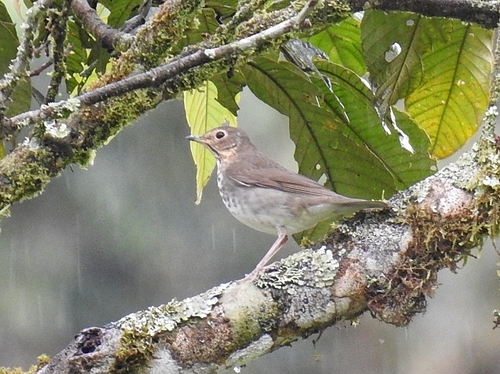
Swainson's Thrush (Catharus ustulatus) Swainson's Thrush

Media

Loading…

In short

The most reliable field mark between Veery and Swainson's Thrush is the pattern and intensity of spotting on the breast: Veery shows faint, blurry, light brown spots on a warm tawny-washed breast, while Swainson's Thrush has darker, more distinct spots on a paler, less tawny breast. Veerys are overall warmer and more cinnamon-toned (especially in the east), with a poorly defined eye ring, while Swainson's Thrush is more olive-brown (east) or russet-backed (west) and has a more prominent pale eye ring. Both species share the Catharus underwing stripe and pink legs, so focus on face and breast pattern for separation. Structure and size are very similar, so field marks are subtle and best seen in good light or with a direct side-by-side comparison.

Identification tips

  1. Breast spotting: Veery has faint, blurry, light brown spots on a warm tawny-washed breast; Swainson's Thrush has darker, more distinct spots on a paler, less tawny breast. This is the most consistent field mark for all ages and seasons.
  2. Overall coloration: Veery is warmer and more cinnamon or light brown above (especially in the east), while Swainson's Thrush is more olive-brown (east) or russet-backed (west). In the west, Swainson's can be quite reddish above, but Veery is never as olive as eastern Swainson's.
  3. Eye ring: Veery's eye ring is poorly defined and faint; Swainson's Thrush has a bold, pale, and complete eye ring, often giving a spectacled look. This is reliable in good light.
  4. Face pattern: Swainson's Thrush often shows a pale, contrasting face with a strong eye ring and pale lores, while Veery's face is plainer and less contrasting.
  5. Underwing stripe: Both species show the Catharus underwing stripe (white-dark-white) in flight, so this is not useful for separation.
  6. Leg color: Both have pink legs; this does not separate them.
  7. Bill shape and color: Both have similar bill shapes and lengths, with overlapping measurements; not a reliable field mark.
  8. Structure and size: Both are similar in size and proportions; do not rely on jizz or bulk.
  9. Song: Swainson's Thrush sings an upward-spiraling, flute-like song; Veery's song is a descending, swirling series of notes. If singing, this is diagnostic.
  10. Habitat: Veery is more likely in dense, damp, deciduous woods near water in the east; Swainson's is widespread, including coniferous forests in the west. However, habitat overlap is broad, so use with caution.
  11. Geographic variation: Eastern Veerys are more cinnamon, western birds more olive-brown and can approach Swainson's in tone, making separation harder in the west—rely on breast spotting and eye ring.
  12. Juvenile/immature plumage: No distinctive age-specific wing or flight marks are described for either species; focus on face and breast pattern at all ages.
  13. Perched vs. in flight: Both species look similar in flight; perched views are best for seeing breast spots and eye ring.
  14. Pitfalls: In poor light or brief views, both can appear plain brown with pale underparts—always look for the combination of breast spotting and eye ring.
  15. Season: Both species are migratory and can overlap on migration; do not rely on season alone for separation.

Size

Both species are nearly identical in size and structure, with Veery measuring 16–19.5 cm in length and Swainson's Thrush 16–20 cm. Veery's mass is typically 26–39 g (exceptionally up to 54 g), while Swainson's Thrush ranges from 23–45 g. Wingspans are also close: Veery averages 28.5 cm, Swainson's Thrush about 30 cm. Bill and tarsus lengths overlap. In the field, neither species appears noticeably larger or bulkier than the other, so size is not a reliable separator.

Plumage

No age-specific upperwing pattern differences are described for either species; both show the Catharus underwing stripe (white-dark-white) in flight, so this is not useful for separation. For all ages, Veery is overall lighter and warmer brown above, especially in eastern birds, with a light tawny wash on the breast and faint, blurry brownish spots. Swainson's Thrush is more olive-brown above in the east or russet-backed in the west, with a paler breast and more distinct, darker spots. The eye ring is poorly defined in Veery but prominent and pale in Swainson's Thrush. Both have white underparts and pink legs. Juvenile and immature plumages are not described as distinctive between these species in the sources.

Behaviour

Both species behave similarly as typical Catharus thrushes: they forage on or near the ground in dense understory, often flicking wings and tails. No behavioral differences are noted in the sources that would reliably separate them in the field.

Habitat

Both species breed in humid deciduous or mixed forests with dense understory, often near water. Veery prefers particularly dense growth close to streams and is more common in the eastern US and southern Canada. Swainson's Thrush is widespread across northern North America, with eastern populations in more olive-brown habitats and western birds in coniferous or mixed forests. Habitat overlap is extensive, so context is only weakly diagnostic unless in the far west (where russet-backed Swainson's is expected).

Voice

Both species have beautiful, flute-like songs, but Swainson's Thrush delivers an ascending, spiraling series of tones, often described as ethereal and upward-spiraling. Veery's song is a descending, swirling, veery-veery-veer sound, softer and more ethereal but not rising. Call notes are not described in detail in the sources, so song is the main vocal clue: upward-spiraling for Swainson's, downward-spiraling for Veery.

Submit a better description

Use the same sections as the comparison. Your text is published immediately.

The most reliable field mark between Veery and Swainson's Thrush is the pattern and intensity of spotting on the breast: Veery shows faint, blurry, light brown spots on a warm tawny-washed breast, while Swainson's Thrush has darker, more distinct spots on a paler, less tawny breast. Veerys are overall warmer and more cinnamon-toned (especially in the east), with a poorly defined eye ring, while Swainson's Thrush is more olive-brown (east) or russet-backed (west) and has a more prominent pale eye ring. Both species share the Catharus underwing stripe and pink legs, so focus on face and breast pattern for separation. Structure and size are very similar, so field marks are subtle and best seen in good light or with a direct side-by-side comparison.

  1. Breast spotting: Veery has faint, blurry, light brown spots on a warm tawny-washed breast; Swainson's Thrush has darker, more distinct spots on a paler, less tawny breast. This is the most consistent field mark for all ages and seasons.
  2. Overall coloration: Veery is warmer and more cinnamon or light brown above (especially in the east), while Swainson's Thrush is more olive-brown (east) or russet-backed (west). In the west, Swainson's can be quite reddish above, but Veery is never as olive as eastern Swainson's.
  3. Eye ring: Veery's eye ring is poorly defined and faint; Swainson's Thrush has a bold, pale, and complete eye ring, often giving a spectacled look. This is reliable in good light.
  4. Face pattern: Swainson's Thrush often shows a pale, contrasting face with a strong eye ring and pale lores, while Veery's face is plainer and less contrasting.
  5. Underwing stripe: Both species show the Catharus underwing stripe (white-dark-white) in flight, so this is not useful for separation.
  6. Leg color: Both have pink legs; this does not separate them.
  7. Bill shape and color: Both have similar bill shapes and lengths, with overlapping measurements; not a reliable field mark.
  8. Structure and size: Both are similar in size and proportions; do not rely on jizz or bulk.
  9. Song: Swainson's Thrush sings an upward-spiraling, flute-like song; Veery's song is a descending, swirling series of notes. If singing, this is diagnostic.
  10. Habitat: Veery is more likely in dense, damp, deciduous woods near water in the east; Swainson's is widespread, including coniferous forests in the west. However, habitat overlap is broad, so use with caution.
  11. Geographic variation: Eastern Veerys are more cinnamon, western birds more olive-brown and can approach Swainson's in tone, making separation harder in the west—rely on breast spotting and eye ring.
  12. Juvenile/immature plumage: No distinctive age-specific wing or flight marks are described for either species; focus on face and breast pattern at all ages.
  13. Perched vs. in flight: Both species look similar in flight; perched views are best for seeing breast spots and eye ring.
  14. Pitfalls: In poor light or brief views, both can appear plain brown with pale underparts—always look for the combination of breast spotting and eye ring.
  15. Season: Both species are migratory and can overlap on migration; do not rely on season alone for separation.

Both species are nearly identical in size and structure, with Veery measuring 16–19.5 cm in length and Swainson's Thrush 16–20 cm. Veery's mass is typically 26–39 g (exceptionally up to 54 g), while Swainson's Thrush ranges from 23–45 g. Wingspans are also close: Veery averages 28.5 cm, Swainson's Thrush about 30 cm. Bill and tarsus lengths overlap. In the field, neither species appears noticeably larger or bulkier than the other, so size is not a reliable separator.

No age-specific upperwing pattern differences are described for either species; both show the Catharus underwing stripe (white-dark-white) in flight, so this is not useful for separation. For all ages, Veery is overall lighter and warmer brown above, especially in eastern birds, with a light tawny wash on the breast and faint, blurry brownish spots. Swainson's Thrush is more olive-brown above in the east or russet-backed in the west, with a paler breast and more distinct, darker spots. The eye ring is poorly defined in Veery but prominent and pale in Swainson's Thrush. Both have white underparts and pink legs. Juvenile and immature plumages are not described as distinctive between these species in the sources.

Both species behave similarly as typical Catharus thrushes: they forage on or near the ground in dense understory, often flicking wings and tails. No behavioral differences are noted in the sources that would reliably separate them in the field.

Both species breed in humid deciduous or mixed forests with dense understory, often near water. Veery prefers particularly dense growth close to streams and is more common in the eastern US and southern Canada. Swainson's Thrush is widespread across northern North America, with eastern populations in more olive-brown habitats and western birds in coniferous or mixed forests. Habitat overlap is extensive, so context is only weakly diagnostic unless in the far west (where russet-backed Swainson's is expected).

Both species have beautiful, flute-like songs, but Swainson's Thrush delivers an ascending, spiraling series of tones, often described as ethereal and upward-spiraling. Veery's song is a descending, swirling, veery-veery-veer sound, softer and more ethereal but not rising. Call notes are not described in detail in the sources, so song is the main vocal clue: upward-spiraling for Swainson's, downward-spiraling for Veery.

Discard your changes?

You have unsaved edits. If you leave now, those changes will be lost.

Veery · Swainson's Thrush · My Tricky Birds