

Uniform Antshrike vs White-shouldered Antshrike
Thamnophilus unicolor versus Thamnophilus aethiops
Play a quiz with Uniform Antshrike and White-shouldered Antshrike
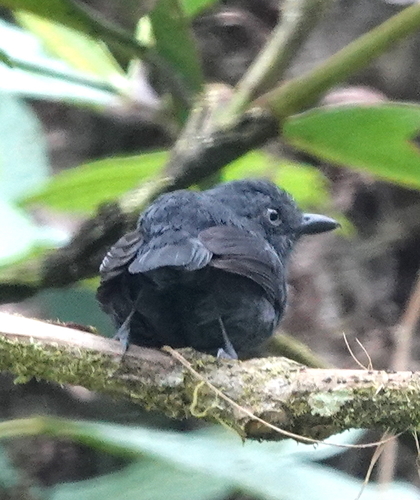 Uniform Antshrike
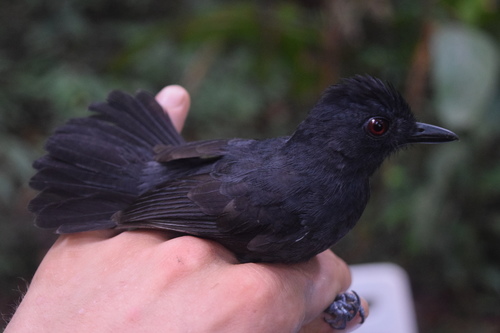 White-shouldered Antshrike
In short
The most reliable field mark to separate Uniform Antshrike from White-shouldered Antshrike is the presence of white spots or patches on the wing coverts and (sometimes) scapulars of White-shouldered Antshrike males and some females, which are absent in Uniform Antshrike of all ages. Uniform Antshrike males are uniformly deep gray or blackish gray, while White-shouldered Antshrike males are black or blackish gray with contrasting white shoulder or wing spots. Females of both species are rufous-brown, but Uniform Antshrike females show a gray face and paler underparts, while White-shouldered Antshrike females are more uniformly deep reddish brown. Immature White-shouldered Antshrikes often show pale wing spots, unlike the more uniform immatures of Uniform Antshrike. Both species are similar in size and structure, but careful attention to wing pattern and subtle plumage differences is key.
Identification tips
- Check for white spots or patches on the wing coverts or scapulars: Present in most male and some female White-shouldered Antshrikes (including immatures), absent in all Uniform Antshrikes. This is the single most reliable mark.
- Look for a white scapular patch: Some White-shouldered Antshrike subspecies (e.g., punctuliger) show a distinct white patch between the scapulars; Uniform Antshrike never does.
- Examine the overall color of the male: Uniform Antshrike males are deep gray or blackish gray with no wing spots; White-shouldered Antshrike males are black or blackish gray with white wing spots and sometimes white on the tail.
- Assess the female plumage: Uniform Antshrike females have a rufous crown, gray face, rufous-brown upperparts, and paler underparts; White-shouldered Antshrike females are deep reddish brown overall, with less contrast between crown, face, and body.
- Immature birds: Immature Uniform Antshrikes resemble adult females and lack wing spots; immature White-shouldered Antshrikes (especially subadult males) show pale wing covert spots, sometimes even when otherwise female-like.
- Tail pattern: Both species may show small white tips on the outer tail feathers in some subspecies, but this is not diagnostic on its own.
- Iris, bill, and legs: Both have a gray-white to whitish gray iris, black bill, and gray or blue-gray legs and feet; not useful for separation.
- Structure: Both are robust, with stout, hooked bills; structure is not a reliable separator.
- Voice: Uniform Antshrike's song is a short, accelerating series of nasal or descending notes; White-shouldered Antshrike's is slower, lower-pitched, and more even. Calls differ subtly, but overlap and variability limit reliability.
- Habitat and range: If outside Colombia, Ecuador, or Peru, Uniform Antshrike is unlikely. In overlap zones, rely on plumage.
- Foraging behavior: Both forage low in dense vegetation; White-shouldered Antshrike may join mixed flocks or follow ant swarms more often, but this is not a strong separator.
- Size: Both are similar in size and weight; do not use as a field mark.
- Season and molt: No seasonal plumage differences are described that aid separation; focus on wing pattern and overall coloration year-round.
- Flight views: In flight, look for white wing spots or scapular patches on White-shouldered Antshrike; Uniform Antshrike will appear plain-winged.
- When in doubt: Any bird with a plain, unmarked gray or rufous-brown appearance and no white on the wing is likely Uniform Antshrike; any bird with white wing spots or a scapular patch is White-shouldered Antshrike.
Size
Both species are similar in length (Uniform Antshrike: 14.5–17 cm; White-shouldered Antshrike: 15–17 cm) and mass (Uniform Antshrike: ~24 g; White-shouldered Antshrike: 23–30 g) [wikipedia][wikidata]. There is no reliable size difference in the field; both are robust, medium-sized antshrikes with stout hooked bills typical of the genus.
Plumage
The most diagnostic difference is in the wing coverts and scapulars, especially in males and immatures. White-shouldered Antshrike males (most subspecies) show small white spots or patches on the wing coverts and sometimes scapulars, visible both perched and in flight; some subspecies also have white tips on the outer tail feathers. Immature and subadult males resemble adult females but retain pale wing covert spots. Females are deep reddish brown overall. In contrast, Uniform Antshrike males are entirely deep gray or blackish gray, with no white spots on the wings (though some may have small white tips on outer tail feathers). Females have a rufous crown, gray face, rufous-brown upperparts, and paler rufous-brown underparts. Immatures of both sexes resemble adult females and lack wing spots. Thus, any bird with pale wing covert spots or a white scapular patch is a White-shouldered Antshrike, regardless of age. Uniform Antshrike is always plain-winged, and females/immatures are paler below and have a grayish face.
Behaviour
Both species forage in dense vegetation, usually singly or in pairs, and seldom join mixed-species flocks. Uniform Antshrike is especially solitary, rarely joining mixed flocks, while White-shouldered Antshrike (nominate subspecies) may do so more often in Ecuador and Peru. Both species forage by hopping among branches and gleaning prey, sometimes making short flights. White-shouldered Antshrike has been observed following army ant swarms, but this is rare.
Habitat
Both species occur in humid forests of the western Amazon and Andean foothills, but their ranges only overlap in Colombia, Ecuador, and Peru. White-shouldered Antshrike is more widespread, occurring also in Bolivia, Brazil, and Venezuela. Habitat preferences are similar: dense undergrowth, often foraging low but sometimes up to 8 m above ground. In areas of overlap, careful attention to plumage is needed.
Voice
Both species give series of nasal or gruff notes, but Uniform Antshrike's song is typically a short, slightly accelerating series of 3–8 high, descending notes ("NYAH NYAH-nyah-nyah"), sometimes with a rising inflection. Its calls include a rattled bark and descending caws. White-shouldered Antshrike's song is a slower, low-pitched series of even, complaining notes ("anh...anh...anh..."), sometimes likened to a trogon or forest-falcon, and the female's song is higher-pitched. Its calls are abrupt, throaty "cuck" notes, caws, nasal twangs, and growls. The difference in song pacing and pitch can help, but overlap and variation make voice a secondary field mark.
Uniform Antshrike · White-shouldered Antshrike · My Tricky Birds