

Tristram's Storm-Petrel vs Bonin Petrel
Hydrobates tristrami versus Pterodroma hypoleuca
Play a quiz with Tristram's Storm-Petrel and Bonin Petrel
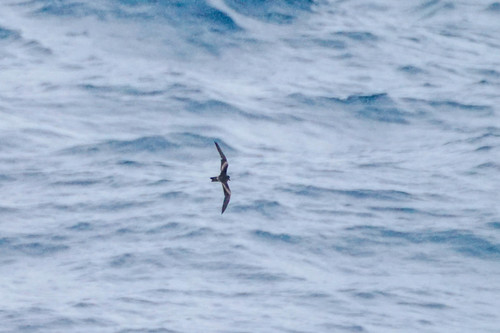 Tristram's Storm-Petrel
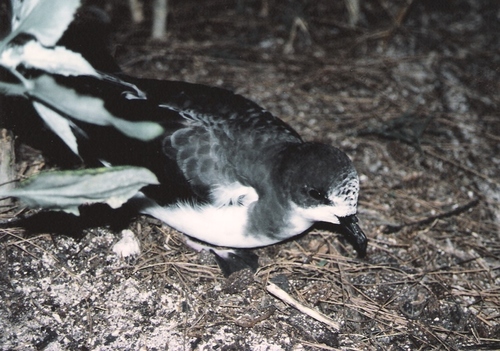 Bonin Petrel
In short
The most reliable field mark to separate Tristram's Storm-Petrel from Bonin Petrel is overall plumage: Tristram's is uniformly dark with only a slightly paler rump and faint upperwing bar, while Bonin Petrel is strikingly pale below and on the face, with a bold black cap, white underwings with dark edges, and a distinctive 'M' pattern across the upperwings. In flight, Bonin Petrel's contrasting wing and underpart patterns are unmistakable against the sooty, almost featureless Tristram's. Structurally, Tristram's is smaller and more angular-winged, while Bonin Petrel is bulkier with a stubbier bill. Both species may occur together in the northwest Pacific, especially around breeding islands, but confusion is most likely with distant or poorly lit views. Focus on underwing and head pattern for the quickest separation.
Identification tips
- Underwing pattern (all ages): Bonin Petrel shows a white underwing with dark edges and a dark carpal patch, while Tristram's Storm-Petrel has uniformly dark underwings with only a faint pale bar—this is the fastest way to separate them in flight.
- Head pattern: Bonin Petrel has a white face with a bold black cap and face markings, creating a 'scaled' look; Tristram's Storm-Petrel's head is uniformly dark, lacking any pale or capped effect.
- Upperwing pattern: Look for the 'M' pattern across Bonin Petrel's upperwings and back, formed by darker primaries and coverts against paler grey upperparts. Tristram's Storm-Petrel is sooty overall, with only a faint pale grey bar on the upperwing and no 'M' or strong contrast.
- Breast and belly: Bonin Petrel is white below with a dark half-collar on the breast; Tristram's is dark sooty brown all over, including the underparts.
- Rump: Tristram's Storm-Petrel may show a slightly paler rump, but it is subtle and not as contrasting as the Bonin Petrel's white underparts.
- Bill structure: Bonin Petrel has a short, hooked black bill; Tristram's Storm-Petrel's bill is stouter but not as obviously hooked—this is subtle at distance.
- Legs and feet: Bonin Petrel has pink legs and feet with dark patches, sometimes visible when landing or in photos; Tristram's leg color is not distinctive in field views.
- Flight style: Tristram's Storm-Petrel is more fluttery and buoyant with long, angular wings; Bonin Petrel is heavier, with deeper wingbeats and more gliding.
- Size and jizz: Bonin Petrel is noticeably larger and bulkier, but this is best judged when both species are seen together.
- Perched/colony views: Bonin Petrel's pale face and dark cap are obvious when seen at burrow entrances; Tristram's appears uniformly dark.
- Seasonal context: Both breed in winter and attend colonies at night, so timing alone does not separate them.
- Habitat clues: Dense burrow colonies in sand or coral suggest Bonin Petrel, but both species may overlap on some islands.
- Common pitfalls: Distant or backlit Bonin Petrels may appear darker, but the white underwing flashes should still be visible; Tristram's never shows strong contrast.
- Juvenile confusion: No age of Tristram's Storm-Petrel shows the pale underparts or bold wing pattern of Bonin Petrel juveniles or adults.
- Lighting: Poor light can obscure Bonin Petrel's pale areas, but the underwing pattern is usually still diagnostic in flight.
Size
Tristram's Storm-Petrel is smaller and lighter, with a body mass around 84 g and a wingspan of 54–57 cm. Bonin Petrel is larger overall, reaching about 30 cm in length and a wingspan of approximately 67 cm. In the field, Bonin Petrel appears bulkier and more robust, while Tristram's is more slender and elongated, especially in the wings. The difference in size is noticeable in direct comparison, but may be subtle at sea without a reference.
Plumage
Juvenile and adult Bonin Petrels are pale below, with a white face, black cap, and a dark half-collar on the breast. Their upperparts are pale grey with a bold dark 'M' across the back and wings, and the underwing is white with dark margins and a dark patch at the carpal joint. In contrast, Tristram's Storm-Petrel of all ages is almost entirely dark sooty brown, with only a slightly paler rump and a faint pale grey bar on the upperwing. The lack of strong contrast, especially on the underwing and face, is diagnostic for Tristram's. These differences are most obvious in flight, where Bonin Petrel's white underparts and patterned wings stand out against Tristram's uniform darkness.
Behaviour
Both species are pelagic and attend colonies at night, but Bonin Petrel is more likely to be seen in dense, noisy colonies and is known for digging long burrows in sand or coral. Tristram's Storm-Petrel is more strictly nocturnal at colonies and tends to be more secretive. In flight, Tristram's shows long, angular wings and a lighter, more buoyant flight style, while Bonin Petrel appears heavier and more direct, with deeper wingbeats. At sea, Bonin Petrel may be seen gliding and banking, showing off its contrasting plumage, while Tristram's is more fluttery and less likely to show strong patterning.
Habitat
Both species breed on remote islands in the northwest Pacific, including the Northwestern Hawaiian Islands and islands south of Japan. Bonin Petrel prefers sandy or coral substrates for burrowing, while Tristram's Storm-Petrel nests colonially in similar areas but is less tied to burrow-digging. At sea, both are pelagic and overlap in range, but Bonin Petrel may be more likely to be seen closer to breeding islands during the nesting season. Habitat alone is not diagnostic, but context (e.g., presence in dense burrow colonies) may hint at Bonin Petrel.