

Tristan Albatross vs Antipodean Albatross
Diomedea dabbenena versus Diomedea antipodensis
Play a quiz with Tristan Albatross and Antipodean Albatross
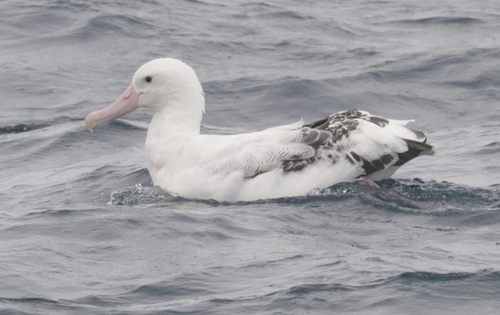 Tristan Albatross
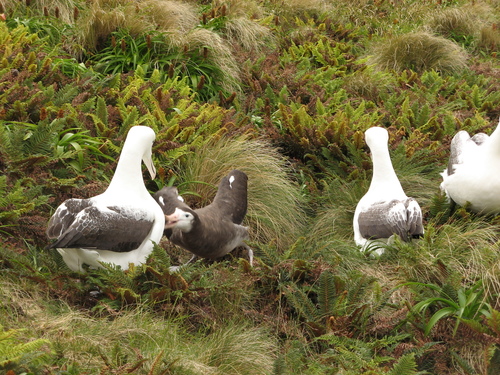 Antipodean Albatross
In short
The most reliable field mark between Tristan Albatross and Antipodean Albatross is the overall darkness and patterning of the upperparts, especially in breeding and immature plumages. Antipodean Albatrosses, especially females and immatures, show distinctly browner upperparts with white vermiculations and a brown breast band, while Tristan Albatrosses are slightly darker-backed than snowy albatrosses but never as brown as Antipodeans. Both are large, pale great albatrosses, but Antipodean is generally browner and less white overall, and Tristan never achieves the full white of snowy albatrosses. Bill color and pattern can help, but is subtle and often unreliable at sea. Separation is most difficult in immatures and non-breeding birds, so careful attention to upperpart color and underwing pattern is essential.
Identification tips
- Upperpart color (all ages): Antipodean Albatross, especially females and immatures, shows distinctly browner upperparts with white vermiculations; Tristan is never as brown, appearing dusky but plainer above.
- Breast band (adult female Antipodean): Look for a dark brown breast band on adult female Antipodean; Tristan lacks this feature.
- Back vermiculations (Antipodean): Fine white vermiculations on the brown back of Antipodean are absent in Tristan.
- Cap, tail, and humeral flexure (male Antipodean): Breeding male Antipodean has a darker cap, tail, and humeral flexure than Tristan.
- Underwing pattern: Both have white underwings with a dark tip, but this is not strongly diagnostic between them; focus on upperparts instead.
- Bill color and pattern: Both have pink bills, but some Antipodean (especially immatures/females) show a dusky tip to the lower mandible and sometimes a dark cutting edge to the upper mandible. Tristan's bill is shorter than snowy albatross, but not reliably different from Antipodean in the field.
- Overall whiteness (adults): Tristan never attains the full white of snowy albatross, but is still whiter than most Antipodean, which remain browner even as adults.
- Immature confusion: Both species' immatures resemble young snowy albatrosses, but Antipodean is browner and more patterned; Tristan is plainer and less white than snowy, but not as brown as Antipodean.
- Sex differences (Antipodean): Females are browner with breast band; males are whiter but still not as white as snowy or Tristan.
- Size and structure: Both are huge, long-winged albatrosses with similar proportions; size is not a reliable separator.
- Flight style: Both soar with minimal flapping; no behavioral difference noted.
- Habitat/context: Only helpful if near breeding islands (Tristan: Gough; Antipodean: Antipodes/Campbell), otherwise not diagnostic at sea.
- Do not rely on voice: No vocal differences are noted or useful at sea.
- Pitfall – snowy albatross confusion: Both can be confused with snowy albatross, but snowy is whiter; between Tristan and Antipodean, focus on brown tones and breast band for Antipodean.
- Lighting pitfalls: Bill pattern (dusky tip/edge) on Antipodean can be exaggerated by strong backlighting; use with caution and confirm with plumage.
Size
Both species are among the largest albatrosses, with similar body lengths (about 110 cm/43 in). Tristan Albatross is slightly smaller than the snowy albatross but similar in size to Antipodean Albatross. There is no strong size difference between Tristan and Antipodean in the field, and both have massive wingspans (Tristan up to 3.05 m/10 ft). Bill length is a subtle difference: Tristan's bill is about 25 mm shorter than snowy albatross, but this is not a reliable field mark when comparing Tristan and Antipodean directly. Overall, size is not a practical separator between these two.
Plumage
Juveniles and immatures of both species can be confusing, as both resemble young snowy albatrosses. However, Antipodean Albatrosses, especially females and immatures, are noticeably browner above, with white vermiculations on the back, a brown breast band (females), and a darker cap, tail, and humeral flexure (males). Their underwings are white with a dark tip. Tristan Albatrosses are slightly darker-backed than snowy albatrosses but never as brown as Antipodean; they do not develop the full white adult plumage of snowy albatross, so always appear somewhat dusky above, but lack the strong brown tones and vermiculations of Antipodean. Bill pattern can help: some Antipodean, especially immatures and females, show a dusky tip to the lower mandible and sometimes a dark cutting edge to the upper mandible, but both species have pink bills. In summary, Antipodean is browner and more patterned above, especially in females and immatures, while Tristan is plainer and less white than snowy albatross but not as brown as Antipodean.
Behaviour
Both species are classic great albatrosses, soaring with stiff, slightly arched wings and rarely flapping except in strong winds or when taking off. No behavioral differences are noted in the sources that would reliably separate Tristan from Antipodean in the field.
Habitat
Both species are pelagic and occupy vast oceanic ranges, with Tristan Albatross breeding on Gough Island and Antipodean Albatross breeding on the Antipodes and Campbell Islands. At sea, their ranges do not overlap significantly, but vagrants are possible. Habitat is not a reliable separator unless you are near a known breeding island.