

Motmot

Townsend's Storm-Petrel vs Ainley's Storm-Petrel

Hydrobates socorroensis versus Hydrobates cheimomnestes

Play a quiz with Townsend's Storm-Petrel and Ainley's Storm-Petrel
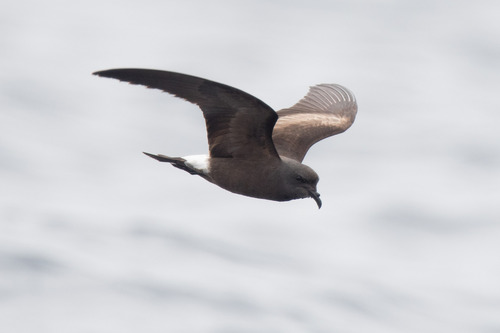
Townsend's Storm-Petrel (Hydrobates socorroensis) Townsend's Storm-Petrel
Ainley's Storm-Petrel (Hydrobates cheimomnestes) Ainley's Storm-Petrel

Media

Loading…

In short

The most reliable way to separate Townsend's and Ainley's Storm-Petrels in the field is by their timing and location on Guadalupe Island: Townsend's breeds in summer, Ainley's in winter. Structurally and in plumage, these two are extremely similar, both showing dark sooty-brown to blackish plumage with a white rump patch, moderately long forked tails, and long wings. Ainley's may show a slightly browner tone in worn pre-moult plumage, and its rump patch is described as U-shaped with a central poorly defined dark area. In practice, field separation based on appearance alone is extremely challenging and often not possible without close or in-hand views, so context and season are crucial.

Identification tips

  1. Breeding season timing is the most reliable field clue: If you encounter storm-petrels on Guadalupe Island, those present in summer are Townsend's, while those in winter are Ainley's. This is the single most practical separation in the field.
  2. Rump patch shape: Ainley's is described as having a U-shaped white rump patch with a central, poorly defined dark area. If you have excellent views or photos, look for this pattern, but be aware that this is subtle and may not always be visible or diagnostic.
  3. Plumage tone in worn birds: Pre-moult adult Ainley's can appear more brownish when the plumage is worn, compared to the generally blackish look of Townsend's. However, this difference is slight and can be affected by lighting and wear in both species.
  4. Overall coloration: Both species are dark sooty-brown to blackish, so do not rely on general color for separation unless the brown tone in Ainley's is obvious and you have context for wear.
  5. Tail and wing structure: Both have moderately long, forked tails and long wings with blunt points. These features are not useful for separating the two, but can help rule out other storm-petrel species.
  6. Feet projection: In both species, the feet do not extend beyond the tail in flight, so this is not a separating mark.
  7. Bill, legs, and feet color: All are black in both species; not useful for separation.
  8. Juvenile and immature plumage: No distinctive juvenile or immature upperwing or flight marks are described for either species, so age does not provide a field separation.
  9. Geographic range outside breeding: Townsend's is more likely north to southern California and south to 10°N, while Ainley's ranges south to the Galápagos. If seen well outside the breeding context, consider the broader range, but overlap is possible.
  10. Colony behavior: Both nest in crevices and burrows and are nocturnal at colonies; this does not help with field ID.
  11. Voice: No vocal differences are described in the sources, so do not rely on calls or songs.
  12. Abundance: Both are rare and local breeders on Guadalupe Island, with Ainley's possibly numbering only a few thousand birds. If you are birding in the area, check the season and context carefully.
  13. Pitfalls: Most field marks are subtle and unreliable without close study or in-hand examination. Do not overinterpret slight differences in rump patch shape or brownish tones unless you have strong supporting context (season, location).

Size

Both species are medium-sized storm-petrels, with Ainley's described as about 18 cm (7.1 in) long, and no direct measurement given for Townsend's in the sources. Both have fairly long wings and moderately long, forked tails. There is no documented size difference that is useful in the field between these two species.

Plumage

For all ages, both species are generally dark sooty-brown to blackish, with a white rump patch. Ainley's Storm-Petrel's rump patch is described as U-shaped with a central, poorly defined dark area, which may be a subtle distinction from Townsend's, but this is not stated as unique or always reliable. Pre-moult adult Ainley's may appear more brownish when the plumage is worn, but this is a subtle and variable mark. Both species have black beaks, legs, and feet, and the feet do not extend beyond the tail in flight. There are no notes on distinctive juvenile or immature wing patterns for either species, so age-specific flight marks are not diagnostic here.

Behaviour

Both species are pelagic and spend much of their lives over open ocean, returning to breed on Guadalupe Island. At breeding colonies, Ainley's is nocturnal and nests in crevices and burrows, similar to other storm-petrels. Their flight and foraging behavior are likely very similar, and there are no behavioral distinctions noted that would help in field identification.

Habitat

Both species breed on Guadalupe Island, but at different times of year: Townsend's in summer, Ainley's in winter. Outside the breeding season, Townsend's ranges north to southern California and south to 10°N latitude in the Eastern Pacific, while Ainley's ranges south to the Galápagos Islands and is found off the Baja California Peninsula during breeding. Both are strictly pelagic away from breeding sites, so habitat overlap is high except for the timing of breeding.

Submit a better description

Use the same sections as the comparison. Your text is published immediately.

The most reliable way to separate Townsend's and Ainley's Storm-Petrels in the field is by their timing and location on Guadalupe Island: Townsend's breeds in summer, Ainley's in winter. Structurally and in plumage, these two are extremely similar, both showing dark sooty-brown to blackish plumage with a white rump patch, moderately long forked tails, and long wings. Ainley's may show a slightly browner tone in worn pre-moult plumage, and its rump patch is described as U-shaped with a central poorly defined dark area. In practice, field separation based on appearance alone is extremely challenging and often not possible without close or in-hand views, so context and season are crucial.

  1. Breeding season timing is the most reliable field clue: If you encounter storm-petrels on Guadalupe Island, those present in summer are Townsend's, while those in winter are Ainley's. This is the single most practical separation in the field.
  2. Rump patch shape: Ainley's is described as having a U-shaped white rump patch with a central, poorly defined dark area. If you have excellent views or photos, look for this pattern, but be aware that this is subtle and may not always be visible or diagnostic.
  3. Plumage tone in worn birds: Pre-moult adult Ainley's can appear more brownish when the plumage is worn, compared to the generally blackish look of Townsend's. However, this difference is slight and can be affected by lighting and wear in both species.
  4. Overall coloration: Both species are dark sooty-brown to blackish, so do not rely on general color for separation unless the brown tone in Ainley's is obvious and you have context for wear.
  5. Tail and wing structure: Both have moderately long, forked tails and long wings with blunt points. These features are not useful for separating the two, but can help rule out other storm-petrel species.
  6. Feet projection: In both species, the feet do not extend beyond the tail in flight, so this is not a separating mark.
  7. Bill, legs, and feet color: All are black in both species; not useful for separation.
  8. Juvenile and immature plumage: No distinctive juvenile or immature upperwing or flight marks are described for either species, so age does not provide a field separation.
  9. Geographic range outside breeding: Townsend's is more likely north to southern California and south to 10°N, while Ainley's ranges south to the Galápagos. If seen well outside the breeding context, consider the broader range, but overlap is possible.
  10. Colony behavior: Both nest in crevices and burrows and are nocturnal at colonies; this does not help with field ID.
  11. Voice: No vocal differences are described in the sources, so do not rely on calls or songs.
  12. Abundance: Both are rare and local breeders on Guadalupe Island, with Ainley's possibly numbering only a few thousand birds. If you are birding in the area, check the season and context carefully.
  13. Pitfalls: Most field marks are subtle and unreliable without close study or in-hand examination. Do not overinterpret slight differences in rump patch shape or brownish tones unless you have strong supporting context (season, location).

Both species are medium-sized storm-petrels, with Ainley's described as about 18 cm (7.1 in) long, and no direct measurement given for Townsend's in the sources. Both have fairly long wings and moderately long, forked tails. There is no documented size difference that is useful in the field between these two species.

For all ages, both species are generally dark sooty-brown to blackish, with a white rump patch. Ainley's Storm-Petrel's rump patch is described as U-shaped with a central, poorly defined dark area, which may be a subtle distinction from Townsend's, but this is not stated as unique or always reliable. Pre-moult adult Ainley's may appear more brownish when the plumage is worn, but this is a subtle and variable mark. Both species have black beaks, legs, and feet, and the feet do not extend beyond the tail in flight. There are no notes on distinctive juvenile or immature wing patterns for either species, so age-specific flight marks are not diagnostic here.

Both species are pelagic and spend much of their lives over open ocean, returning to breed on Guadalupe Island. At breeding colonies, Ainley's is nocturnal and nests in crevices and burrows, similar to other storm-petrels. Their flight and foraging behavior are likely very similar, and there are no behavioral distinctions noted that would help in field identification.

Both species breed on Guadalupe Island, but at different times of year: Townsend's in summer, Ainley's in winter. Outside the breeding season, Townsend's ranges north to southern California and south to 10°N latitude in the Eastern Pacific, while Ainley's ranges south to the Galápagos Islands and is found off the Baja California Peninsula during breeding. Both are strictly pelagic away from breeding sites, so habitat overlap is high except for the timing of breeding.

Discard your changes?

You have unsaved edits. If you leave now, those changes will be lost.

Townsend's Storm-Petrel · Ainley's Storm-Petrel · My Tricky Birds