

Tennessee Warbler vs Orange-crowned Warbler
Leiothlypis peregrina versus Leiothlypis celata
Play a quiz with Tennessee Warbler and Orange-crowned Warbler
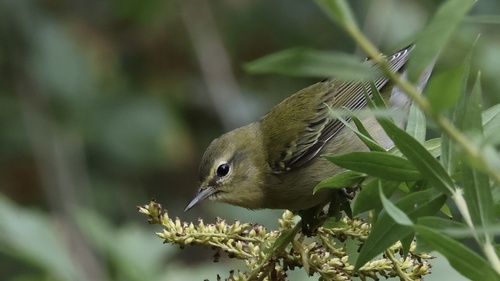 Tennessee Warbler
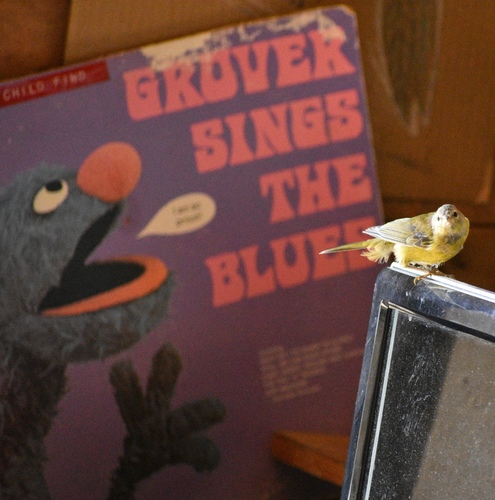 Orange-crowned Warbler
In short
The most reliable field mark to separate Tennessee Warbler from Orange-crowned Warbler is the presence of a crisp, pale eyebrow (supercilium) and clean white undertail coverts in Tennessee, versus the Orange-crowned's faint, broken eye ring and yellow undertail coverts. Tennessee Warbler often shows a sharper contrast between the gray head and olive back (especially in breeding males), while Orange-crowned Warbler is more uniformly olive-gray above and yellowish below with faint streaking. Both species lack wing bars, but Tennessee Warbler typically appears cleaner and brighter, especially below. Immature and fall birds are trickier, but the Tennessee's white undertail coverts and more prominent eyebrow remain useful. Structure is similar, but Tennessee may look longer-winged and shorter-tailed.
Identification tips
- Eyebrow vs Eye Ring: Tennessee Warbler shows a strong, pale yellowish eyebrow (supercilium) above the eye, most obvious in all plumages, while Orange-crowned Warbler has only a faint, broken eye ring and a faint line above the eye. This is the single most consistent field mark.
- Undertail Coverts: Tennessee Warbler always has clean white undertail coverts, contrasting with the rest of the underparts. Orange-crowned Warbler has yellow undertail coverts, blending with the yellowish belly. Check this feature when the bird is flitting or flicking its tail.
- Face Pattern: Tennessee Warbler's face looks cleaner and more contrasting, with a grayish crown and nape (in males) and a crisp eyebrow. Orange-crowned Warbler's face is plainer, with no strong markings and a more uniform olive-gray tone.
- Upperparts Color: Tennessee Warbler (especially males) shows a sharp contrast between the gray crown/nape and olive back. Orange-crowned Warbler is more uniformly olive-gray above, with no sharp contrast.
- Underparts: Tennessee Warbler is usually cleaner below, with gray-white or yellow-washed underparts but little or no streaking. Orange-crowned Warbler has yellowish underparts with faint streaking, especially on the breast and flanks.
- Wing Bars: Both species lack wing bars, so this is not useful for separation, but be aware that some other confusing warblers (like Black-throated Blue) do show wing spots.
- Bill Shape: Both have thin, pointed bills, but Tennessee's may look slightly finer and longer. This is subtle and not always reliable.
- Tail and Wing Structure: Tennessee Warbler may appear longer-winged and shorter-tailed than Orange-crowned, especially when perched. This is a minor structural clue.
- Juvenile/Immature Birds: Young Tennessee Warblers are duller but still show the white undertail and eyebrow; young Orange-crowned are even plainer and lack these marks.
- Sex and Seasonal Variation: Female and non-breeding Tennessee Warblers are duller, with more yellow and olive, but the white undertail and eyebrow remain. Orange-crowned Warbler females and immatures are the dullest, with the least facial contrast.
- Crown Patch: The orange crown patch of Orange-crowned Warbler is rarely visible and should not be relied on.
- Habitat/Range: Where both occur, habitat is not a separator, but Tennessee Warbler is more likely in the east and Orange-crowned in the west during breeding season.
- Voice: Orange-crowned's descending trill is distinctive if heard, but Tennessee's vocalizations are not detailed here.
- Comparison with Other Species: Both can be confused with other warblers; Tennessee is sometimes mistaken for female Black-throated Blue (which has wing spots) or Red-eyed Vireo (which is larger and moves more slowly). Orange-crowned is often confused with Tennessee in fall, but lacks the crisp facial pattern and white undertail.
- Pitfalls: In poor light or quick views, both can look plain and greenish-yellow. Focus on undertail coverts and facial pattern for the best chance at a correct ID.
Size
Both species are very close in size, with Tennessee Warbler averaging about 9.6g in body mass [wikidata]. Length and proportions are similar, though Tennessee Warbler may appear a bit longer-winged and shorter-tailed. In the field, size is not a reliable separator between these two.
Plumage
Juvenile and first-year Tennessee Warblers resemble adult females and fall adults, showing a duller olive and yellow wash, but always retain crisp white undertail coverts and a clear yellowish eyebrow. Orange-crowned Warblers (all ages) lack the bright eyebrow, instead showing a faint, broken eye ring and a faint line over the eye, and have yellow undertail coverts. Adult male Tennessee Warblers in spring have a striking gray crown and nape, olive back, and white-gray underparts, while females and non-breeding birds are duller but still show more contrast and a cleaner face than Orange-crowned. Orange-crowned Warblers are more uniformly olive-gray above and yellowish below, with faint streaking on the underparts and no strong face markings. The orange crown patch is rarely visible in the field. Western Orange-crowned Warblers are yellower overall, but still lack the Tennessee's crisp facial pattern and white undertail.
Behaviour
Both species are active foragers in shrubs and trees, moving quickly through foliage. Tennessee Warbler may appear more energetic and is sometimes described as having a shorter tail and longer wings, but behavioral differences are subtle and not reliable for separation. Both can be found in mixed warbler flocks during migration.
Habitat
Tennessee Warbler breeds in eastern North America and migrates through a wide range, wintering in Central and northern South America. Orange-crowned Warbler has a broader North American range, breeding farther west and north, and winters in the southern US and Mexico. Both use similar shrubby or woodland habitats during migration, so habitat alone is not a strong separator where ranges overlap.
Voice
Orange-crowned Warbler gives a descending trill for its song and a high chip call. Tennessee Warbler's song and calls are not described in the provided notes, so vocalizations are not a reliable separator here.
Tennessee Warbler · Orange-crowned Warbler · My Tricky Birds