

Tenerife Blue Chaffinch vs Gran Canaria Blue Chaffinch
Fringilla teydea versus Fringilla polatzeki
Play a quiz with Tenerife Blue Chaffinch and Gran Canaria Blue Chaffinch
 Tenerife Blue Chaffinch
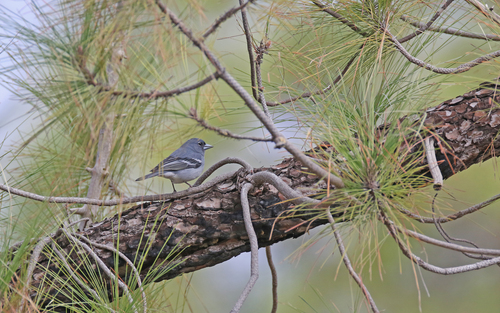 Gran Canaria Blue Chaffinch
In short
The most reliable field mark to separate these two blue chaffinches is the presence of two distinct white wing bars on the Gran Canaria Blue Chaffinch, which are absent or much weaker on the Tenerife Blue Chaffinch. Adult males of both species are blue, but the Gran Canaria bird is paler below and less extensively blue, while the Tenerife male is a deeper, more uniform blue. Females of both species are dull grey-brown, but the Gran Canaria female has stronger wing bars. Size is also helpful: Tenerife Blue Chaffinch is noticeably larger and bulkier, with a thicker bill. These differences are best seen at close range or in good light, but even at a distance, the wing bars and overall size can often be picked out.
Identification tips
- White wing bars: Gran Canaria Blue Chaffinch always shows two clear white wing bars on the closed wing, visible in all plumages and ages. Tenerife Blue Chaffinch has much weaker or absent wing bars—this is the fastest way to separate them at any age.
- Overall size and bulk: Tenerife Blue Chaffinch is noticeably larger and bulkier, especially in the head and bill. If you see a robust, heavy-headed blue chaffinch, it is likely Tenerife.
- Bill thickness: The bill of Tenerife Blue Chaffinch is thicker and heavier than that of Gran Canaria, especially obvious in males.
- Male plumage (breeding): Tenerife Blue Chaffinch males are a deep, uniform blue with a grey bill and no dark cap. Gran Canaria males are paler below, with less blue overall and a whiter belly.
- Female plumage: Both are dull grey-brown, but Gran Canaria females have stronger, more obvious white wing bars. Tenerife females are plainer with weak or absent wing bars.
- Perched vs. in flight: The white wing bars of Gran Canaria Blue Chaffinch are visible both when perched and in flight. Always check for these bars if the bird flushes or moves its wings.
- Absence of dark cap: Both species lack the dark cap of common chaffinch, but this does not help separate them from each other.
- Location: If you are on Tenerife, you are seeing Tenerife Blue Chaffinch; if on Gran Canaria (especially in Inagua, Ojeda, Pajonales), it is Gran Canaria Blue Chaffinch. Range is a strong clue due to their strict endemism.
- Plumage uniformity: Tenerife Blue Chaffinch is more uniform in color, especially in males, while Gran Canaria birds are paler below and less blue overall.
- Wing pattern in juveniles/immatures: Even in young birds, the white wing bars of Gran Canaria Blue Chaffinch should be visible and are a key mark.
- Bill color: Breeding male Tenerife Blue Chaffinch has a grey bill, which can help in close views.
- Habitat context: Both are found in mature pine forests, but Gran Canaria Blue Chaffinch is extremely restricted—if you are outside the Inagua pine forests, you are unlikely to see it.
- Relative abundance: Tenerife Blue Chaffinch is more widespread and common within its range; Gran Canaria Blue Chaffinch is critically endangered and extremely localized.
- No reliable vocal differences: No vocal distinctions are noted in the sources, so do not rely on calls or song for separation.
- Common pitfalls: Weak wing bars on a dull female or immature may suggest Tenerife, but always check for even faint white bars to avoid confusion with Gran Canaria birds.
Size
Tenerife Blue Chaffinch is consistently larger: males weigh 31–33 g and females 28–30 g, compared to Gran Canaria Blue Chaffinch males at 27–29 g and females at 26–28 g [wikipedia]. In the field, Tenerife birds look bulkier and more robust, especially in the head and bill. This size difference can be subtle unless both are seen side by side, but in direct comparison, Tenerife birds have a noticeably heavier build.
Plumage
- Juvenile and immature birds: No specific juvenile/immature wing pattern details are given, but the Gran Canaria Blue Chaffinch of all ages shows two clear white wing bars, which are much weaker or absent in Tenerife Blue Chaffinch. This is the most consistent field mark in all plumages.
- Adult males: Tenerife Blue Chaffinch males are a deep, uniform blue with a grey bill and lack a dark cap. Gran Canaria males are paler below, with less blue overall and a whiter belly, and show two white wing bars.
- Females: Both are dull grey-brown, but Gran Canaria females have stronger, more obvious wing bars than Tenerife females, whose wing bars are weak or barely visible. Both lack the dark cap of common chaffinch.
- Bill: Tenerife Blue Chaffinch has a noticeably thicker bill in all plumages.
- Perched and in flight: The white wing bars of Gran Canaria Blue Chaffinch are visible both perched and in flight, and the paler underparts contrast with the more uniform blue or grey of Tenerife birds.
Behaviour
Both species behave similarly, feeding mainly on pine seeds and foraging in the canopy and on the ground. There are no strong behavioral differences noted for field identification. Both are non-migratory and breed in pine forests, and both feed their young insects. In the field, their movements and feeding style are not reliable for separation.
Habitat
Both species are restricted to their respective islands and are found in mature Canary Island pine (Pinus canariensis) forests. Tenerife Blue Chaffinch is more widespread across Tenerife, while Gran Canaria Blue Chaffinch is extremely localized, found only in the highland pine forests of Inagua, Ojeda, and Pajonales on Gran Canaria. If you are outside these specific areas, the species present is almost certainly the local endemic.
Tenerife Blue Chaffinch · Gran Canaria Blue Chaffinch · My Tricky Birds