

Temminck's Sunbird vs Crimson Sunbird
Aethopyga temminckii versus Aethopyga siparaja
Play a quiz with Temminck's Sunbird and Crimson Sunbird
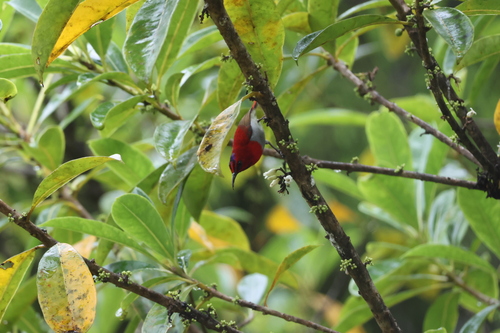 Temminck's Sunbird
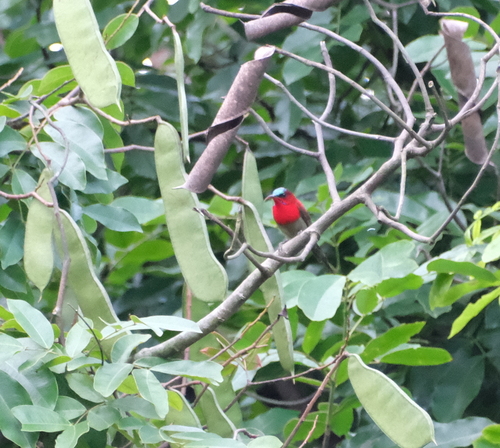 Crimson Sunbird
In short
The most reliable field mark between Temminck's Sunbird and Crimson Sunbird is the male's head and back coloration: Temminck's male shows a mostly scarlet body with four distinct purple head stripes and yellow and purple bands above the tail, while Crimson Sunbird males have a crimson breast, maroon back, and black malar stripes. Females are trickier, but Temminck's female is drab olive with rufous wing and tail fringes, whereas Crimson Sunbird females are olive-green above with a yellowish breast and white tips to the outer tail feathers. Both species are similar in size and structure, but subtle differences in tail length and color pattern, especially in males, are key. Habitat can also help: Temminck's is a montane specialist, while Crimson Sunbird is more widespread.
Identification tips
- Adult male head pattern: Temminck's Sunbird males have four purple bands radiating from the bill across the head, a unique feature not seen in Crimson Sunbird. Look for these lines in good light.
- Adult male back and rump: Temminck's has yellow and purple bands between the back and tail, while Crimson Sunbird males have a maroon back and yellow rump. The maroon back and black malar stripes are distinctive for Crimson Sunbird.
- Adult male belly color: Temminck's male has a greyish belly; Crimson Sunbird male has an olive belly. This can be subtle but is visible in good views.
- Adult male tail: Both can have long tails, but Crimson Sunbird males (except some subspecies) have a long green-blue tail, while Temminck's tail is not described as green-blue. Tail length alone is not diagnostic due to overlap and subspecies variation.
- Female upperparts: Temminck's female is drab olive above, with rufous fringes on wing and tail feathers. Crimson Sunbird female is olive-green above, lacking rufous fringes.
- Female underparts: Temminck's female is drab overall; Crimson Sunbird female has a yellowish breast and belly, often brighter than Temminck's.
- Female tail pattern: Crimson Sunbird female has white tips to the outer tail feathers, a useful field mark. Temminck's female lacks these white tips.
- Bill and feeding behavior: Both have medium-length, thin, down-curved bills suited for nectar feeding. Bill shape is not a reliable separator.
- Habitat context: In montane forest above 1000 m, especially in Borneo, Sumatra, or the Malay Peninsula, Temminck's is more likely. In lowland or varied habitats, especially outside those regions, Crimson Sunbird is more probable.
- Voice: If you hear a 'chee-cheewee' call, Crimson Sunbird is likely. Temminck's vocalizations are not described here.
- Flight and feeding behavior: Both species can hover briefly but usually perch to feed; this is not a separator.
- Overall impression (jizz): Temminck's male gives a more uniform scarlet impression with unique head stripes, while Crimson Sunbird male appears more contrasting with a crimson breast, maroon back, and black face stripes.
- Pitfalls with immatures: No distinctive immature or juvenile wing pattern is described for either species, so rely on adult and female marks.
- Subspecies variation: Some Crimson Sunbird subspecies lack the long central tail feathers; do not rely solely on tail length for separation.
- Overlap and confusion: Both species can occur in overlapping regions, especially in the Malay Peninsula and Borneo. Use a combination of head pattern, back/rump color, and female tail pattern for best results.
Size
Both species are tiny sunbirds, with Temminck's Sunbird males reaching up to 12.5 cm (females 10 cm) and Crimson Sunbird averaging about 11 cm long. Temminck's males have a proportionally longer tail than Crimson Sunbird males in most of the latter's range, but this is not absolute due to tail variation among Crimson Sunbird subspecies. Overall, size is very similar and not a reliable separator in the field.
Plumage
No distinctive juvenile or immature upperwing pattern is described for either species, so focus is on adult and female plumage. Adult male Temminck's Sunbird is mostly scarlet with a greyish belly, four purple bands radiating from the bill across the head, and yellow and purple bands between the back and tail. Crimson Sunbird males have a crimson breast, maroon back, black malar stripes, yellow rump, olive belly, and a long green-blue tail (except in some subspecies). Female Temminck's is drab olive with rufous fringes on wing and tail feathers, while female Crimson Sunbird is olive-green above, yellowish below, and has white tips to the outer tail feathers. The presence of white in the tail and yellow on the underparts is a strong pointer to Crimson Sunbird female, while rufous fringes and overall dullness favor Temminck's female.
Behaviour
Both species feed largely on nectar and may take insects, especially when feeding young. Their flight is fast and direct, with short wings. Both can hover briefly to feed, but usually perch. There is no strong behavioral difference described that would reliably separate them in the field.
Habitat
Temminck's Sunbird is a montane specialist, found in tropical moist montane forests up to 1800 m in Borneo, Sumatra, West Malaysia, and southwest Thailand. Crimson Sunbird is more widespread and not restricted to montane forests, occurring in a broader range of habitats including lowland areas. Thus, in montane forest above 1000 m, Temminck's is more likely, while Crimson Sunbird is expected in lowland and varied habitats.
Voice
Crimson Sunbird's call is described as a 'chee-cheewee.' No distinctive vocalization is described for Temminck's Sunbird in the provided sources, so voice is not a reliable separator unless Crimson Sunbird's call is heard.