
Temminck's Stint vs Long-toed Stint
Calidris temminckii versus Calidris subminuta
Play a quiz with Temminck's Stint and Long-toed Stint
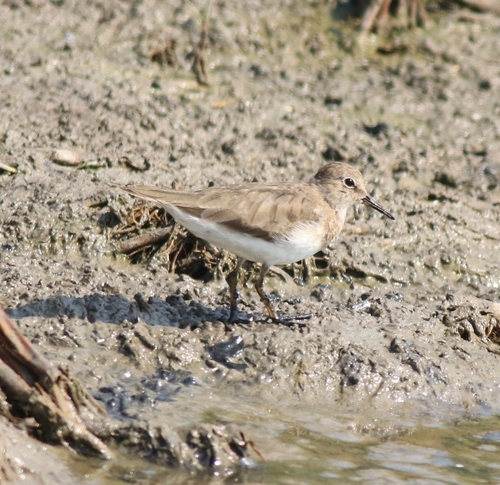 Temminck's Stint
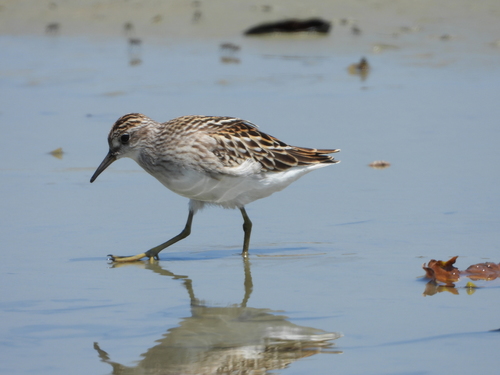 Long-toed Stint
In short
The most reliable field mark between Temminck's Stint and Long-toed Stint is the leg and toe structure: Long-toed Stint has distinctly longer, more slender toes, especially the middle one, giving it a spindlier look on the ground. Both species have yellowish legs, but Temminck's are duller and sometimes brownish, while Long-toed's are brighter yellow. In juvenile plumage, Long-toed Stint is more brightly patterned above with rufous tones and white mantle stripes, while Temminck's is plainer and drabber. Temminck's Stint shows white outer tail feathers, a key mark in flight or when preening, whereas Long-toed's tail pattern is less distinctive. Structure and subtle plumage differences, especially in the upperparts and face, are crucial for separation.
Identification tips
- Toe length and structure: Long-toed Stint has much longer, more slender toes, especially the middle toe, giving it a spidery-footed look. This is visible when the bird is standing or walking on mud. Temminck's Stint has shorter, stubbier toes.
- Leg color: Both have yellowish legs, but Temminck's are dull yellow or brownish, while Long-toed's are a brighter, clearer yellow. This is best judged in good light and can be subtle.
- Tail pattern in flight: Temminck's Stint shows white outer tail feathers, a strong mark when the tail is spread or in flight. Long-toed Stint's tail is less contrasting and lacks this white edge.
- Juvenile upperparts: Juvenile Long-toed Stint is brighter and more patterned above, with rufous tones and clear white mantle stripes. Temminck's juvenile is plainer, duller brown with little contrast and no strong mantle stripes.
- Supercilium and crown: Long-toed Stint of all ages shows a pale supercilium (eyebrow) and a brown crown, giving a more contrasting facial pattern. Temminck's is plainer-faced, with less obvious supercilium and a more uniform head.
- Breast pattern: Temminck's Stint often has a darker, more defined breast patch, especially in winter, while Long-toed's breast is more evenly speckled pale brown.
- Bill: Both have short, thin, dark bills, but Long-toed's may look slightly finer and sharper-tipped. This is a minor mark and not always reliable in the field.
- Body shape and jizz: Temminck's Stint is compact, with a rounded belly, short legs, and a horizontal stance. Long-toed Stint appears longer-necked, more slender, and stands more upright, partly due to its longer legs and toes.
- Primary projection: Temminck's Stint is longer-winged relative to its body, which may be visible when at rest (primaries extending beyond the tail). Long-toed's primaries reach the tail tip but do not project as far.
- Underpart color: Both are white below, but Temminck's may show a more abrupt transition from the darker breast to white belly, while Long-toed is more evenly pale.
- Flight jizz: In flight, Temminck's looks compact and swift, with prominent white outer tail feathers. Long-toed appears lighter, with less tail contrast and a weaker wingbar.
- Habitat micro-choice: If both are present, Long-toed may prefer wetter or more vegetated edges, using its long toes to walk on floating vegetation or softer mud.
- Seasonal context: In Europe, Long-toed Stint is a rare vagrant; Temminck's is regular. If you are outside Asia, always consider rarity.
- Plumage pitfalls: In dull light, leg color and subtle upperpart differences can be hard to judge. Focus on structure and tail pattern if possible.
- Voice: Not reliably separated in the field with the information given, but Long-toed's flight call is reportedly distinctive among sandpipers.
Size
Both are tiny stints, but Long-toed Stint averages slightly heavier (30.5 g vs. 26.05 g for Temminck's Stint) and can appear a touch longer (13–16 cm vs. 13.5–15 cm). In the field, this difference is subtle and easily masked by posture. Temminck's Stint is shorter-legged and longer-winged, giving it a more compact, less spindly look compared to the longer-toed, longer-necked appearance of Long-toed Stint.
Plumage
- Juvenile/immature birds: Long-toed Stint juveniles are distinctly brighter above, with rufous tones and clear white mantle stripes, while Temminck's Stint juveniles are plainer brown with little contrast and lack strong mantle stripes. Long-toed Stint also shows a pale supercilium and brown crown, which is less marked in Temminck's.
- Adults (breeding): Temminck's Stint is generally drab brown above with some rufous or blackish mantle feathers, but never as bright or patterned as Long-toed. Long-toed Stint adults are richer brown above with darker feather centers and a clear pale line above the eye.
- Adults (non-breeding/winter): Both species become greyer above, but Temminck's is dull grey to brownish-grey, while Long-toed is grey above with a pale supercilium still visible. Underparts are white in both, but Temminck's often has a darker breast patch.
- Flight/uppertail: Temminck's Stint has white outer tail feathers, a strong field mark in flight or when tail is spread. Long-toed Stint's tail is less contrasting.
Behaviour
Both forage actively on mudflats, picking by sight and sometimes probing. Long-toed Stint often appears more delicate and spindly, with a distinctive stance due to its long toes and legs set well back. Temminck's Stint is more compact, often feeding with a horizontal posture. In mixed flocks, Long-toed may look more upright and 'looser-jointed' in movement.
Habitat
Both species use similar muddy or marshy habitats during migration and winter. Temminck's Stint is widespread in the Old World, while Long-toed Stint is mostly an Asian species and a rare vagrant to Europe. Habitat is not a strong separator in overlapping range, but Long-toed may be found in slightly wetter or more vegetated microhabitats due to its longer toes.
Voice
No distinctive vocal differences are described in the provided notes. Both species have typical high-pitched stint calls, but Long-toed Stint's flight call is said to be distinctive among sandpipers (details not provided).