

Tawny Pipit vs Rock Pipit
Anthus campestris versus Anthus petrosus
Play a quiz with Tawny Pipit and Rock Pipit
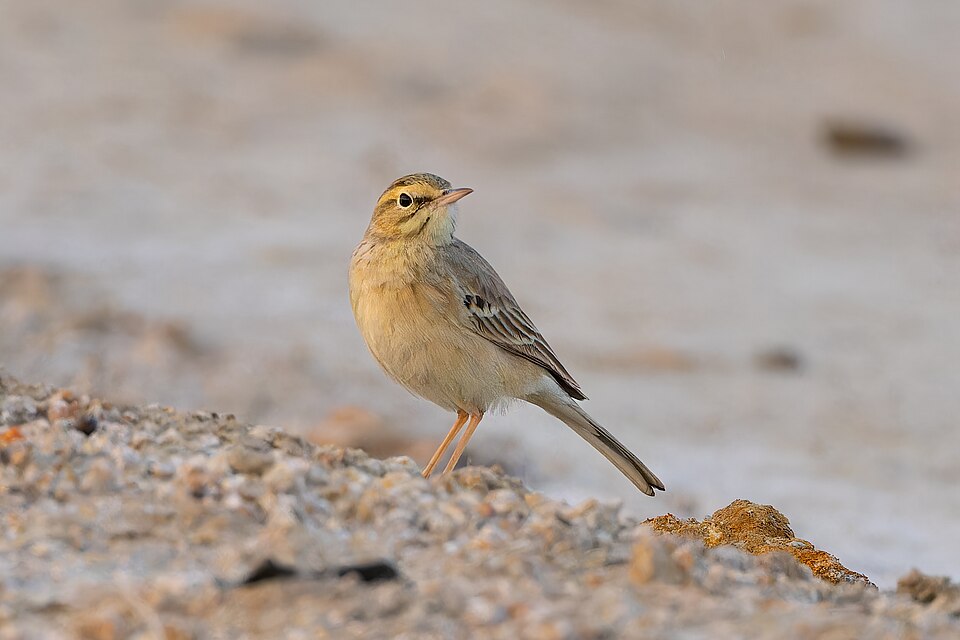 Tawny Pipit
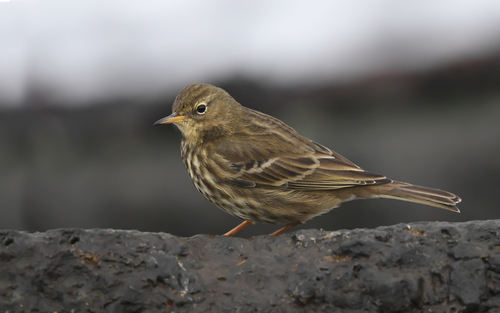 Rock Pipit
In short
The most reliable field mark between Tawny Pipit and Rock Pipit is overall plumage tone and streaking: Tawny Pipit is sandy-brown and very plain above and below, while Rock Pipit is darker, more olive-brown, and heavily streaked, especially on the underparts. Juvenile and immature birds of both species are more streaked, but Rock Pipit always shows more extensive and blurred streaking below. Structurally, Tawny Pipit is slightly slimmer with a narrower bill and shorter legs, but this is subtle. Habitat is often decisive: Tawny Pipit is found in open, dry ground, while Rock Pipit is almost always on rocky coasts. Calls and songs differ, but are best used with experience.
Identification tips
- Underpart streaking: Rock Pipit of all ages shows heavy, blurry brown streaks on buff underparts; Tawny Pipit is much plainer, with faint or no streaks below (especially adults).
- Upperpart color: Tawny Pipit is sandy or pale brown above; Rock Pipit is darker, more olive-brown or smoky.
- Tail pattern in flight: Rock Pipit has dusky (not white) outer tail feathers; Tawny Pipit shows more contrast with paler outer tail feathers, but this is subtle.
- Bill and legs: Tawny Pipit has a narrower, finer bill and shorter legs; Rock Pipit has a stouter, darker bill and legs, but differences can be hard to judge unless side-by-side.
- Supercilium: Only eastern Rock Pipit (littoralis) in summer may show a pale supercilium and pinkish underparts; Tawny Pipit does not, but is always paler overall.
- Juvenile confusion: Juvenile Rock Pipits can look browner and more streaked above, but always show heavier underpart streaking than juvenile Tawny Pipits.
- Habitat: If the bird is on a rocky coast, Rock Pipit is far more likely; Tawny Pipit avoids such habitats and prefers open, dry ground.
- Flight style: Tawny Pipit flies strongly and directly; Rock Pipit may display with a fluttering, parachuting descent in breeding season.
- Song and call: Tawny Pipit's call is a high "schip"; Rock Pipit's is a shrill "pseep." Songs differ, but are best used with experience.
- Seasonal context: In winter, Tawny Pipit is a migrant in Africa and South Asia, while Rock Pipit remains on European coasts (except the migratory Fennoscandian subspecies, which winters further south but still on coasts).
- Sex and age: Both species are similar between sexes; age differences are mainly in streaking, but the pattern of heavier streaking in Rock Pipit holds for all ages.
- Confusion with other pipits: Both can be confused with Meadow or Water Pipit, but Rock Pipit is always darker and more streaked than Tawny Pipit.
- Iris and leg color: Both have dark irises; Rock Pipit's legs are always dark, while Tawny Pipit's can be paler but this is not a strong field mark.
- Display behavior: Only Rock Pipit performs the parachuting song flight on territory.
- Local abundance: On rocky European coasts, Rock Pipit is common; Tawny Pipit is rare or absent in such habitats.
Size
Tawny Pipit is slightly smaller and lighter, with a body mass around 22 g [wikidata], while Rock Pipit ranges from 18–32.5 g (overlapping, but often heavier) [wikipedia]. Both are similar in length (Tawny Pipit about 16 cm, Rock Pipit 16.5–17 cm), so size alone is not a reliable separator in the field. Structure is more helpful: Tawny Pipit has a slimmer build, shorter legs, and a narrower bill compared to the chunkier, darker Rock Pipit.
Plumage
Juvenile and immature Tawny Pipits are plainer than Rock Pipits of the same age, with sandy-brown upperparts and minimal streaking below. Juvenile Rock Pipits can be browner and more streaked above, sometimes resembling Meadow Pipit, but always show heavy, blurry streaks on the underparts and a generally darker, olive-brown cast. Adults maintain these differences: Tawny Pipit is pale and unmarked below, while Rock Pipit is buffy with poorly defined brown streaks. Rock Pipit also has dusky (not white) outer tail feathers, a useful mark in flight for all ages. The eastern Rock Pipit (littoralis) may show a pale supercilium and pinkish underparts in summer, but this is not present in Tawny Pipit. Both sexes are similar in each species; sex is not separable by plumage.
Behaviour
Rock Pipit is highly territorial on rocky coasts, often seen foraging among rocks and displaying with a parachuting song flight. Tawny Pipit is more likely to be seen walking or running on open, dry ground, rarely on rocks. In flight, Tawny Pipit is strong and direct, while Rock Pipit may show fluttering, parachute-like display flights in breeding season. Both species are ground-feeders, but their preferred substrates differ sharply.
Habitat
Habitat is a strong separator: Tawny Pipit breeds and forages in open, dry, sandy or steppe-like habitats across the Palearctic, and winters in similar open country in Africa and South Asia. Rock Pipit is strictly coastal, breeding and wintering on rocky European shores, rarely venturing inland or away from the immediate coast. If you see a pipit well away from rocks or the sea, it is almost certainly not a Rock Pipit.
Voice
Tawny Pipit's call is a sharp, high-pitched "schip," higher than Richard's Pipit, and its song is a short, loud, disyllabic "chir-ree chir-ree." Rock Pipit's flight call is a shrill "pseep," intermediate between Meadow and Water Pipit, and its song is a tinkling series of "cheepa" notes followed by thin "gee" calls and a short trill. Both species' calls are best learned by experience, but Tawny's is higher and shorter, while Rock's is more drawn-out and complex.