

Surf Scoter vs Velvet Scoter
Melanitta perspicillata versus Melanitta fusca
Play a quiz with Surf Scoter and Velvet Scoter
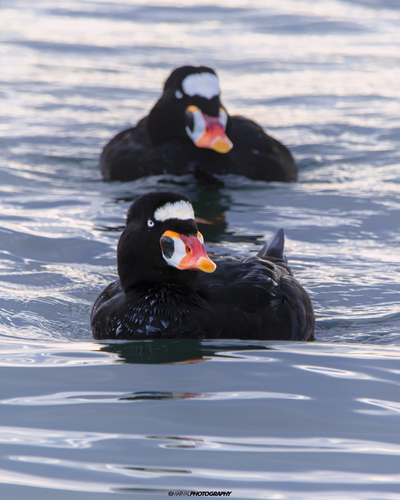 Surf Scoter
 Velvet Scoter
In short
The most reliable field mark to separate Surf Scoter from Velvet Scoter in all plumages—especially in flight—is the presence or absence of a bold white wing patch: Velvet Scoter of all ages and sexes shows a large, striking white patch on the upperwing, while Surf Scoter’s wings are entirely dark. Adult male Surf Scoters are further distinguished by their white forehead and nape patches and a swollen, multicolored bill, while Velvet males have a smaller white mark behind the eye and a partly orange bill. Females and immatures are trickier, but Surf Scoter females and young birds have a squarer, bulkier bill and sometimes a pale nape patch, while Velvet Scoter females are browner and lack the Surf’s head pattern. Size is also a clue: Velvet Scoter is much heavier and longer-winged than Surf Scoter. Always check wing pattern first, especially when viewing birds in flight or at a distance.
Identification tips
- White wing patch in flight: Velvet Scoter of all ages and sexes shows a large, bold white patch on the upperwing, visible in flight and sometimes at rest. Surf Scoter never shows a white wing patch—its wings are entirely dark. This is the single most reliable mark, especially for immatures and females.
- Head pattern (adult males): Surf Scoter males have a white patch on the forehead and nape; Velvet Scoter males have a small white spot behind the eye but no white on the forehead or nape. Use this when viewing adult males at close range.
- Bill shape and color (adult males): Surf Scoter males have a swollen, multicolored bill (orange at a distance, with white, red, yellow, and a black spot near the base). Velvet Scoter males have a long, broad bill that is partly orange but lacks the Surf’s swollen, multicolored look.
- Female and immature head pattern: Female Surf Scoters are browner with indistinct pale patches on the cheeks below the eye and sometimes a pale nape patch (unique among scoters). Velvet Scoter females are duller, browner, lack the Surf’s nape patch, and do not show pale cheek patches.
- Bill structure (females/immatures): Surf Scoter females and immatures have a bulkier, squarer bill with a more flattened head profile. Velvet Scoter’s bill is long and broad but less squared-off at the base.
- Juvenile/immature underparts: Juvenile Surf Scoters are paler and browner overall, with a whitish breast and belly; Velvet Scoter juveniles are similar to adult females but are always browner and lack the Surf’s pale belly, but again, the white wing patch is the best separator.
- Size and bulk: Velvet Scoter is much larger and heavier than Surf Scoter. If you see both together, Velvet will look bulkier and longer-winged. Beware: lone birds can be misleading due to posture or distance.
- Gloss and feather quality (adult males): Velvet Scoter males are glossy black; Surf Scoter males are velvety black. This is subtle and only useful at close range in good light.
- Tail shape: Velvet Scoter has a more pointed tail; Surf Scoter’s tail is less pointed. This is a minor mark and hard to use in the field.
- Geographic range: In North America, Surf Scoter is expected; Velvet Scoter would be a rare vagrant. In Europe, the reverse is true. Always consider location when making an ID.
- Plumage seasonality: Surf Scoter males may appear browner and duller in summer (eclipse plumage), but the white wing patch is still absent. Velvet Scoter’s white wing patch is present year-round.
- Second-year males: Surf Scoter second-year males may lack the full white forehead patch and look browner, but still lack the white wing patch of Velvet.
- Mixed scoter flocks: When scanning flocks, use the white wing patch to pick out Velvet among Surf Scoters or vice versa. Be cautious of lighting and wing position.
- At rest: If the wing is partially open, the white patch may be visible on Velvet Scoter even when perched on water; Surf Scoter will never show this.
- When in doubt: If you cannot see the wing pattern, use a combination of head pattern, bill shape, and size, but be aware that females and immatures can be very similar—prioritize the wing patch whenever possible.
Size
Velvet Scoter is significantly larger and heavier than Surf Scoter. Velvet averages 1762 g in body mass and measures 51–56 cm in length with a wingspan of 90–99 cm, while Surf Scoter averages 950 g, 44–48 cm in length, and a wingspan of 76–77 cm. This makes Velvet Scoter bulkier and longer-winged, which can be apparent when both species are seen together or in mixed scoter flocks. However, size alone can be misleading at a distance or with lone birds, so use in combination with other marks.
Plumage
The most diagnostic plumage difference at all ages is the wing pattern in flight: Velvet Scoter (male, female, and immature) shows a large, bold white patch on the upperwing, visible both at rest (when the wing is partially open) and especially in flight. Surf Scoter’s wings are uniformly dark with no white patch at any age or sex.
Adult male Surf Scoters are velvety black with a white patch on the forehead and nape, and a swollen, multicolored bill. Velvet Scoter males are glossy black but lack the forehead/nape white; instead, they have a small white spot behind the eye and a large white wing patch. Female Surf Scoters are browner, with a slightly darker crown, indistinct pale cheek patches below the eye, and sometimes a pale nape patch (unique among scoters), plus a bulkier bill. Female Velvet Scoters are duller, browner, and lack the Surf’s pale nape patch and cheek pattern, but always show the white wing patch in flight. Juvenile Surf Scoters resemble females but are paler below, with a whitish belly and breast; Velvet juveniles are similar to adult females but still show the white wing patch. Second-year male Surf Scoters may lack the full white forehead patch, appearing browner and less clean-cut than adults, but still lack the white wing patch of Velvet. In eclipse or non-breeding plumage, Surf Scoter males may look duller, but the wing pattern remains diagnostic.
Behaviour
Both species are large, diving sea ducks, often seen in flocks on open water. Velvet Scoter, being larger and heavier, may appear more ponderous in flight and on the water, with a thicker neck and longer, broader bill. Surf Scoter tends to have a more compact, slightly squarer-headed look, especially in females and immatures. Both species dive for food and can be seen associating with other scoters, but their behavior is broadly similar and not a reliable separator.
Habitat
Surf Scoter is native to North America, breeding in northern Canada and Alaska and wintering along both Pacific and Atlantic coasts. Velvet Scoter breeds in far northern Europe and the western Palearctic and winters in European and western Asian coastal waters. In North America, Velvet Scoter is extremely rare and would be a vagrant; in Europe, Surf Scoter is the rarity. Habitat overlap is possible only in exceptional circumstances (e.g., vagrancy), so geographic context is usually a strong clue.