

Stub-tailed Spadebill vs Golden-crowned Spadebill
Platyrinchus cancrominus versus Platyrinchus coronatus
Play a quiz with Stub-tailed Spadebill and Golden-crowned Spadebill
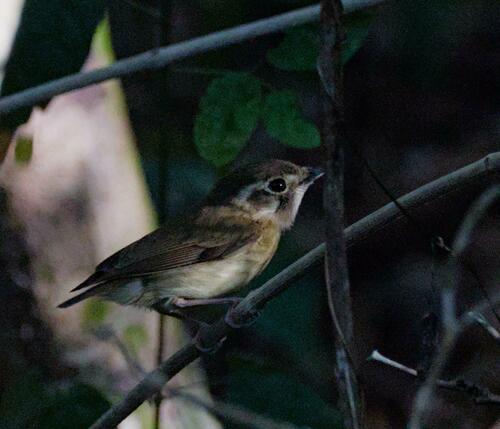 Stub-tailed Spadebill
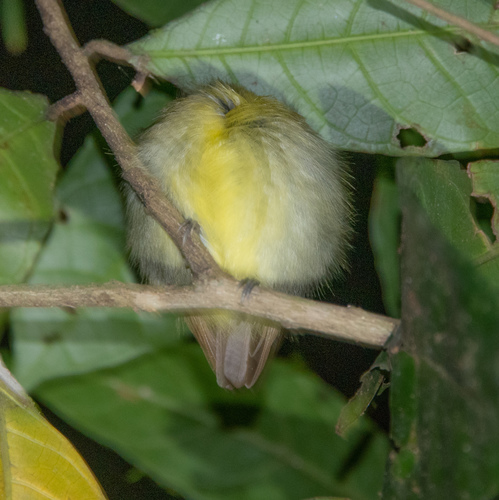 Golden-crowned Spadebill
In short
The most reliable field mark for separating Stub-tailed Spadebill from Golden-crowned Spadebill is the presence or absence of a colorful crown patch: Golden-crowned Spadebill adults show a distinctive orange or rufous crown patch (often partly hidden), while Stub-tailed Spadebill lacks any crown patch entirely. Juvenile Golden-crowned Spadebills lack the crown patch but have paler facial markings and ochraceous wing edges, which are not seen in Stub-tailed. Both species are small, round-headed flycatchers with broad, flat bills and stubby tails, but Stub-tailed is slightly larger and heavier, with a browner overall tone and a more reduced or absent crown. Careful attention to the crown, face pattern, and subtle plumage differences, especially in perched birds, is key to correct identification.
Identification tips
- Crown Patch (Adults): Golden-crowned Spadebill adults have a black crown with a central orange or rufous patch (males rufous, females orange), often partly hidden but visible at close range or when the bird raises its crown feathers. Stub-tailed Spadebill lacks any crown patch or contrasting crown color at all ages. This is the single most reliable field mark for adults.
- Juvenile Wing and Face Pattern: Juvenile Golden-crowned Spadebills lack the crown patch but show paler facial markings and ochraceous edges to the wing coverts and flight feathers. Stub-tailed Spadebill juveniles are not described as having these features, so a juvenile with ochraceous wing edges and pale face is likely Golden-crowned.
- Facial Pattern: Golden-crowned Spadebill has a bold, pale yellow facial pattern: a patch above the lores, eye-ring, postocular stripe, and ear patch, all contrasting with a dark line through and under the eye. Stub-tailed Spadebill has a yellow postocular stripe but otherwise less extensive pale facial markings.
- Crown Structure: Stub-tailed Spadebill has a greatly reduced or absent crown, giving the head a more uniformly brown appearance. Golden-crowned Spadebill has a large head with a distinct crown patch (adults) or at least a darker crown area (juveniles).
- Upperparts Color: Stub-tailed Spadebill is overall brown on the head, mantle, and wings, blending into the background. Golden-crowned Spadebill is olive above, with less brown tone.
- Underparts: Both have pale yellow underparts, but Stub-tailed Spadebill males have a brighter yellow belly, while females may be browner. Golden-crowned Spadebill's underparts are pale yellow with an olive wash or streaks on the breast.
- Throat: Both have whitish or pale throats, but Stub-tailed's is described as white and more sharply set off from the brown upperparts.
- Tail: Both have short, stubby tails, but Stub-tailed Spadebill's tail is especially short and brown, giving a 'stubby' appearance that is the origin of its name.
- Bill: Both species have a broad, flat bill with a pale mandible and pinkish feet. Bill structure is not reliably diagnostic between these two.
- Size: Stub-tailed Spadebill is slightly larger and heavier, but this is subtle and not a strong field mark unless both are seen together.
- Voice: If heard, Stub-tailed Spadebill gives a nasal, rapid, shaky call, while Golden-crowned Spadebill's song is a weak, high-pitched trill easily confused with insect noise. Stub-tailed's call is more distinctive and mechanical.
- Habitat and Range: In Central America, Stub-tailed is more likely in drier or lower-elevation forests, while Golden-crowned is in humid lowland and foothill forests. Outside Central America, only Golden-crowned occurs.
- Behavior: Both can join mixed-species flocks and forage in the undergrowth, but Golden-crowned males may display with short, whirring flights in the breeding season.
- Sex Differences: Golden-crowned Spadebill shows little sexual dimorphism except for the hue of the crown patch (rufous in males, orange in females). Stub-tailed Spadebill males are brighter yellow below; females are browner.
- Pitfalls: Immature Golden-crowned Spadebills lacking a crown patch may be confused with Stub-tailed, but look for ochraceous wing edges and paler face in Golden-crowned juveniles. Always check for the presence or absence of a crown patch and the extent of pale facial markings.
Size
Stub-tailed Spadebill is slightly larger and heavier (body mass ~11 g, length up to 9.5 cm) than Golden-crowned Spadebill (body mass ~9.2 g, length 8.5–9 cm). In the field, this difference is subtle and unlikely to be diagnostic unless both are seen side by side, but Stub-tailed may appear a bit bulkier or more robust. Both are among the smallest flycatchers, but Golden-crowned is the smallest in its genus.
Plumage
- Juveniles: Golden-crowned Spadebill juveniles lack the adult's crown patch and have paler facial markings, paler underparts, grayish-olive upperparts, and ochraceous (yellowish-brown) edges to the wing coverts and flight feathers. Stub-tailed Spadebill juveniles are not described in detail, but there is no mention of ochraceous wing edges or a crown patch at any age.
- Adults: Golden-crowned Spadebill adults have a black crown with a central orange-rufous (male) or orange (female) patch, bold pale yellow facial markings (above lores, eye-ring, postocular stripe, ear patch), olive upperparts, and pale yellow underparts with an olive wash or streaks on the breast. Stub-tailed Spadebill adults have brown feathering on the head, mantle, and wings, a white throat, yellow (male) or brown/yellow (female) belly, and a notably reduced or absent crown. Both have broad, flat bills with a pale mandible and pinkish feet, but only Golden-crowned has the colorful crown patch and more extensive pale facial pattern.
Behaviour
Both species are typically found in the lower strata or undergrowth of tropical forests and may join mixed-species flocks. Stub-tailed Spadebill is noted for its secretive, solitary or paired behavior and its ability to blend into the background due to its brownish plumage. Golden-crowned Spadebill males perform short display flights with whirring wings during the breeding season. Both forage for arthropods and small fruits, but behavioral differences are subtle and not reliably diagnostic in the field.
Habitat
Stub-tailed Spadebill is restricted to Central America (southern Mexico to Costa Rica) and prefers tropical dry or moist lowland forests, often below 500 m but up to 1500 m elevation. Golden-crowned Spadebill has a much broader range, from Honduras through Panama and across most of South America (except the southern cone), occupying humid lowland and foothill forests from sea level up to 1250 m (Central America) or higher in the Andes and Amazon. Where ranges overlap (Honduras–Panama), both may occur in similar forest types, but Stub-tailed is more tied to drier and lower-elevation forests.
Voice
Stub-tailed Spadebill gives a nasal, rapid, shaky 'ki-di-di-di-rrril' call, often after short flights. Golden-crowned Spadebill's song is a very high-pitched, rapid, hissing trill that undulates and is easily mistaken for an insect, being weak and barely audible at a distance. In practice, Stub-tailed's call is more mechanical and distinctive, while Golden-crowned's is softer and more insect-like. These differences can be helpful if the bird is vocalizing, but both are easily overlooked in the noisy forest.
Stub-tailed Spadebill · Golden-crowned Spadebill · My Tricky Birds