

Stripe-crowned Spinetail vs Bay-capped Wren-Spinetail
Cranioleuca pyrrhophia versus Spartonoica maluroides
Play a quiz with Stripe-crowned Spinetail and Bay-capped Wren-Spinetail
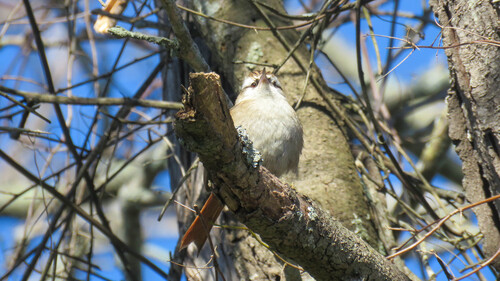 Stripe-crowned Spinetail
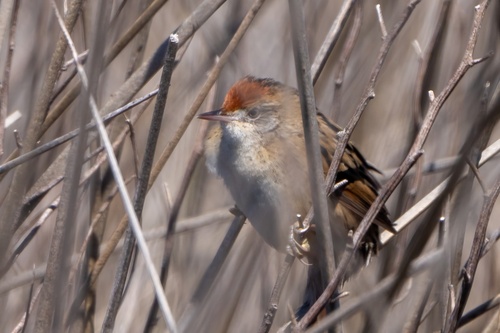 Bay-capped Wren-Spinetail
In short
The most reliable field mark to separate Stripe-crowned Spinetail from Bay-capped Wren-Spinetail is the crown pattern: adult Stripe-crowned has a boldly striped crown, while Bay-capped Wren-Spinetail shows a solid rufous crown. Juvenile Stripe-crowned lacks crown stripes (unlike adults), but still differs in overall coloration and tail pattern. Stripe-crowned Spinetail prefers drier woodlands and scrub, whereas Bay-capped Wren-Spinetail is found strictly in marshes and reedbeds. Both are small, brownish ovenbirds with pointed tails, but careful attention to head pattern, habitat, and subtle structural differences will prevent confusion.
Identification tips
- Crown pattern (adults): Stripe-crowned Spinetail always shows a boldly striped crown (blackish and buffy brown); Bay-capped Wren-Spinetail has a solid rufous crown with no stripes. This is the single most reliable mark for adults.
- Crown pattern (juveniles): Juvenile Stripe-crowned lacks crown stripes and has a plain crown, but still differs from Bay-capped by overall darker, faintly mottled/scaled underparts and habitat. Bay-capped juveniles always have a rufous crown.
- Supercilium: Both have a whitish supercilium, but Stripe-crowned's is broader and more contrasting, especially above the dark brown lores and behind the eye. Bay-capped's is narrower, set on a sandy brown face.
- Face pattern: Stripe-crowned shows dark brown lores and a mix of whitish/brown ear coverts; Bay-capped has a plain sandy brown face.
- Upperparts: Bay-capped has bold black streaks on the nape and upper back, which Stripe-crowned lacks (its back is more uniform grayish brown or browner, depending on subspecies).
- Tail shape and color: Both have graduated, pointed tails, but Stripe-crowned's tail is more obviously forked, with rufous and brown patterning (central feathers dark brown/rufous, outer feathers rufous). Bay-capped's tail is mostly brown, with some black on the central pair, and less color contrast.
- Wing pattern: Stripe-crowned has rufous wing coverts and dull brownish flight feathers; Bay-capped's wings are brown with cinnamon at the base of the flight feathers. This is subtle and best seen at close range or in good light.
- Underparts: Stripe-crowned is brownish gray or buffish gray, darker on the belly; Bay-capped is whitish with a buff or cinnamon wash on the breast, sides, and flanks. Stripe-crowned juveniles have faintly mottled/scaled underparts.
- Iris color: Stripe-crowned's iris is variable (dark red to orange to brown); Bay-capped's is pale (dull white to pale bluish). This is only visible at close range.
- Bill and legs: Both have similar bill structure; Stripe-crowned's legs are olive-green to greenish gray or yellowish brown, while Bay-capped's are light tan. This is not a strong field mark.
- Habitat: If the bird is in a marsh, especially among reeds or sedges, Bay-capped is strongly favored. If in woodland, scrub, or dry savanna, it is Stripe-crowned.
- Behavior: Bay-capped is typically solitary and skulking in dense marsh vegetation; Stripe-crowned is more arboreal, often in pairs or small groups, and more active in trees and shrubs.
- Size: Stripe-crowned is slightly larger and heavier, but this is rarely useful in the field unless both are seen side by side.
- Voice: If a grasshopper-like buzzing song is heard, it points to Bay-capped. Otherwise, voice is not a strong separator with the information available.
- Season and range: Both species overlap in parts of Argentina, Brazil, Paraguay, and Uruguay, but only Stripe-crowned occurs at higher elevations and in drier habitats. Always consider habitat and elevation in ambiguous cases.
Size
Stripe-crowned Spinetail is slightly heavier (15.0 g vs. 11.0 g) and a bit longer (13–16 cm) than Bay-capped Wren-Spinetail (13–14.5 cm). In the field, this difference is subtle and not usually diagnostic, but Stripe-crowned may appear a touch bulkier. Both are small, slender birds; size alone is rarely a safe separator.
Plumage
- Juveniles: Juvenile Stripe-crowned Spinetail lacks the adult's crown stripes, showing a plain crown and darker, faintly mottled or scaled underparts. Bay-capped Wren-Spinetail juveniles are not described as differing much from adults, but always have a solid rufous crown.
- Adults: Stripe-crowned Spinetail (all subspecies) shows a strikingly striped crown (blackish and buffy brown), a wide white supercilium, and a graduated, pointed tail with rufous and brown patterning. Bay-capped Wren-Spinetail has a solid rufous crown, a whitish supercilium, sandy brown face, and a tail that is mostly brown with some black on the central feathers.
- Upperparts: Stripe-crowned is grayish to brownish above, with less obvious streaking; Bay-capped has bold black streaks on the nape and upper back.
- Underparts: Stripe-crowned is brownish gray to buffish gray, darker on the belly; Bay-capped is whitish with a buff or cinnamon wash on breast and flanks.
- Wings: Stripe-crowned has rufous wing coverts and dull brownish flight feathers; Bay-capped's wings are brown with cinnamon at the base of the flight feathers.
- Iris color: Stripe-crowned varies (dark red to orange to brown); Bay-capped is pale (dull white to pale bluish).
Behaviour
Stripe-crowned Spinetail is typically seen foraging in a variety of wooded and shrubby habitats, often moving through branches and foliage, sometimes in pairs or small groups. It is agile and active, sometimes flicking its tail. Bay-capped Wren-Spinetail is restricted to marshes and reedbeds, usually seen alone, moving through dense grasses and sedges, gleaning insects. Its behavior is more skulking and tied to wetland vegetation. Both species have graduated, pointed tails, but Bay-capped is more likely to be seen low in marshy vegetation, while Stripe-crowned is more arboreal or in drier scrub.
Habitat
Habitat is a strong separator. Stripe-crowned Spinetail inhabits a wide range of dry to semi-humid woodlands, gallery forests, arid montane scrub, savannas, and sometimes Andean woodlands, from near sea level to 3,100 m. It avoids true wetlands. Bay-capped Wren-Spinetail is a marsh specialist, found only in reedbeds and sedges of freshwater, brackish, or saltwater marshes, from sea level up to 900 m. If the bird is in a marsh, Bay-capped is far more likely; if in woodland or scrub, Stripe-crowned is the default.
Voice
The notes do not provide a detailed comparison of vocalizations. Bay-capped Wren-Spinetail is described as having a grasshopper-like buzz for its primary song. Stripe-crowned Spinetail's song is not described here. Voice is not the most reliable separator unless the Bay-capped's buzzing song is heard.
Stripe-crowned Spinetail · Bay-capped Wren-Spinetail · My Tricky Birds