

Striated Heron vs Green Heron
Butorides striata versus Butorides virescens
Play a quiz with Striated Heron and Green Heron
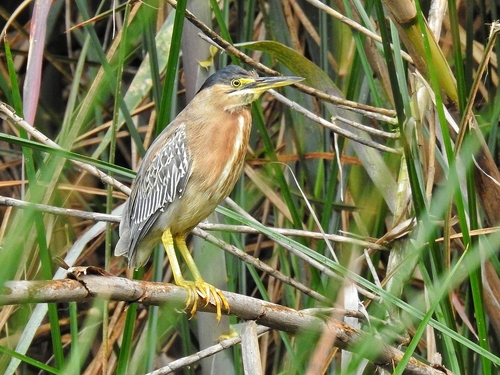 Striated Heron
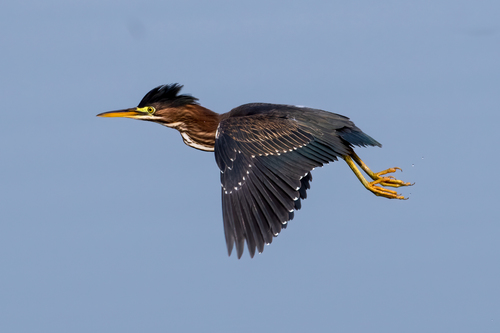 Green Heron
In short
The most reliable field mark between Striated Heron and Green Heron is the color and pattern of the neck and underparts, especially in adults: Striated Heron usually shows a mid-grey to orangey or pinkish wash below with a dark cap and white throat, while Green Heron adults have a rich chestnut neck with distinct white lines down the front. Juveniles of both species are streaked below, but Green Heron juveniles are more heavily and extensively streaked with brown and white, and show tan-splotched upperparts. Both species are compact, short-legged herons with similar size and structure, but subtle differences in plumage and leg color can help. When seen perched or foraging, focus on the neck color, streaking, and upperpart tones to separate them.
Identification tips
- Juvenile streaking: Juvenile Green Herons show bold brown and white streaks on the neck, breast, and belly, with tan-splotched backs and wing coverts. Juvenile Striated Herons are browner above and heavily streaked below, but the streaking is generally less extensive and less sharply defined. Use this mark for immatures.
- Adult neck color: Adult Green Herons have a rich chestnut neck with one or more distinct white lines down the front. Striated Herons lack this chestnut coloration and instead have a mid-grey to orangey or pinkish wash below, sometimes with a white throat.
- Cap and back: Both species have a dark cap, but Green Heron's is glossy greenish-black, while Striated Heron's is black. The back and wings of Striated Heron are blue-grey, while Green Heron shows an iridescent greenish back and wings, grading into blue or gray-black.
- Underparts: Striated Heron adults have white or pale underparts, sometimes with a pinkish or orangey wash. Green Heron adults have gray underparts, but the chestnut neck and white lines are more distinctive.
- Leg color: Both have short yellow legs as adults, but Green Heron juveniles have greenish-yellow legs and bill, while Striated Heron juveniles have yellow legs.
- Bill color: Green Heron adults have a dark bill with a long, sharp point; Striated Heron has a dark line from the bill to under the eye, but bill color is not strongly diagnostic between the two.
- Sexual dimorphism: Green Heron females are smaller and duller than males, especially in breeding season. Striated Heron sexes are alike.
- Behavior: Both species are solitary and secretive, but Green Heron is especially intolerant of other birds while feeding. Striated Heron juveniles may display by stretching necks and pointing bills skyward when threatened.
- Habitat context: In the Americas, Green Heron is more likely in inland wetlands, ponds, and lakes, while Striated Heron is more coastal, especially in mangroves. Use range and habitat as supporting context, not primary ID.
- Flight and jizz: Both are compact, short-necked herons with the neck pulled in during flight. Structure is not a reliable separator.
- Voice: Only Green Heron's calls are described ('kyow', 'kuk', 'raah-rahh', etc.), but vocalization is rarely diagnostic unless heard well.
- Seasonal movement: Green Heron is migratory in the north of its range, absent in winter from northern areas. Striated Heron is mostly sedentary.
- Plumage variability: Striated Heron underparts can vary from mid-grey to orangey or pinkish, so beware of color variation. Always check for the chestnut neck and white lines of Green Heron adults.
- Pitfalls: Immature birds are often confused due to similar streaking. Focus on the extent and sharpness of streaks, upperpart color, and leg color for juveniles.
- When in doubt: If the bird shows a chestnut neck with white lines, it's a Green Heron. If the underparts are more uniform grayish or washed, and the bird is in a mangrove or coastal setting in South America or the Caribbean, Striated Heron is more likely.
Size
Both species are very similar in size and structure, with adults measuring about 41–48 cm in length. Striated Heron is 35–48 cm long, weighing 130–250 g, with a wingspan of 52–60 cm. Green Heron is 41–46 cm long, about 240 g, and has a slightly broader wingspan of 64–68 cm. In the field, these differences are subtle and not reliable for separation. Both are compact, short-necked, and short-legged herons.
Plumage
Juvenile Striated Herons are browner above and heavily streaked below, but the streaking is generally less extensive and less sharply defined than in Green Heron juveniles. Green Heron juveniles have brown and white streaks on the head, neck, and underparts, with tan-splotched backs and wing coverts, and greenish-yellow legs and bill. Adult Striated Herons have a blue-grey back and wings, a black cap, white underparts (sometimes with a pinkish or orangey wash), and short yellow legs. In contrast, adult Green Herons have a glossy greenish-black cap, iridescent greenish back and wings, a rich chestnut neck with white lines down the front, gray underparts, and short yellow legs. Female Green Herons are slightly duller and lighter, especially in the breeding season. The most consistent difference is the chestnut neck and white neck lines in adult Green Herons versus the more uniform grayish or washed underparts of Striated Heron.
Behaviour
Both species are solitary and secretive when foraging, often standing motionless at the water's edge or on low branches. Green Herons are noted for their intolerance of other birds while feeding and are rarely seen in groups. Both species use bait-fishing techniques, dropping objects on the water to lure prey. Juvenile Striated Herons may display by stretching their necks and pointing their bills skyward when threatened, a behavior not specifically noted for Green Heron. In flight, both appear compact with the neck pulled in.
Habitat
Striated Heron is mostly sedentary, found in South America and the Caribbean, and is often associated with mangroves and coastal habitats. Green Heron is found in North and Central America, inhabiting riparian zones, wetlands, ponds, lakes, canals, and ditches. Both can be found in similar wetland habitats, but Green Heron is more likely in inland freshwater areas, while Striated Heron is more coastal and mangrove-associated in its range.
Voice
Green Heron is described as giving a loud, sudden 'kyow' call and a series of subdued 'kuk' notes. During courtship, males are noisy with 'raah-rahh', 'whoom-whoom-whoom', and 'roo-roo' calls. Striated Heron's vocalizations are not described in the provided notes, so calls are not a reliable field mark for separation based on this information.