

Streaky-breasted Flufftail vs Somali Courser
Sarothrura boehmi versus Cursorius somalensis
Play a quiz with Streaky-breasted Flufftail and Somali Courser
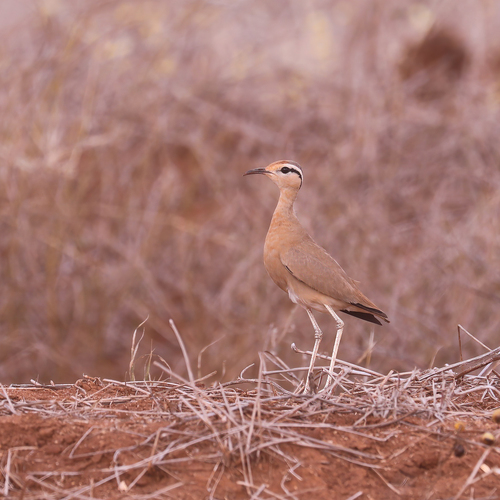 Somali Courser
In short
The most reliable field mark to separate Somali Courser from Streaky-breasted Flufftail is seen in flight: Somali Courser shows a distinctive underwing pattern with only the outer half of the wing black underneath, while the inner underwing is sandy-brown—this is diagnostic for all ages. Streaky-breasted Flufftail, in contrast, is a secretive, small rail-like bird of wet grasslands, rarely seen in open flight and lacking any such underwing contrast. On the ground, Somali Courser is a long-legged, upright, courser with a bold facial pattern, always in open, dry country, while Streaky-breasted Flufftail is much smaller, rounder, and streaky, and restricted to dense, wet grass. These two species differ dramatically in structure, habitat, and behavior, so confusion is most likely from fleeting views or unfamiliarity with one of the groups.
Identification tips
- Underwing pattern in flight (all ages): Somali Courser shows only the outer half of the underwing black, with the inner half sandy-brown; Streaky-breasted Flufftail lacks any such contrast and is rarely seen in open flight.
- Size and shape: Somali Courser is much larger, longer-legged, and stands upright, while Streaky-breasted Flufftail is small, round, and squat with short legs.
- Facial pattern: Somali Courser has a bold black eye-stripe and white eyebrow forming a 'V' behind the head, visible from behind; flufftail lacks any such facial markings and is overall more cryptic.
- Breast and body plumage: Streaky-breasted Flufftail is heavily streaked on the breast, while Somali Courser is plain sandy or greyish-brown above and below, with no streaking.
- Bill shape: Somali Courser has a straight, slender bill suited for picking insects; flufftail has a shorter, stubbier bill.
- Leg length: Somali Courser’s long legs are obvious in the open; flufftail’s legs are short and usually hidden in grass.
- Behavior: Courser runs openly and pauses, rarely flushes; flufftail creeps through dense grass and only flies when forced, dropping quickly back into cover.
- Habitat: Courser in dry, open, or burnt grassland; flufftail in wet, marshy grass—never overlap in typical conditions.
- Flight style: Courser’s flight is strong and direct over open ground; flufftail’s flight is weak, low, and brief.
- Group association: Courser may be seen in small groups or pairs in open; flufftail is solitary or in pairs, always in dense cover.
- Pitfall—distant views: At great distance, a running courser might be mistaken for a small rail, but note the upright stance and open habitat.
- Pitfall—flushed birds: A flufftail flushed from wet grass may be glimpsed in flight, but will lack any underwing contrast and will drop quickly.
- Pitfall—immature birds: No evidence for confusing juvenile plumage in either species; courser’s underwing pattern is consistent across ages.
- Voice: Not diagnostic from available sources; rely on visual marks.
- Seasonal context: Both species are resident in their respective ranges, but never share the same habitat at the same time.
Size
Somali Courser is notably larger, at 19–22 cm in length, with long legs and a slim, upright stance. Streaky-breasted Flufftail is much smaller and more compact, typical of flufftails, with a squat, rounded body and short legs. This size and shape difference is obvious if both are seen well, but can be hard to judge at a distance or in dense cover.
Plumage
Age-specific wing pattern is diagnostic for Somali Courser: in all plumages, the underwing in flight shows only the outer half black, with the inner half sandy-brown, unlike the similar cream-coloured courser (and entirely absent in flufftails). Streaky-breasted Flufftail does not have any contrasting underwing pattern and is rarely seen in flight. On the ground, Somali Courser has a greyish-brown upper body, a striking black eye-stripe with a white supercilium forming a 'V' behind the head, and sandy tones below. Streaky-breasted Flufftail is streaky on the breast and generally much more cryptic, with no bold facial markings. These differences apply to adults and immatures. No information is available for juvenile-specific upperwing marks in flufftail, but the courser’s underwing pattern is reliable across ages.
Behaviour
Somali Courser is a ground-dwelling, fast-running bird of open country, often seen dashing after insects in the open, and rarely flushes unless closely approached. It stands upright and moves with a characteristic run-and-pause gait. Streaky-breasted Flufftail is extremely secretive, skulking in dense, wet grass, and is rarely seen in the open; it typically creeps or runs through cover and only flies short distances if flushed, usually dropping quickly back into vegetation.
Habitat
Habitat is a strong separator: Somali Courser is found in open, dry, semi-desert or short grassland, often in burnt or sparsely vegetated areas. Streaky-breasted Flufftail is restricted to wet grasslands and marshy areas in central Africa, never venturing into open, dry terrain. If you see a bird in open, arid country, it is almost certainly not a flufftail.
Streaky-breasted Flufftail · Somali Courser · My Tricky Birds