

Stejneger's Scoter vs Black Scoter
Melanitta stejnegeri versus Melanitta americana
Play a quiz with Stejneger's Scoter and Black Scoter
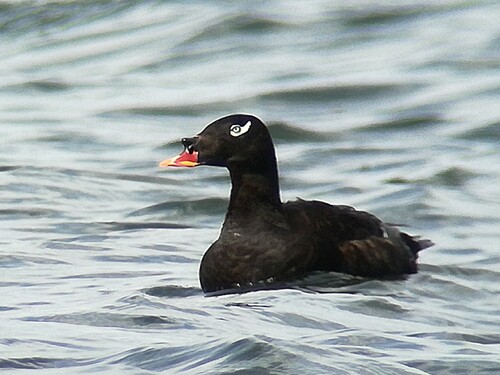 Stejneger's Scoter
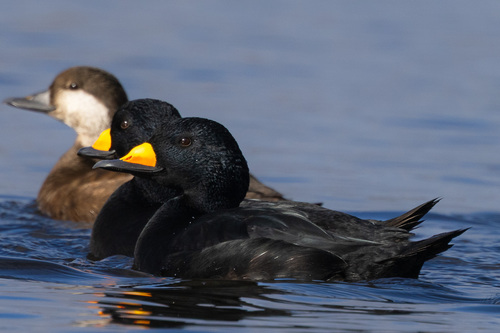 Black Scoter
In short
Stejneger's Scoter and Black Scoter are both large, dark sea ducks, but adult males are best separated by bill shape and color: Stejneger's has a tall, prominent knob and mostly orange-yellow bill, while Black Scoter's bill is bulbous and mostly yellow. Females of both are brown with pale cheeks, but Black Scoter females show more extensive pale areas. In flight and at a distance, structure and head profile are key, as plumage is generally similar and both lack white in the wing. Immature and female birds are especially challenging, so focus on bill shape and head profile when possible. Both species form tight winter flocks on coastal waters, but their ranges only overlap in western Alaska and as vagrants elsewhere.
Identification tips
- Adult male bill shape and color: Stejneger's Scoter has a very tall knob at the base of its mostly orange-yellow bill, while Black Scoter has a bulbous, mostly yellow bill. This is the most reliable field mark for adult males at close range.
- Head profile (males): Stejneger's shows a long, sloping 'Roman nose' profile, similar to Common Eider, while Black Scoter's head is more rounded and less elongated. Use this when the bill knob is hard to see.
- Female plumage: Both are brown with pale cheeks, but Black Scoter females have more extensive pale areas. However, this is subtle and often unreliable at distance or in poor light.
- Bill base feathering (males): The feathering along the base of the upper mandible forms an acute angle on Stejneger's, but a right angle on Black Scoter. This is a fine detail, best seen in good photos or close views.
- Absence of white in wing (all ages): Both species lack white in the wing, so this is not useful for separation.
- Immature/first-winter birds: No distinctive upperwing or flight marks are described for either species, so rely on structure and bill shape.
- Size and bulk: Both are large and bulky sea ducks; size is not a reliable separator.
- Behavior in flocks: Both form dense, synchronized flocks on the water and take off together, so flocking behavior does not separate them.
- Range and context: In North America, Stejneger's is rare outside western Alaska; Black Scoter is widespread. If seen outside Alaska, a Stejneger's is exceptional and requires careful documentation.
- Male display: Black Scoter males may perform a downward head movement when stretching wings, but this is not a strong field mark for separation.
- Habitat: Both use coastal waters in winter; Black Scoter may prefer sheltered bays, but this is not diagnostic.
- Sexing in the field: Adult males are much easier to separate than females or immatures; for brown birds, structural clues are key, but identification is often uncertain without close views.
- Photographic review: For rare vagrants, high-quality photos of bill shape and head profile are essential for confirmation.
- Plumage pitfalls: Do not rely on subtle brown tones or slight differences in cheek patch for field ID, especially in poor light or at distance.
- When in doubt: If you cannot see the bill shape or head profile clearly, and the bird is not an obvious adult male, it may not be possible to separate these species with confidence in the field.
Size
Both species are similar in size and bulk, with Black Scoter males averaging 49 cm and 1100 g, and females about 45 cm and 980 g [wikipedia]. Stejneger's Scoter is described as a large sea duck, but no direct measurements are given in the notes. In the field, size alone is not a reliable separator between these two.
Plumage
There are no distinctive juvenile or immature upperwing patterns described for either species that would allow for easy separation in flight. Both lack white in the wing and are generally dark overall. Adult male Stejneger's Scoter is all black with a tall, orange-yellow bill knob, while Black Scoter males are all black with a bulbous, mostly yellow bill. Females of both are brown with pale cheeks, but Black Scoter females have more extensive pale areas. No age-specific flight marks are noted for either species, so field separation relies on head and bill structure, especially for immatures and females.
Behaviour
Both species dive for food and form tightly packed flocks on coastal waters in winter, often taking off together. Black Scoter males may show a diagnostic downward head movement when stretching their wings, but this is subtle and not always visible. In breeding season, Black Scoter is less social, while Stejneger's Scoter's breeding behavior is not detailed in the notes.
Habitat
Both species winter on coastal waters and are most often seen in large, dense flocks. Black Scoter may show a preference for sheltered embayments and mixed-depth waters, but this is not a strong field mark. Stejneger's Scoter breeds in northern Asia and is rare in North America outside Alaska, while Black Scoter breeds in North America. Overlap is limited to western Alaska and vagrant records elsewhere.