

Motmot

Spotted Sandpiper vs Lesser Yellowlegs

Actitis macularius versus Tringa flavipes

Play a quiz with Spotted Sandpiper and Lesser Yellowlegs
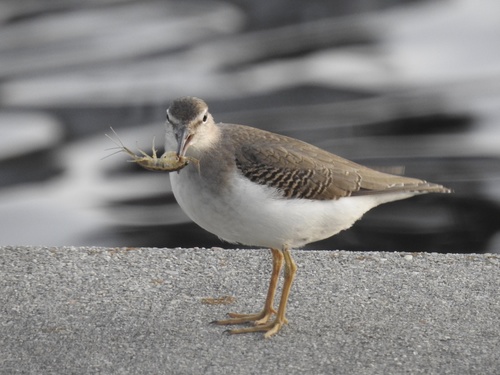
Spotted Sandpiper (Actitis macularius) Spotted Sandpiper
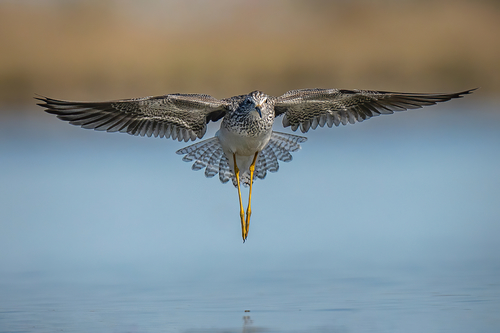
Lesser Yellowlegs (Tringa flavipes) Lesser Yellowlegs

Media

Loading…

In short

The most reliable field mark between Spotted Sandpiper and Lesser Yellowlegs is overall structure and size: Lesser Yellowlegs is distinctly larger, longer-legged, and more elegant, while Spotted Sandpiper is compact with a short tail and a distinctive teetering walk. In breeding season, Spotted Sandpiper shows bold black spots below, but in non-breeding plumage both species are plain below and confusion is most likely. Lesser Yellowlegs always has long, bright yellow legs and a slim, straight, dark bill about the length of its head, while Spotted Sandpiper has shorter, yellowish legs and a shorter orange bill with a dark tip. In flight, Spotted Sandpiper lacks the bold white rump and trailing edge of many Tringa, and its upperwing pattern is more washed-out than Common Sandpiper, but Lesser Yellowlegs shows a uniform upperwing. Structure, leg color, and bill shape are the most reliable clues in all ages and seasons.

Identification tips

  1. Size and structure: Lesser Yellowlegs is much larger and taller, with long, thin legs and a longer neck. Spotted Sandpiper is compact, with a short tail and a lower, horizontal stance. This is reliable at any distance if you have a sense of scale.
  2. Leg color: Lesser Yellowlegs always has long, bright yellow legs. Spotted Sandpiper has shorter, yellowish (sometimes duller) legs, but never the long, stilt-like look of Lesser Yellowlegs.
  3. Bill shape and color: Lesser Yellowlegs has a slim, straight, uniformly dark bill about the length of its head. Spotted Sandpiper has a shorter, orange bill with a distinct dark tip. This is visible at moderate range.
  4. Breeding plumage underparts: Spotted Sandpiper adults in breeding plumage have bold black spots on the white underparts—diagnostic. Lesser Yellowlegs never shows spots below, only fine streaking or barring on breast and flanks.
  5. Non-breeding/immature underparts: Both species become plain white below in non-breeding plumage, but Lesser Yellowlegs may retain some fine streaking on the breast and flanks. Spotted Sandpiper is clean white below and can be very plain, especially in juveniles.
  6. Supercilium: Spotted Sandpiper shows a white supercilium (eyebrow), especially in non-breeding plumage. Lesser Yellowlegs may show a faint pale line but is less distinct.
  7. Upperwing pattern in flight: Spotted Sandpiper has a more washed-out upperwing pattern than Common Sandpiper, lacking bold white panels or trailing edges. Lesser Yellowlegs has uniform upperwings without bold contrasts. Separation in flight relies on structure and leg color, not wing pattern.
  8. Behavior: Spotted Sandpiper bobs its tail constantly when walking or standing—this is a classic behavior and very reliable. Lesser Yellowlegs does not bob its tail in the same way and moves with a high-stepping, active gait.
  9. Flight style: Spotted Sandpiper flies low over water with stiff, shallow wingbeats. Lesser Yellowlegs flies higher and more directly, with steady wingbeats typical of Tringa.
  10. Habitat preference: Spotted Sandpiper is more often found along rocky or muddy shorelines and smaller water bodies. Lesser Yellowlegs prefers open, shallow wetlands, mudflats, and flooded fields, often in deeper water and in flocks.
  11. Group size: Spotted Sandpiper is usually solitary or in pairs. Lesser Yellowlegs often forages in small to medium-sized flocks, especially during migration.
  12. Sex differences: Both species are similar in plumage between sexes, but female Spotted Sandpipers are heavier than males (not usually visible in the field).
  13. Age-related variation: Spotted Sandpiper juveniles and non-breeding birds lack spots and can be very plain, increasing confusion. Focus on structure and behavior in these cases.
  14. Pitfalls: In non-breeding plumage, both species can appear plain and similar below. Do not rely on underpart markings alone—use size, leg length, bill shape, and behavior.
  15. When in doubt: If the bird is bobbing its tail constantly and is small and compact, it's a Spotted Sandpiper. If it's taller, with long yellow legs, a straight dark bill, and foraging in deeper water or with a flock, it's a Lesser Yellowlegs.

Size

Lesser Yellowlegs is substantially larger and heavier than Spotted Sandpiper. Lesser Yellowlegs measures 23–25 cm (9.1–9.8 in) in length and weighs 67–94 g (2.4–3.3 oz) [wikidata], while Spotted Sandpiper is only 18–20 cm (7.1–7.9 in) long and weighs 34–50 g (1.2–1.8 oz) [wikipedia]. The difference is obvious in direct comparison: Lesser Yellowlegs stands taller, with much longer legs and a longer neck, giving it a lankier, more upright look. Spotted Sandpiper is compact, with a shorter tail and lower stance.

Plumage

In breeding plumage, Spotted Sandpiper adults are brown above and white below with bold black spots on the underparts. These spots are diagnostic for breeding birds, but fade outside the breeding season. Non-breeding Spotted Sandpipers lose the spots and become plain white below, closely resembling Common Sandpiper, but still show a white supercilium and a more washed-out wing pattern in flight. Juvenile and immature Spotted Sandpipers lack the bold spots and can be very plain below, increasing confusion with Lesser Yellowlegs. Lesser Yellowlegs in breeding plumage has grey-brown, black, and white mottled upperparts, with white underparts and irregular brown streaking on the breast and neck. In non-breeding plumage, the upperparts become more uniform grey-brown, and the underparts remain white with some fine markings on the breast and flanks. The legs are always bright yellow. In flight, Lesser Yellowlegs shows uniform upperwings without bold panels or trailing edges. Both species have white underwings, but Spotted Sandpiper's upperwing is more washed-out and lacks the bold contrast of some Tringa. No distinctive juvenile upperwing pattern is described for either species, so separation in flight relies on structure and leg color.

Behaviour

Spotted Sandpiper is famous for its constant tail-bobbing walk, both when foraging and when paused, which is rarely matched by Lesser Yellowlegs. Lesser Yellowlegs moves with a high-stepping, active gait, often foraging with neck outstretched and moving quickly through shallow water. In flight, Spotted Sandpiper has a distinctive stiff-winged, low-over-water flight style, while Lesser Yellowlegs flies with steady, direct wingbeats typical of Tringa. Spotted Sandpiper is more likely to be seen singly or in pairs, while Lesser Yellowlegs often forages in small flocks.

Habitat

Both species can be found at the edges of freshwater bodies, but Spotted Sandpiper is more often seen along rocky or muddy shorelines, stream banks, and smaller ponds, especially in North America. Lesser Yellowlegs prefers open, shallow wetlands, flooded fields, and mudflats, often wading in deeper water than Spotted Sandpiper. During migration, Lesser Yellowlegs is more likely to be found in large flocks on open mud or shallow water, while Spotted Sandpiper tends to be solitary or in small groups.

Submit a better description

Use the same sections as the comparison. Your text is published immediately.

The most reliable field mark between Spotted Sandpiper and Lesser Yellowlegs is overall structure and size: Lesser Yellowlegs is distinctly larger, longer-legged, and more elegant, while Spotted Sandpiper is compact with a short tail and a distinctive teetering walk. In breeding season, Spotted Sandpiper shows bold black spots below, but in non-breeding plumage both species are plain below and confusion is most likely. Lesser Yellowlegs always has long, bright yellow legs and a slim, straight, dark bill about the length of its head, while Spotted Sandpiper has shorter, yellowish legs and a shorter orange bill with a dark tip. In flight, Spotted Sandpiper lacks the bold white rump and trailing edge of many Tringa, and its upperwing pattern is more washed-out than Common Sandpiper, but Lesser Yellowlegs shows a uniform upperwing. Structure, leg color, and bill shape are the most reliable clues in all ages and seasons.

  1. Size and structure: Lesser Yellowlegs is much larger and taller, with long, thin legs and a longer neck. Spotted Sandpiper is compact, with a short tail and a lower, horizontal stance. This is reliable at any distance if you have a sense of scale.
  2. Leg color: Lesser Yellowlegs always has long, bright yellow legs. Spotted Sandpiper has shorter, yellowish (sometimes duller) legs, but never the long, stilt-like look of Lesser Yellowlegs.
  3. Bill shape and color: Lesser Yellowlegs has a slim, straight, uniformly dark bill about the length of its head. Spotted Sandpiper has a shorter, orange bill with a distinct dark tip. This is visible at moderate range.
  4. Breeding plumage underparts: Spotted Sandpiper adults in breeding plumage have bold black spots on the white underparts—diagnostic. Lesser Yellowlegs never shows spots below, only fine streaking or barring on breast and flanks.
  5. Non-breeding/immature underparts: Both species become plain white below in non-breeding plumage, but Lesser Yellowlegs may retain some fine streaking on the breast and flanks. Spotted Sandpiper is clean white below and can be very plain, especially in juveniles.
  6. Supercilium: Spotted Sandpiper shows a white supercilium (eyebrow), especially in non-breeding plumage. Lesser Yellowlegs may show a faint pale line but is less distinct.
  7. Upperwing pattern in flight: Spotted Sandpiper has a more washed-out upperwing pattern than Common Sandpiper, lacking bold white panels or trailing edges. Lesser Yellowlegs has uniform upperwings without bold contrasts. Separation in flight relies on structure and leg color, not wing pattern.
  8. Behavior: Spotted Sandpiper bobs its tail constantly when walking or standing—this is a classic behavior and very reliable. Lesser Yellowlegs does not bob its tail in the same way and moves with a high-stepping, active gait.
  9. Flight style: Spotted Sandpiper flies low over water with stiff, shallow wingbeats. Lesser Yellowlegs flies higher and more directly, with steady wingbeats typical of Tringa.
  10. Habitat preference: Spotted Sandpiper is more often found along rocky or muddy shorelines and smaller water bodies. Lesser Yellowlegs prefers open, shallow wetlands, mudflats, and flooded fields, often in deeper water and in flocks.
  11. Group size: Spotted Sandpiper is usually solitary or in pairs. Lesser Yellowlegs often forages in small to medium-sized flocks, especially during migration.
  12. Sex differences: Both species are similar in plumage between sexes, but female Spotted Sandpipers are heavier than males (not usually visible in the field).
  13. Age-related variation: Spotted Sandpiper juveniles and non-breeding birds lack spots and can be very plain, increasing confusion. Focus on structure and behavior in these cases.
  14. Pitfalls: In non-breeding plumage, both species can appear plain and similar below. Do not rely on underpart markings alone—use size, leg length, bill shape, and behavior.
  15. When in doubt: If the bird is bobbing its tail constantly and is small and compact, it's a Spotted Sandpiper. If it's taller, with long yellow legs, a straight dark bill, and foraging in deeper water or with a flock, it's a Lesser Yellowlegs.

Lesser Yellowlegs is substantially larger and heavier than Spotted Sandpiper. Lesser Yellowlegs measures 23–25 cm (9.1–9.8 in) in length and weighs 67–94 g (2.4–3.3 oz) [wikidata], while Spotted Sandpiper is only 18–20 cm (7.1–7.9 in) long and weighs 34–50 g (1.2–1.8 oz) [wikipedia]. The difference is obvious in direct comparison: Lesser Yellowlegs stands taller, with much longer legs and a longer neck, giving it a lankier, more upright look. Spotted Sandpiper is compact, with a shorter tail and lower stance.

In breeding plumage, Spotted Sandpiper adults are brown above and white below with bold black spots on the underparts. These spots are diagnostic for breeding birds, but fade outside the breeding season. Non-breeding Spotted Sandpipers lose the spots and become plain white below, closely resembling Common Sandpiper, but still show a white supercilium and a more washed-out wing pattern in flight. Juvenile and immature Spotted Sandpipers lack the bold spots and can be very plain below, increasing confusion with Lesser Yellowlegs. Lesser Yellowlegs in breeding plumage has grey-brown, black, and white mottled upperparts, with white underparts and irregular brown streaking on the breast and neck. In non-breeding plumage, the upperparts become more uniform grey-brown, and the underparts remain white with some fine markings on the breast and flanks. The legs are always bright yellow. In flight, Lesser Yellowlegs shows uniform upperwings without bold panels or trailing edges. Both species have white underwings, but Spotted Sandpiper's upperwing is more washed-out and lacks the bold contrast of some Tringa. No distinctive juvenile upperwing pattern is described for either species, so separation in flight relies on structure and leg color.

Spotted Sandpiper is famous for its constant tail-bobbing walk, both when foraging and when paused, which is rarely matched by Lesser Yellowlegs. Lesser Yellowlegs moves with a high-stepping, active gait, often foraging with neck outstretched and moving quickly through shallow water. In flight, Spotted Sandpiper has a distinctive stiff-winged, low-over-water flight style, while Lesser Yellowlegs flies with steady, direct wingbeats typical of Tringa. Spotted Sandpiper is more likely to be seen singly or in pairs, while Lesser Yellowlegs often forages in small flocks.

Both species can be found at the edges of freshwater bodies, but Spotted Sandpiper is more often seen along rocky or muddy shorelines, stream banks, and smaller ponds, especially in North America. Lesser Yellowlegs prefers open, shallow wetlands, flooded fields, and mudflats, often wading in deeper water than Spotted Sandpiper. During migration, Lesser Yellowlegs is more likely to be found in large flocks on open mud or shallow water, while Spotted Sandpiper tends to be solitary or in small groups.

Discard your changes?

You have unsaved edits. If you leave now, those changes will be lost.

Spotted Sandpiper · Lesser Yellowlegs · My Tricky Birds