

Spotted Nothura vs White-faced Ibis
Nothura maculosa versus Plegadis chihi
Play a quiz with Spotted Nothura and White-faced Ibis
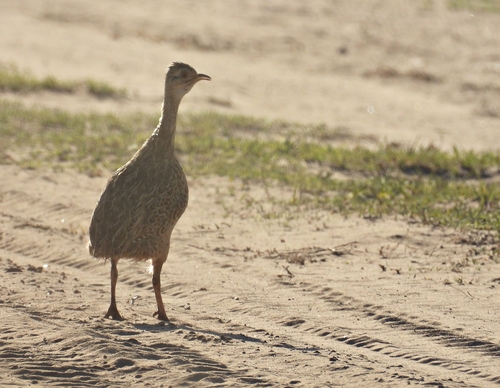 Spotted Nothura
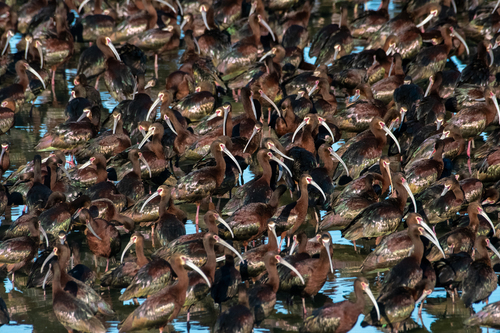 White-faced Ibis
In short
The most reliable field mark to separate Spotted Nothura from White-faced Ibis is overall structure and jizz: Spotted Nothura is a compact, ground-dwelling tinamou with short legs and a small head, while White-faced Ibis is a large, long-legged wader with a long, decurved bill and elongated neck. In flight or on the ground, the ibis is much larger and lankier, with a distinctive wader silhouette, whereas the nothura is quail-like and never seen wading. Plumage differences are also strong: Spotted Nothura shows brown and buff streaking and barring, especially on the breast and flanks, while White-faced Ibis is dark, glossy, and unpatterned except for subtle breeding face markings. Habitat is a strong clue: nothura in dry grassland, ibis in marshes.
Identification tips
- Size and Structure: White-faced Ibis is much larger, with a long neck, legs, and decurved bill; Spotted Nothura is compact, short-legged, and quail-like. This difference is obvious even at a distance.
- Bill Shape: Nothura has a short, straight bill; ibis has a long, slender, downward-curved bill. Bill shape alone is diagnostic in any clear view.
- Leg Length: Ibis has long, stilt-like legs visible both in flight and on the ground; nothura's legs are short and never extend beyond the tail in flight.
- Flight Silhouette: Ibis flies with neck and legs outstretched, forming a long, horizontal profile; nothura flies with a compact, rounded body, short tail, and no visible neck extension.
- Plumage Pattern: Nothura is brown above with buff streaking and barring on the underparts (all ages); ibis is uniformly dark and glossy, lacking any streaks or bars.
- Face and Eye Color: Breeding ibis shows a pink bare face with a white feather border and red eyes; nothura has a streaked crown and white throat, with no bare skin or bright eye color. Non-breeding ibis lacks the white border but still has a bare face and red eyes.
- Leg Color: Ibis legs are bright red (especially in breeding season); nothura's legs are dull yellowish-grey or brown.
- Habitat: Nothura is only found in dry grasslands; ibis is only found in marshes and wetlands. Habitat alone is usually enough to separate them.
- Behavior: Nothura walks or runs on the ground, rarely flushes; ibis is often seen wading, probing mud, or flying in flocks.
- Juvenile Confusion: Juvenile ibis lack the white facial border but are still dark and unpatterned, with a long bill and legs; juvenile nothura are streaked and barred like adults.
- Underwing/Flight Pattern: No distinctive age-specific upperwing or flight pattern is described for either species, so rely on structure and plumage.
- Voice: No vocalizations are described in the notes; do not use voice for separation.
- Context: If seen in a flock, especially in flight over water, it is almost certainly an ibis; nothura are solitary or in pairs and never flock in open air.
- Pitfalls: At long range, a distant ibis on land might appear brownish, but the long bill and legs will still be visible. A nothura never shows the ibis's proportions or behavior.
- When Uncertain: If you cannot see the bill or legs, use habitat and overall shape—compact and streaked in dry grass (nothura) vs. lanky and dark in wetland (ibis).
Size
White-faced Ibis is dramatically larger and heavier than Spotted Nothura. The ibis measures 46–56 cm in length with a body mass around 612.5 g [wikidata], while the nothura is only 24–25.5 cm long [wikipedia] and much lighter (exact mass not given, but tinamous of this size are typically under 300 g). In the field, the ibis towers over the nothura, with much longer legs, neck, and bill. The nothura is quail-sized; the ibis is closer to a small heron in bulk and stature.
Plumage
No age-specific upperwing or flight patterns are described for either species, so focus is on overall body plumage. Spotted Nothura (all ages) is brown above with buff streaking, and the underparts are buff with black and brown streaks on the breast and barring on the flanks. The crown is black streaked with buff, and the throat is white. The nothura's plumage is cryptic and patterned for camouflage in grass. In contrast, White-faced Ibis is dark and glossy overall, with no streaking or barring on the body. Breeding adults have a pink bare face bordered with white feathers, a gray bill, and red eyes and legs; non-breeding adults lack the white face border but remain dark and glossy. Juvenile ibis are similar to adults but duller, and lack the white facial border. There is no barring or streaking on the body at any age. Thus, any bird with strong streaking or barring on the underparts is a nothura; any bird with a uniform dark glossy body and long bill is an ibis.
Behaviour
Spotted Nothura is a terrestrial, ground-dwelling bird, typically seen walking or running in grasslands and rarely flies except when flushed. It never wades or swims. White-faced Ibis is a social, colonial wader, often seen probing in shallow water with its long bill, walking through marshes, or flying in flocks with neck and legs outstretched. The ibis is rarely found away from water and is almost always seen in wetland settings. Their behaviors are so different that confusion is unlikely except in a static, close-up view.
Habitat
Spotted Nothura is found in dry, grassy habitats—open grasslands, pampas, and savannas—across eastern and southern Brazil, Paraguay, Bolivia, Uruguay, and northern Argentina [wikipedia]. It avoids wetlands. White-faced Ibis is strictly associated with marshes, wetlands, and flooded fields, nesting in dense marsh vegetation or low trees and feeding in shallow water. Its range overlaps with nothura in parts of South America, but the two species occupy entirely different habitats. If the bird is in a wetland, it is almost certainly an ibis; in dry grassland, a nothura.