
Spotted Flycatcher vs Red-breasted Flycatcher
Muscicapa striata versus Ficedula parva
Play a quiz with Spotted Flycatcher and Red-breasted Flycatcher
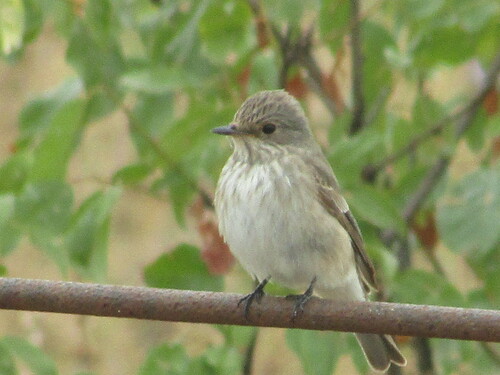 Spotted Flycatcher
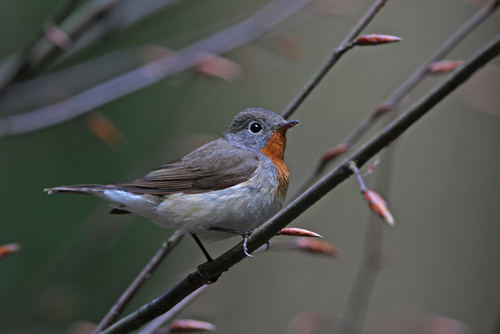 Red-breasted Flycatcher
In short
The most reliable field mark between Spotted Flycatcher and Red-breasted Flycatcher is the presence of a streaked crown and breast on Spotted Flycatcher of all ages, versus the clean face and (in adult males) orange throat of Red-breasted Flycatcher. Juvenile Spotted Flycatchers show ochre-buff spots above and scaly brown spots below, while Red-breasted Flycatcher juveniles and females lack these and instead have a clear white eyering and a distinctive black-and-white tail pattern. Structure also helps: Spotted Flycatcher is noticeably longer-tailed and larger, with a more upright, elongated jizz. Vocalizations and habitat overlap, so focus on plumage and structure for separation.
Identification tips
- Juvenile/immature plumage: Look for ochre-buff spots on the upperparts and scaly brown spots below in juvenile Spotted Flycatcher—Red-breasted Flycatcher juveniles and females never show these, instead appearing plain with a clear white eyering.
- Crown and breast streaking: Spotted Flycatcher of all ages has brown streaks on the crown and breast; Red-breasted Flycatcher is always unstreaked here, with a clean face and throat (except for the orange patch in adult males).
- Tail pattern in flight or fanned: Red-breasted Flycatcher has a black tail with white bases to the outer feathers, visible when the tail is spread or in flight—Spotted Flycatcher lacks any white in the tail, which is uniformly brownish with pale edges.
- Eyering: Red-breasted Flycatcher (all ages) shows a prominent white eyering, which is lacking or indistinct in Spotted Flycatcher.
- Throat patch: Adult male Red-breasted Flycatcher has a bright orange throat patch; Spotted Flycatcher never shows any orange on the throat. Females and immatures of Red-breasted lack the orange, so use other marks in those cases.
- Overall coloration: Spotted Flycatcher is grey-brown above and off-white below, with a slightly colder tone; Red-breasted Flycatcher is warmer brown above, especially in males.
- Wing and tail structure: Spotted Flycatcher has longer wings and tail, giving a more elongated, upright profile; Red-breasted Flycatcher is smaller, more compact, and often flicks its tail upwards.
- Perched jizz: Spotted Flycatcher sits upright and elongated, often returning to the same perch; Red-breasted Flycatcher is more active, flicking its tail and sometimes hovering near foliage.
- Bill color: Both have a black bill, but Red-breasted Flycatcher often shows a pale pinkish base, especially in males; Spotted Flycatcher bill is all black.
- Voice: Spotted Flycatcher gives a soft, high 'tssssseeeeeppppp'; Red-breasted Flycatcher gives a rattling 'zrrrt' and, in spring, a sweet, whistled song. Calls are subtle and best used as supporting evidence.
- Habitat: Not reliably diagnostic, but Spotted Flycatcher is more widespread in western Europe as a breeder; Red-breasted Flycatcher is more likely as a migrant or in eastern Europe/Central Asia.
- Size: Spotted Flycatcher is noticeably larger (14.5 cm vs 11–12 cm); with experience, this is apparent in the field, especially when both species are present.
- Sex and season: Only adult male Red-breasted Flycatcher shows the orange throat; females and immatures are plainer, so rely on eyering, tail pattern, and lack of streaking for these.
- Pitfalls: Beware of dull or worn Spotted Flycatchers appearing plain—check for subtle streaking and lack of eyering/tail pattern. Juvenile Spotted Flycatchers can look confusingly spotted, but this is never shown by Red-breasted Flycatcher.
- Flight views: In flight, look for the white tail bases of Red-breasted Flycatcher and the longer, more pointed wings of Spotted Flycatcher.
Size
Spotted Flycatcher is larger, measuring about 14.5 cm in length and weighing 14–20 g [wikipedia]. Red-breasted Flycatcher is smaller, at 11–12 cm long [wikipedia]. This size difference is often visible in direct comparison or with experience, with Spotted Flycatcher appearing longer and slimmer, especially in the tail and wings. Bill size is similar, but Spotted Flycatcher is overall bulkier.
Plumage
- Juveniles/immatures: Spotted Flycatcher juveniles have ochre-buff spots on the upperparts and scaly brown spots below, giving a distinctly speckled look. Red-breasted Flycatcher juveniles and females lack these spots, instead showing plainer brown upperparts and a clear white eyering. Both species are brownish above and pale below as immatures, but only Spotted Flycatcher is heavily spotted and streaked.
- Adults: Adult Spotted Flycatcher is grey-brown above, off-white below, with brown streaks on the crown, throat, and breast. Red-breasted Flycatcher adult males have muted brown upperparts, a grey head, white underparts, and a well-defined orange throat patch (females and immatures lack the orange). Both sexes of Red-breasted Flycatcher have a prominent white eyering and a black tail with white bases to the outer feathers, which is diagnostic in flight or when the tail is fanned. Spotted Flycatcher lacks this tail pattern, having uniformly brownish tail feathers with pale edges.
- Wings: Spotted Flycatcher has long wings with pale thin margins; Red-breasted Flycatcher wings are proportionally shorter and less pointed, with no distinctive pale panels.
Behaviour
Both species hunt by sallying from perches to catch insects, but Spotted Flycatcher often uses a more upright posture and returns to the same perch repeatedly. Red-breasted Flycatcher frequently flicks its tail upwards and holds wingtips down while perched, and may forage more in the canopy or among leaves, sometimes hovering briefly. Both can be seen on exposed perches, but Spotted Flycatcher appears more elongated and static, while Red-breasted Flycatcher is more active and flicks its tail more often.
Habitat
Both species can overlap in woodland edge, gardens, and parks, but Spotted Flycatcher breeds widely across Europe and western Asia, whereas Red-breasted Flycatcher breeds mainly in eastern Europe and Central Asia and is a passage migrant in the west. Habitat is not a reliable separator in migration or in mixed woodlands, but Spotted Flycatcher is more likely in western Europe as a breeder.
Voice
Spotted Flycatcher gives a thin, high-pitched, descending 'tssssseeeeeppppp' call. Red-breasted Flycatcher has a short, rattling 'zrrrt' call and, in breeding males, a sweet, whistled song with quiet introductory notes and a descending sequence. Calls are not always diagnostic, but the rattling call of Red-breasted Flycatcher is slower and more mechanical than Spotted Flycatcher's soft, high-pitched call. Song is only given by adult males for a few weeks in spring and is not heard on migration or in winter.
Spotted Flycatcher · Red-breasted Flycatcher · My Tricky Birds