

Spotted Flycatcher vs European Pied Flycatcher
Muscicapa striata versus Ficedula hypoleuca
Play a quiz with Spotted Flycatcher and European Pied Flycatcher
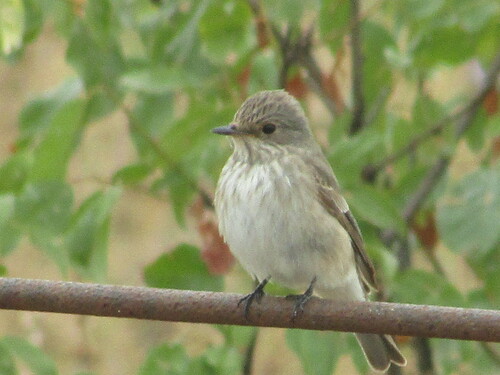 Spotted Flycatcher
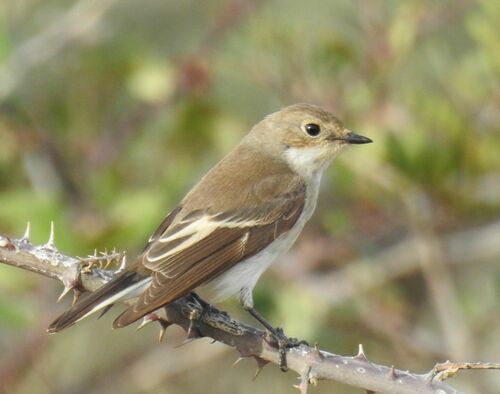 European Pied Flycatcher
In short
The most reliable field mark between Spotted Flycatcher and European Pied Flycatcher is the presence of strong streaking on the crown and breast in Spotted Flycatcher of all ages, versus the clean, unstreaked underparts of Pied Flycatcher (except for faint juvenile spotting). Juvenile Spotted Flycatchers also show ochre-buff spots above and scaly brown spots below, while young Pied Flycatchers are plainer brownish. Adult male Pied Flycatchers in breeding plumage are strikingly black-and-white, unlike the always grey-brown Spotted Flycatcher. Structure helps: Spotted Flycatcher is longer-tailed and longer-winged, with a more upright, slender jizz. Both species can appear similar in dull female or immature plumage, but careful attention to streaking, wing pattern, and posture will separate them.
Identification tips
- Streaked Crown and Breast (All Ages): Spotted Flycatcher always shows brown streaks on the crown, throat, and breast. Pied Flycatcher lacks these streaks at all ages.
- Juvenile Plumage: Juvenile Spotted Flycatchers have ochre-buff spots above and scaly brown spots below, making them look speckled or scaly. Juvenile Pied Flycatchers are plain brownish without strong spotting or streaking.
- Adult Male Pied Flycatcher: Breeding males are unmistakable: black above, white below, with a bold white wing patch and white on the tail sides and forehead. Spotted Flycatcher is never black-and-white.
- Female/Immature Pied Flycatcher: These can be confusingly brownish and white, but lack the Spotted Flycatcher's streaked breast and crown. They may show a faint wing patch, which Spotted Flycatcher never has.
- Wing Pattern: Pied Flycatcher (especially males) shows a white wing patch; Spotted Flycatcher has dull wings with only pale edges, no patch.
- Tail and Wing Structure: Spotted Flycatcher has a longer tail and wings, giving a more elongated and upright look when perched; Pied Flycatcher is shorter-tailed and more compact.
- Perching Posture: Spotted Flycatcher sits very upright, often returning to the same perch after sallying. Pied Flycatcher is more horizontal and flicks its wings and tail more frequently.
- Bill Shape: Both have broad-based bills typical of flycatchers, but Spotted Flycatcher's is slightly longer and more pointed in impression.
- Breast and Belly: Spotted Flycatcher always has some streaking or spotting below; Pied Flycatcher is clean white or buff below (except faint juvenile marks).
- Wing Edges: Spotted Flycatcher has thin, pale edges to wing and tail feathers; Pied Flycatcher may show a more obvious wing patch (males) or faint panel (females/immatures).
- Seasonal Pitfalls: In autumn, both species can appear drab; rely on streaking (Spotted) vs. plainness (Pied) and look for any residual wing patch in Pied.
- Habitat: Overlap is extensive, but Pied Flycatcher is more tied to mature woodland with cavities, while Spotted Flycatcher is common in gardens and open woodland.
- Size: Spotted Flycatcher is slightly larger and longer-tailed, but this is subtle and best used in direct comparison.
- Voice: If heard, Spotted Flycatcher gives a thin, descending 'tssssseeeeeppppp'; Pied Flycatcher’s calls are not described here.
- Subspecies: Mediterranean flycatchers (formerly Spotted Flycatcher subspecies) may be paler and less streaked, but still show more streaking than Pied Flycatcher.
Size
Spotted Flycatcher is slightly larger and heavier, averaging about 14.5 cm in length and 14–20 g in weight, while European Pied Flycatcher is smaller at 12–13.5 cm and about 12 g. In the field, this size difference is subtle, but Spotted Flycatcher often appears longer and slimmer, with a proportionally longer tail and wings. Pied Flycatcher is more compact and short-tailed, especially noticeable when perched.
Plumage
- Juveniles/First-years: Juvenile Spotted Flycatchers are brownish above with ochre-buff spots on the upperparts and scaly brown spots below, plus distinct streaking on the crown and breast. Juvenile Pied Flycatchers are plainer brown above and below, lacking strong streaking or spotting, and do not show the Spotted Flycatcher's scaly or spotted look.
- Adult males (breeding): Male Pied Flycatchers are boldly black above and white below, with a large white wing patch, white tail sides, and a small white forehead patch. Spotted Flycatcher adults are always grey-brown above and off-white below, with brown streaks on the crown, throat, and breast, and never show black-and-white contrast or wing patches.
- Females/Non-breeding males: Female and non-breeding male Pied Flycatchers are pale brown above and whitish below, sometimes with a faint wing patch, but lack the Spotted Flycatcher's streaked crown and breast. Spotted Flycatcher remains streaked and dull grey-brown year-round, with paler thin edges to wing and tail feathers.
- Wing pattern: Pied Flycatcher (all ages) may show a white wing patch (especially males), while Spotted Flycatcher has uniformly dull wings with only pale edges, never a wing patch.
Behaviour
Both species hunt insects from perches, but Spotted Flycatcher is especially noted for its upright posture and repeated use of the same perch for sallying. Pied Flycatcher is more restless, often flicking wings and tail, and may appear more active in short flights between perches. Spotted Flycatcher’s longer tail and wings give it a more elongated, upright look when perched, whereas Pied Flycatcher is more compact and horizontal.
Habitat
Both species breed widely across Europe and the Western Palearctic, often in similar wooded or parkland habitats. There is significant overlap, so habitat alone is not diagnostic, but Spotted Flycatcher may be more likely in open woodlands, gardens, and edges, while Pied Flycatcher prefers mature deciduous or mixed forests, especially with nest boxes or natural cavities.
Voice
Spotted Flycatcher's call is a thin, drawn-out, soft and high-pitched 'tssssseeeeeppppp,' slightly descending in pitch. Pied Flycatcher's vocalizations are not described in the provided notes, so voice is not a reliable separator based on this information.
Spotted Flycatcher · European Pied Flycatcher · My Tricky Birds