
Spotted Flycatcher vs Common Nightingale
Muscicapa striata versus Luscinia megarhynchos
Play a quiz with Spotted Flycatcher and Common Nightingale
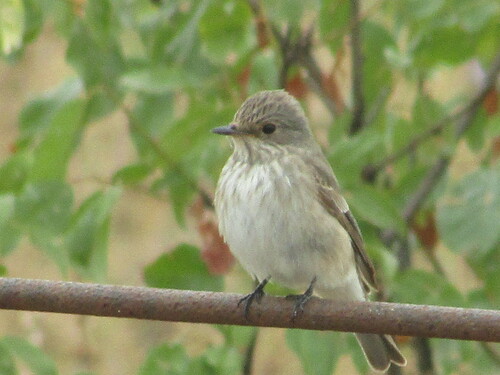 Spotted Flycatcher
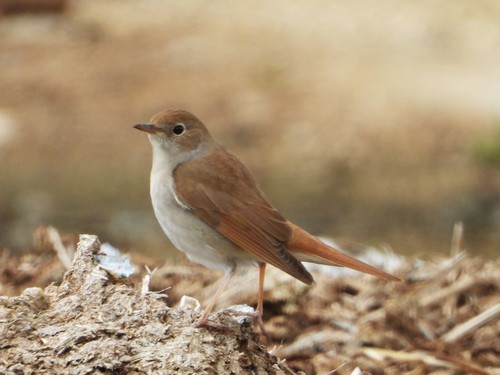 Common Nightingale
In short
Juvenile Spotted Flycatchers show ochre-buff spots above and scaly brown spots below, while juvenile Common Nightingales are plain brown above with a reddish tail and lack strong spotting. Adults are best separated by the Spotted Flycatcher's streaked crown and breast, compared to the Nightingale's plain face and underparts (except for the reddish tail). The Spotted Flycatcher is slimmer, with longer wings and a more upright, sallying posture, while the Nightingale appears bulkier and more terrestrial. If singing, the Nightingale's famously rich, varied song is unmistakable, but silent birds require careful attention to structure and subtle plumage details.
Identification tips
- Juvenile plumage: Look for ochre-buff spots on the upperparts and scaly brown below in juvenile Spotted Flycatchers; Nightingale juveniles are plain brown above and buff below, with a rufous tail but no spots. This is a strong separation in late summer/autumn.
- Crown and breast streaking (adults): Adult Spotted Flycatchers have fine brown streaks on the crown, throat, and breast, while Nightingales are plain-faced and plain-breasted (except for a subtle pale supercilium in some eastern subspecies).
- Tail color: Nightingales of all ages have a warm rufous tail contrasting with the brown back; Spotted Flycatchers have a duller brown tail with pale edges, lacking any rufous tone.
- Wing and tail structure: Spotted Flycatchers have long wings and tail, giving a slim, elongated appearance, especially when perched upright. Nightingales are bulkier, with shorter wings and a rounder body.
- Bill shape: The Flycatcher's bill is broad at the base and pointed, suited to aerial insect catching; the Nightingale's bill is finer and less broad.
- Leg color: Both species have dark legs, so this is not a useful separator.
- Perched posture: Spotted Flycatchers perch upright and exposed, often high on branches or wires; Nightingales are more horizontal, low, and hidden in dense cover.
- Foraging behavior: Watch for repeated sallying flights from a perch (Flycatcher) versus ground or low-vegetation foraging (Nightingale).
- Habitat: In dense, damp thickets or scrub, Nightingale is more likely; in open woodland, parks, or gardens with scattered trees, expect Spotted Flycatcher.
- Song: If singing, Nightingale's rich, varied, and loud song is unmistakable; Spotted Flycatcher's call is thin, soft, and easily missed.
- Seasonal context: Both are migrants, but Nightingale is much more localized and scarce in northern/western Europe; check local abundance on eBird if unsure.
- Sex differences: Both species are sexually monomorphic in plumage; do not rely on sex for separation.
- Flight views: No strong wing pattern in either species, but the Flycatcher's long, pointed wings may be apparent in flight compared to the Nightingale's shorter, rounder wings.
- Subspecies confusion: Eastern Nightingales may show a pale supercilium, but still lack breast streaking; Mediterranean Flycatchers (split from Spotted) are paler but retain the streaked breast.
- Pitfalls: Beware of worn or molting birds, which may lose some streaking or appear plainer; always combine multiple marks for confident ID.
Size
The Common Nightingale is slightly larger, measuring 15–16.5 cm in length, compared to the Spotted Flycatcher's 14.5 cm. Both are small passerines, but the Nightingale is bulkier, while the Flycatcher is slimmer and more elongated, with longer wings and tail relative to body size. Weight ranges overlap (Flycatcher: 14–20 g), but the Nightingale's more robust build is often apparent in the field. [wikipedia][avonet]
Plumage
- Juvenile/First-year: Juvenile Spotted Flycatchers are distinctly marked with ochre-buff spots on the upperparts and scaly brown spots below, making them appear speckled and patterned. In contrast, juvenile Nightingales are plain brown above and buff to white below, with no strong spotting, but show a warm reddish tail even at this age.
- Adult: Adult Spotted Flycatchers have grey-brown upperparts, off-white underparts, and show fine brown streaks on the crown, throat, and breast. Their wings and tail are edged with pale margins. Nightingales are plain brown above, with a contrasting rufous tail and buff to white underparts, lacking any streaking or strong facial markings except in some eastern subspecies (which may show a pale supercilium). Both species have similar dark legs and bills, but the Flycatcher's bill is broader at the base and more pointed. Sexes are alike in both species. [wikipedia]
Behaviour
Spotted Flycatchers are classic aerial insectivores: they perch upright and conspicuously, making repeated sallies to catch flying insects and often returning to the same perch. Their posture is upright and alert, and they are frequently seen in open, elevated spots. Nightingales, by contrast, are more terrestrial and secretive, foraging mostly on or near the ground in dense cover. They rarely sally for insects and are more likely to be seen skulking in low vegetation. The Flycatcher's behavior is active and open, while the Nightingale is shy and retiring. [wikipedia]
Habitat
Spotted Flycatchers breed in open woodlands, parks, gardens, and edges of forests across most of Europe and the Palearctic, favoring areas with scattered trees and open perches. Nightingales prefer dense, low scrub, thickets, and coppiced woodland, especially in humid or damp areas, and are much less likely to be found in open or urban habitats. In the UK, Nightingales are very localized and declining, mostly in southeast England, while Spotted Flycatchers are more widespread but also declining. [wikipedia][ebird]
Voice
The Spotted Flycatcher's call is a thin, soft, high-pitched 'tssssseeeeeppppp', slightly descending. It is not musical and is easily overlooked. The Common Nightingale, on the other hand, is renowned for its powerful, rich, and varied song, often delivered at night or dawn, with a mix of whistles, trills, and gurgles. The Nightingale's song is a key field mark and is unmatched by the Flycatcher. [wikipedia]