

Spot-winged Grosbeak vs Scarlet Finch
Mycerobas melanozanthos versus Carpodacus sipahi
Play a quiz with Spot-winged Grosbeak and Scarlet Finch
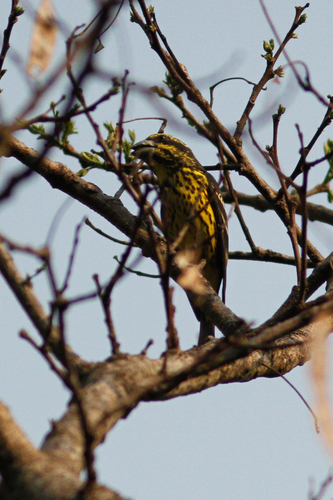 Spot-winged Grosbeak
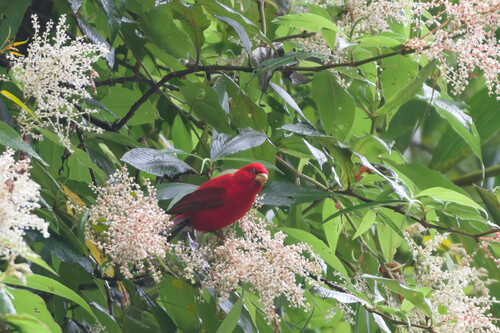 Scarlet Finch
In short
Spot-winged Grosbeak and Scarlet Finch can be confused where their ranges overlap in the Himalayas and Southeast Asia, but the most reliable field mark is size: Spot-winged Grosbeak is substantially heavier and bulkier than Scarlet Finch. If you see two birds together, the grosbeak will look noticeably larger and more robust. Both species occur in similar montane forest habitats, so focus on structure and overall impression. Plumage details are not described in the sources, so rely on size and jizz for separation.
Identification tips
- Size is the most reliable field mark: Spot-winged Grosbeak is much larger and heavier than Scarlet Finch. Use this whenever you get a direct comparison or a clear view of the bird's bulk.
- Overall structure/jizz: Spot-winged Grosbeak appears more robust, with a thicker neck and heavier body, while Scarlet Finch is slimmer and more delicate in build.
- Bill size: Although not detailed in the sources, grosbeaks generally have a stouter, deeper bill than finches. If you see a particularly thick, conical bill, it likely belongs to the grosbeak.
- Plumage is not diagnostic: No age-specific or adult plumage marks are described for either species in the sources. Do not rely on wing pattern or color differences for separation.
- Flight views: Since no wing pattern or flight-specific marks are given, focus on the bird's size and shape in flight. The grosbeak should appear bulkier and more powerful.
- Habitat overlap: Both species occur in the same types of montane forests and can be found together, so do not use habitat as a primary separator.
- Flock context: If you see a mixed flock, look for the largest, most robust finch—this will likely be the Spot-winged Grosbeak.
- Perched posture: Spot-winged Grosbeak may appear more upright and solid when perched, while Scarlet Finch may look more delicate and less imposing.
- No vocalization data: Do not use voice for separation based on current sources.
- Geographic range: Both species overlap widely in the Himalayas and Southeast Asia, so range alone is not a safe separator.
- Sex and age: No sex- or age-specific differences are described for field identification in the sources. Assume size is consistent across ages and sexes for both species.
- Season: Both species are present year-round in parts of their range; seasonal movement is not a reliable field mark for separation.
- When in doubt: If you cannot judge size or structure, and no other marks are visible, it may not be possible to separate these species with confidence from a brief or distant view.
Size
Spot-winged Grosbeak is much heavier (62g) than Scarlet Finch (40g) [wikidata], making it one of the bulkiest finches in its range. In the field, this translates to a noticeably larger, more powerful bird with a thicker neck and stouter body compared to the more delicate, slim Scarlet Finch. If you get a good view, the grosbeak's size and mass are often apparent even at a distance, especially if both species are present at the same feeding flock or perch.
Plumage
No detailed plumage or age-specific wing pattern information is provided in the sources for either species. Therefore, plumage is not a reliable field mark for separating Spot-winged Grosbeak from Scarlet Finch in this context. Focus on structure, size, and jizz.
Behaviour
Behavioral differences are not described in the provided sources. Both species are finches and likely to be seen feeding in trees or shrubs, sometimes in mixed flocks. Without further details, behavior is not a reliable separator.
Habitat
Both species occur in similar habitats: subtropical or tropical moist montane forests and dry forests at middle to higher elevations. Their ranges overlap in the Himalayas and parts of Southeast Asia, so habitat alone will not reliably separate them. Both can be found from India and Nepal east to Thailand and Vietnam.