

Spot-tailed Nightjar vs Rufous Nightjar
Antiurus maculicaudus versus Antrostomus rufus
Play a quiz with Spot-tailed Nightjar and Rufous Nightjar
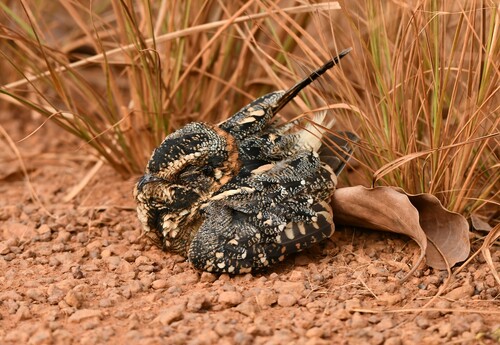 Spot-tailed Nightjar
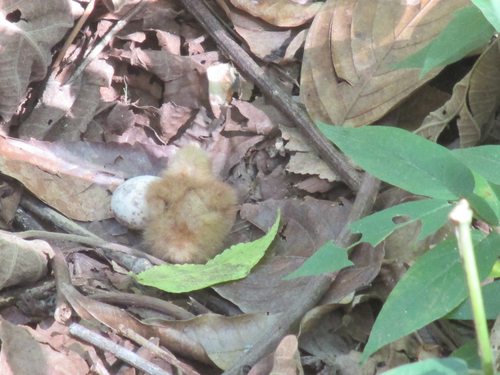 Rufous Nightjar
In short
The most reliable way to separate Spot-tailed Nightjar from Rufous Nightjar is by size and tail pattern: Spot-tailed is distinctly smaller and lighter, with a shorter, less robust look, and the male’s tail shows large white spots plus white tips with a buff wash, while Rufous Nightjar is much larger, bulkier, and the male’s tail has only a single large white spot at the end of the outer three pairs of feathers. Spot-tailed shows a broad cinnamon hindneck band and a buff supercilium, while Rufous is overall more rufous with a buff neck collar and a white throat band. In flight or perched, Spot-tailed’s upperparts are more patterned with buff or tawny spots and bars, while Rufous Nightjar is more uniform reddish brown. These differences are visible in both perched and flying birds, but size and tail pattern are most reliable, especially in males.
Identification tips
- Size is a strong separator: Spot-tailed Nightjar is much smaller and lighter than Rufous Nightjar. If the bird looks large and robust, suspect Rufous.
- Tail pattern in males: Spot-tailed males have two or three large white spots on the outer tail feathers and white tips with a buff wash; Rufous males have only one large white spot at the end of the outer three pairs of tail feathers. This is the most diagnostic mark if you see the tail well.
- Tail pattern in females: Spot-tailed females lack the white tips but still show tawny markings and multiple white spots; Rufous females have pale buff tips but not the multiple white spots of Spot-tailed.
- Hindneck band: Spot-tailed shows a broad cinnamon band across the hindneck, while Rufous has a buff collar on the sides and back of the neck but not as broad or cinnamon-toned.
- Supercilium: Spot-tailed has a broad buff supercilium (eyebrow), which Rufous lacks or is much less distinct.
- Facial color: Spot-tailed’s face is tawny or rufous with dark brown speckles; Rufous is more uniformly reddish brown.
- Upperparts pattern: Spot-tailed is more heavily spotted and barred with buff or tawny above; Rufous is more uniform reddish brown with dark brown streaks but less contrasty.
- Underparts: Spot-tailed’s underparts are cinnamon to buff, with less white; Rufous has underparts speckled with dark brown and white, and a prominent white band under the throat.
- Wing pattern: Neither species has white in the wings, but Spot-tailed’s wings are more obviously spotted with tawny, while Rufous’s are more uniformly barred and lack white.
- Flight jizz: Spot-tailed appears shorter, lighter, and more patterned in flight; Rufous is bulkier, longer-winged, and more uniform in color.
- Foraging behavior: Spot-tailed often flushes from the ground; Rufous is more likely to sally from a low perch, though this is not always visible.
- Habitat context: Both can occur in open areas, but Spot-tailed is more likely in sandy or scrubby habitats; Rufous is more generalist.
- Voice: If you hear a high, lisping 'tip-SEEEUUEEET', it is Spot-tailed; Rufous’s song is not described here, so do not rely on voice unless you know local calls well.
- Subspecies variation: Some Rufous Nightjar subspecies (e.g., A. r. saltarius) are grayer, but none are as patterned as Spot-tailed.
- Pitfall: Both can look rufous and spotted, especially in poor light; always check size and tail pattern if possible.
Size
Spot-tailed Nightjar is significantly smaller: 20.3–21.5 cm in length and 26–39 g in mass. Rufous Nightjar is much larger and heavier: 25–30 cm long and 88–98 g. This size difference is substantial and obvious in the field, with Rufous Nightjar appearing bulkier and longer-winged. If you see both together, the contrast is striking, but even singly, a nightjar approaching the size of a Common Nighthawk is likely Rufous, while a much smaller, more delicate bird fits Spot-tailed.
Plumage
- Juvenile/immature/first-winter birds: No specific age-unique upperwing or flight marks are described for either species, so focus is on adult plumage, which is similar across ages.
- Spot-tailed Nightjar: Upperparts brown with strong buff/tawny spots and bars; crown darker, rump paler. Broad cinnamon band on hindneck, broad buff supercilium. Wings brown with tawny spots. Tail: four outer feathers on each side dark brown with tawny markings, two or three large white spots, and (in males) white tips with a buff wash. Inner tail feathers longer, grayish brown with bars. Underparts cinnamon to buff, belly and flanks buff.
- Rufous Nightjar: Overall much more rufous or reddish brown, with a buff collar on the sides and back of neck and a white band under the throat. Upperparts have dark brown streaks, wings are spotted/barred with dark brown, but notably lack white in the wings. Underparts are speckled with dark brown and white. Male’s outer three pairs of tail feathers have a large white spot at the end; female’s have a pale buff tip. Some subspecies are grayer, but none as patterned as Spot-tailed.
- Key contrasts: Spot-tailed is more patterned and spotted above, with a cinnamon hindneck band and buff supercilium; Rufous is more uniform, redder, with a buff neck collar and white throat band. Tail pattern is diagnostic in males: Spot-tailed has multiple white spots and white tips, Rufous has only one large white spot at the end of the outer three pairs.
Behaviour
Both species are nocturnal insectivores, but Spot-tailed Nightjar often forages by sallying from the ground or in low, slow flight, while Rufous Nightjar typically sallies from a low perch such as a branch or fencepost. This difference can be subtle and is not always visible, but if you see a bird launching from the ground, Spot-tailed is more likely; from a low perch, Rufous is more likely.
Habitat
Both species have overlapping ranges in much of South America and occupy similar lowland and open habitats. Spot-tailed Nightjar’s distribution is highly patchy, with populations scattered from southern Mexico through much of South America except Chile and Uruguay, and it is found from lowlands up to moderate elevations (up to 1,350 m in Peru). Rufous Nightjar is widespread in South and Central America, including some Caribbean islands. Habitat alone is not diagnostic, but Spot-tailed is more likely in open, sandy, or scrubby areas, while Rufous is more adaptable and can be found in a range of open woodlands and edges.
Voice
Spot-tailed Nightjar’s song is a high, lisping 'tip-SEEEUUEEET', with calls including a rapid 't-seet t-seet t-seet' and a slightly wailing 'seeeu' in flight. Rufous Nightjar’s vocalizations are not described in detail in the provided notes, so voice is not a reliable separator based on this information.