

Southern Royal Albatross vs Atlantic Yellow-nosed Albatross
Diomedea epomophora versus Thalassarche chlororhynchos
Play a quiz with Southern Royal Albatross and Atlantic Yellow-nosed Albatross
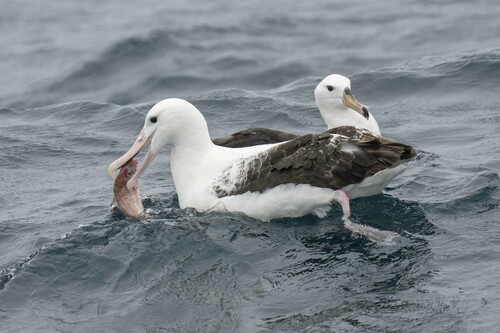 Southern Royal Albatross
 Atlantic Yellow-nosed Albatross
In short
The most reliable way to separate Southern Royal Albatross from Atlantic Yellow-nosed Albatross is by size and structure: Southern Royal is a true giant, massively outsizing the Atlantic Yellow-nosed in every dimension, with a bulkier build and much broader wings. In flight, juvenile Southern Royals show all-dark upperwings, but adults of both species differ sharply: Southern Royal is mostly white with black upperwings and a clean white head, while Atlantic Yellow-nosed is a smaller, narrower-winged mollymawk with a grey head and a distinctive black-and-yellow bill. Even at a distance, the immense wingspan and bulk of Southern Royal is unmistakable next to the daintier, more sharply marked Atlantic Yellow-nosed. Bill color and head pattern are also strong clues, especially at close range.
Identification tips
- Size is overwhelming: Southern Royal is nearly four times heavier and vastly larger than Atlantic Yellow-nosed. If the bird appears truly massive, with a wingspan over 3 meters, it's a Southern Royal. Atlantic Yellow-nosed is much smaller and lighter.
- Wing shape and breadth: Southern Royal has very broad, long wings, giving a heavy, ponderous flight. Atlantic Yellow-nosed has notably narrower wings, resulting in a more agile, quick flight style.
- Juvenile upperwing pattern: Juvenile Southern Royals have all-dark upperwings with white flecks, while juvenile Atlantic Yellow-nosed shows a similar pattern but with a white head and a black bill. However, the size difference still applies.
- Adult head color: Adult Southern Royal has a clean white head and neck, while Atlantic Yellow-nosed adult has a grey head with a prominent dark eye patch and white nape/hindneck.
- Bill color and pattern: Southern Royal's bill is pink with a black cutting edge (all ages). Atlantic Yellow-nosed has a black bill with a yellow ridge (culminicorn) and a pink tip (adult); juveniles have a black bill.
- Underwing pattern: Atlantic Yellow-nosed shows a narrow black margin to the underwing, while Southern Royal's underwing is mostly white with only black at the tip in juveniles and black upperwings in adults.
- Tail pattern: Juvenile Southern Royal has a white tail with a black tip, which is lost as they age. Atlantic Yellow-nosed has a blackish-grey tail.
- Body structure: Southern Royal appears heavy-bodied and thick-necked, while Atlantic Yellow-nosed is slim and more delicate overall.
- Crown and mantle: Southern Royal lacks any dark crown or peachy wash, while Atlantic Yellow-nosed has a grey crown and dark saddle.
- Context and range: If seen in the far southern oceans, especially near New Zealand, Southern Royal is more likely. Atlantic Yellow-nosed is more likely in the South Atlantic.
- Perched posture: If seen on land, Southern Royal is much bulkier and stands taller than Atlantic Yellow-nosed.
- Sexual dimorphism: Southern Royal males are even heavier than females, but both sexes are much larger than Atlantic Yellow-nosed.
- Pitfalls: Juvenile Southern Royal with all-dark upperwings can superficially resemble a mollymawk, but the huge size and white head remain distinctive.
- Bill details at close range: The yellow culminicorn and pink tip of Atlantic Yellow-nosed are unique among these two, never shown by Southern Royal.
- Flight style: Southern Royal's flight is slower and more stately, while Atlantic Yellow-nosed is quicker and more buoyant.
Size
Southern Royal Albatross is among the largest flying birds, averaging 9000 g (with males even heavier), and a wingspan well over 3 meters. Atlantic Yellow-nosed Albatross is much smaller, averaging only 2060 g, and about 81 cm in length. The difference is so extreme that, even with poor views, the Southern Royal appears enormous and heavy-bodied, with long, broad wings, while the Atlantic Yellow-nosed looks slim, light, and narrow-winged by comparison. Size alone is diagnostic if both are seen together or with other seabirds for scale.
Plumage
Juvenile Southern Royal Albatrosses have all-dark upperwings with white flecks on the coverts, a white head, neck, and underparts, and a white tail with a black tip. As they age, the upperwing becomes increasingly white, starting as speckles from the leading edge. Adults are strikingly white overall with black upperwings and a clean white head, lacking any peach or buffy wash. In contrast, Atlantic Yellow-nosed Albatross adults have a grey head with a large dark eye patch, a white nape and hindneck, and a blackish-grey saddle, tail, and upperwing. Their underwing shows a narrow black margin. Juveniles resemble adults but have a white head and a black bill. The bill of Atlantic Yellow-nosed is black with a yellow top ridge and a pink tip, while Southern Royal's bill is pink with a black cutting edge. The Southern Royal lacks the grey head and yellow bill markings of the Atlantic Yellow-nosed at all ages.
Behaviour
Southern Royal Albatrosses display elaborate courtship behaviors such as bill-snapping, clapping, gulping, and sky-calling with outstretched wings. While both species are pelagic and soar over the ocean, the Southern Royal's flight is slower and more ponderous due to its size, with deep, powerful wingbeats and long glides. Atlantic Yellow-nosed Albatross, being much lighter, shows quicker, more agile flight with narrower wings. Both species are rarely seen perched except at breeding colonies.
Habitat
Both species are oceanic and spend most of their lives at sea, but Southern Royal Albatross breeds on subantarctic islands like Campbell Island, preferring tussock grassland and ridges. Atlantic Yellow-nosed Albatross breeds on islands in the South Atlantic. In the field, habitat is rarely a useful separator unless seen at a known colony, but the Southern Royal is more likely encountered in the far southern oceans, while Atlantic Yellow-nosed is more restricted to the South Atlantic and adjacent waters.
Southern Royal Albatross · Atlantic Yellow-nosed Albatross · My Tricky Birds