

Southern Pochard vs Rosy-billed Pochard
Netta erythrophthalma versus Netta peposaca
Play a quiz with Southern Pochard and Rosy-billed Pochard
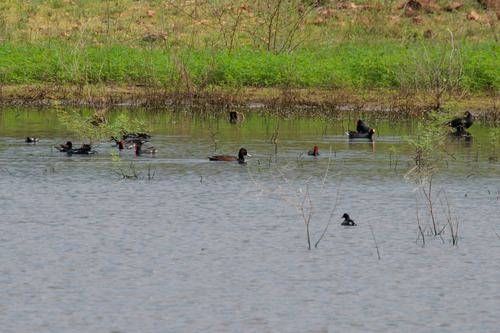 Southern Pochard
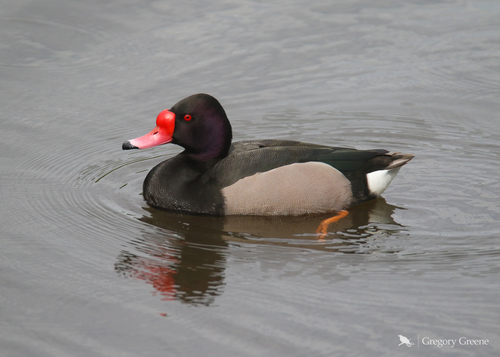 Rosy-billed Pochard
In short
The most reliable field mark to separate Southern Pochard from Rosy-billed Pochard is the male Rosy-billed's vivid red bill with a large, rounded knob, which is entirely absent in Southern Pochard. In flight, Rosy-billed Pochard of all ages shows a broad white stripe on the primaries and secondaries, a feature not mentioned for Southern Pochard. Female and immature Rosy-billeds are dull brown, but still show a contrasting white crissum and the white wing stripe in flight. Southern Pochard lacks these bold contrasts and is overall plainer. Size is also a clue: Rosy-billed is noticeably heavier and bulkier than Southern Pochard.
Identification tips
- In flight, look for the broad white stripe on the primaries and secondaries of Rosy-billed Pochard (all ages/sexes); Southern Pochard lacks this and appears more uniformly dark.
- Adult male Rosy-billed shows a bright red bill with a large, rounded knob at the base—unique and unmistakable; Southern Pochard never shows a red bill or knob.
- Female and immature Rosy-billeds are dull brown but show a bluish-gray bill with a black tip and a contrasting white crissum (undertail area); Southern Pochard females/immatures lack the white crissum and have a more uniformly dark or brownish appearance.
- Rosy-billed males have a purplish-black head, neck, and breast with gray sides; Southern Pochard is overall more uniformly dark or brownish, lacking the strong contrast.
- Rosy-billed Pochard is noticeably bulkier and heavier than Southern Pochard—look for a more robust, broad-bodied duck, especially in mixed flocks.
- Rosy-billeds do not show a dull eclipse plumage; males are always bright, so a drab male is unlikely to be Rosy-billed.
- Bill color is a key field mark: bright red with a knob (male Rosy-billed), bluish-gray with black tip (female/immature Rosy-billed), never seen in Southern Pochard.
- Southern Pochard lacks any bright or contrasting bill coloration and is overall more subdued in appearance.
- On the water, Rosy-billeds may appear more buoyant and broad-backed; Southern Pochard sits lower and appears slimmer.
- If you see feeding behavior, Rosy-billeds may dabble more often than Southern Pochard, but both are primarily diving ducks.
- Leg color is not a strong separator, but Rosy-billeds have yellow to orange legs and feet, sometimes grayish in females.
- Vocalizations are not diagnostic in the field, but a deep, quiet honk may suggest Rosy-billed if heard well.
- Habitat overlap is extensive in South America; do not rely on location alone for identification.
- Juvenile Rosy-billeds resemble females but are darker below; still look for the white crissum and wing stripe in flight.
- When in doubt, prioritize the presence or absence of the white wing stripe in flight and the bill shape/color for perched or swimming birds.
Size
Rosy-billed Pochard is significantly larger and heavier, with an average body mass of about 1092.5 g compared to Southern Pochard's 777 g [wikidata]. Rosy-billeds can reach up to 56 cm in length and have a wingspan of 72–84 cm, making them bulkier and longer-winged than Southern Pochard. While both are medium-sized ducks, in direct comparison, the Rosy-billed will appear more robust and broad-bodied, especially in males.
Plumage
For all ages, the most distinctive plumage difference is in flight: Rosy-billed Pochard shows a broad white stripe on the primaries and secondaries, visible only when the wings are outstretched [wikipedia]. Southern Pochard does not show this feature and is overall more uniformly dark. Adult male Rosy-billeds have a purplish-black head, neck, and breast, gray sides, and a bright red bill with a large knob. Females and immatures are dull brown with a bluish-gray bill and a contrasting white crissum (undertail area); their underparts are darker than adult females. Southern Pochard lacks the bright bill, knob, and white crissum, and is more uniformly dark or brownish overall, with no strong contrasts. Rosy-billed males do not show an eclipse (dull) plumage, so their bright features are present year-round, unlike some northern ducks.
Behaviour
Both species are diving ducks, but Rosy-billed Pochard often feeds more like a dabbling duck, frequently seen upending for seeds and aquatic plants [wikipedia]. Rosy-billeds are strong fliers but have blunt-tipped wings and require faster wingbeats and a longer takeoff run than many ducks. Their legs are set far back, making them awkward walkers on land. Southern Pochard's behavior is less described, but as a typical Netta, it is likely similar in being more aquatic and less agile on land.
Habitat
Both species inhabit freshwater wetlands, lakes, and marshes. Rosy-billed Pochard is endemic to South America, found in Argentina, central Chile, Paraguay, Uruguay, and southern Brazil, with some seasonal movement. Southern Pochard also occurs in South America (with a separate African subspecies), so their ranges overlap in southern South America. Both may be seen in similar wetland habitats, so habitat alone is not a reliable separator.
Voice
Rosy-billed Pochard has a characteristic Anatidae 'honk,' but it is deeper and relatively quiet compared to a Mallard [wikipedia]. There is no specific vocal description for Southern Pochard in the notes, so voice is not a strong field mark for separation.