

Southern Bald Ibis vs Hadada Ibis
Geronticus calvus versus Bostrychia hagedash
Play a quiz with Southern Bald Ibis and Hadada Ibis
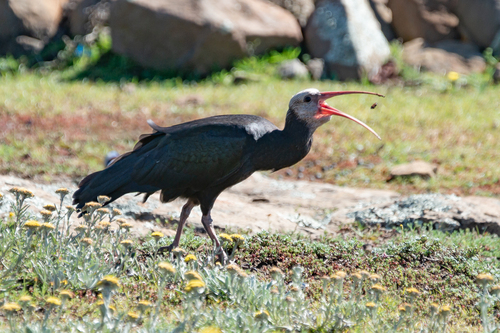 Southern Bald Ibis
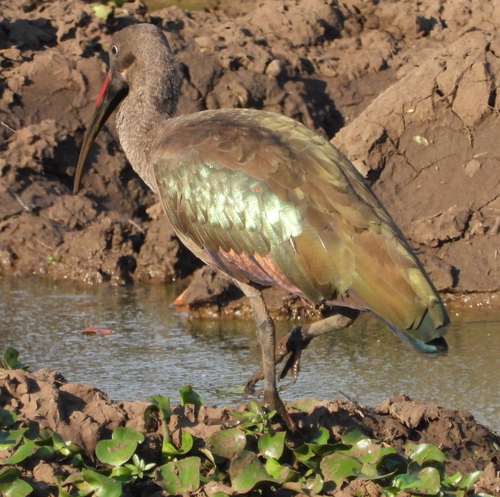 Hadada Ibis
In short
The single most reliable field mark is the bare, whitish head with a red crown of the Southern Bald Ibis, which is never shown by Hadada Ibis. Juvenile Southern Bald Ibises are dull grey but still show the bald head, while Hadada Ibis of all ages have feathered heads with a narrow white cheek stripe. In flight, both are large dark ibises with some wing gloss, but the Southern Bald Ibis is more iridescent overall and lacks the Hadada's distinctive white facial mark. Habitats overlap in open country, but Southern Bald Ibis is a highland specialist, usually seen in remote grasslands or on cliffs, while Hadada is common in gardens and urban areas. Calls are also very different: Hadada is famously loud and raucous, while Southern Bald Ibis is much quieter.
Identification tips
- Bare, whitish head with red crown (Southern Bald Ibis): Only Southern Bald Ibis has a bald, wrinkled, whitish head with a red dome-shaped crown. This is visible at all ages and is the most reliable field mark. Hadada Ibis always has a feathered head.
- White cheek stripe (Hadada Ibis): Hadada Ibis has a narrow, white, horizontal cheek stripe (sometimes called a 'moustache'), which does not reach the mouth corners. Southern Bald Ibis never shows this feature.
- Head feathering (all ages): Juvenile Southern Bald Ibis is dull grey but still bald-headed; Hadada Ibis of all ages has a feathered head.
- Bill color: Southern Bald Ibis has a long, down-curved red bill at all times. Hadada Ibis has a grey-to-black bill, with a red base only during breeding season (and even then, only on the upper mandible).
- Leg color: Southern Bald Ibis has red legs; Hadada Ibis has blackish legs, with the upper surface of the toes turning red only at the onset of breeding.
- Overall plumage gloss: Southern Bald Ibis is more iridescent overall (green, violet, bronze, copper on shoulders), especially in good light. Hadada Ibis has a purple gloss limited to the wings.
- Body color: Southern Bald Ibis is dark greenish with blue-green neck; Hadada Ibis is grey-brown overall.
- Juvenile confusion: Young Southern Bald Ibis is dull grey but still bald-headed; young Hadada Ibis looks like a duller adult but always has a feathered head and white cheek stripe.
- Flight profile: Both are large, broad-winged ibises, but Southern Bald Ibis is more uniformly dark and iridescent, while Hadada Ibis may show the white cheek stripe even in flight at close range.
- Vocalization: Hadada Ibis is extremely noisy, with loud, raucous calls often heard before the bird is seen. Southern Bald Ibis is much quieter.
- Habitat context: Southern Bald Ibis is found in remote, highland grasslands and cliffs, rarely near humans. Hadada Ibis is common in gardens, parks, and urban areas, often around people.
- Foraging behavior: Southern Bald Ibis forages in open, short grass or ploughed fields, avoiding tall grass and wetlands. Hadada Ibis forages in soft soil, lawns, and even flower beds.
- Group size: Southern Bald Ibis often seen in small flocks or colonies, especially near cliffs. Hadada Ibis is often seen singly or in small groups, especially in urban settings.
- Seasonal marks: Hadada Ibis shows more red on bill and toes only in breeding season; Southern Bald Ibis always has red bill and legs.
- Range: Southern Bald Ibis is a local southern African endemic, while Hadada Ibis is widespread across sub-Saharan Africa. If seen in a city or lowland wetland, Hadada is far more likely.
Size
Both species are large ibises, but Hadada Ibis is slightly longer (about 76 cm) and heavier (mean adult mass 1.2 kg) [wikipedia]. Southern Bald Ibis is also large, but specific measurements are not given in the notes; both are comparable in bulk. In the field, size alone is not a reliable separator, especially at a distance or in flight.
Plumage
- Juvenile/immature birds: Southern Bald Ibis juveniles are mostly dull grey with a bare, whitish head and red crown, lacking the iridescent gloss of adults. Hadada Ibis immatures look like adults: grey-brown overall, feathered head, and a narrow white cheek stripe, with some purple gloss on the wings.
- Adults: Southern Bald Ibis is dark green with strong iridescence (green, violet, bronze), blue-green neck, and coppery shoulders. The head is bald, whitish, and topped with a red crown. Hadada Ibis adults are grey-brown with a purple gloss on the wings, feathered head, and a narrow white horizontal cheek stripe (not reaching the bill), with no bare skin. Hadada's bill is mostly blackish, with a red base only in breeding season.
- In flight: Both show dark wings with some gloss, but Southern Bald Ibis is more uniformly iridescent and lacks Hadada's white facial mark. No distinctive upperwing panel or trailing edge is described for either species in the notes.
Behaviour
Southern Bald Ibis is more often seen in remote, open highland grasslands or on cliffs, foraging in groups or colonies, and is generally wary. Hadada Ibis is highly tolerant of humans, often seen foraging in gardens, lawns, and urban parks, and is much more approachable. Both species forage by probing the ground for invertebrates, but Hadada is especially known for feeding in soft soil and even in residential areas. Southern Bald Ibis forages more in open, short grass or ploughed fields, avoiding tall grass.
Habitat
Southern Bald Ibis is a highland and mountain grassland specialist, nesting on cliffs and foraging in open, often remote areas of southern Africa. It avoids marshy or densely vegetated areas. Hadada Ibis is widespread across sub-Saharan Africa, found in a broad range of habitats including wetlands, cultivated land, gardens, and urban parks. It is much more likely to be seen near human habitation and in lowland areas.
Voice
Hadada Ibis is extremely vocal, giving a loud, distinctive "haa-haa-haa-de-dah" call, especially in flight at dawn and dusk, and a single loud "haaaa" when roosting. These calls are unmistakable and often the first sign of the species. Southern Bald Ibis is much quieter and does not produce the loud, raucous calls of Hadada; its vocalizations are not described as diagnostic in the notes.