

Motmot

Sooty Tyrannulet vs Straneck's Tyrannulet

Serpophaga nigricans versus Serpophaga griseicapilla

Play a quiz with Sooty Tyrannulet and Straneck's Tyrannulet
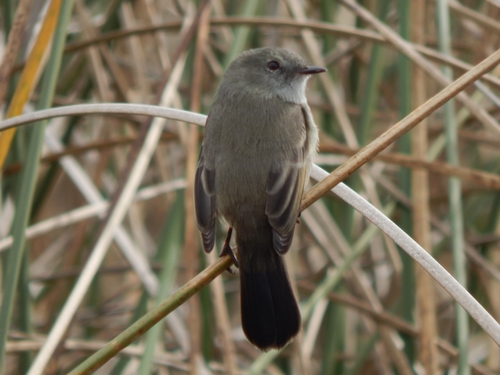
Sooty Tyrannulet (Serpophaga nigricans) Sooty Tyrannulet
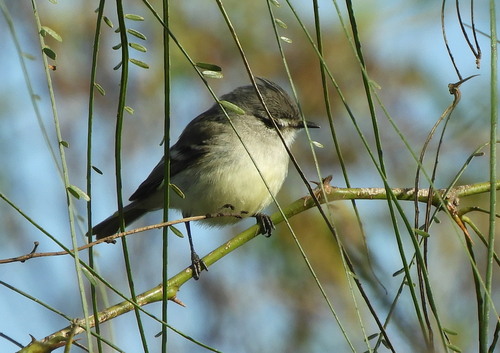
Straneck's Tyrannulet (Serpophaga griseicapilla) Straneck's Tyrannulet

Media

Loading…

In short

The most reliable way to separate Sooty Tyrannulet from Straneck's Tyrannulet is overall darkness: Sooty Tyrannulet is distinctly darker, especially on the head, upperparts, and tail, while Straneck's Tyrannulet is paler and more contrasting, with a gray crown, obvious pale supercilium, and whitish underparts with yellowish belly. Sooty Tyrannulet lacks the strong facial pattern of Straneck's, appearing more uniformly dusky. Both species have pale wingbars, but Straneck's are often tinged cinnamon and set off by paler feather edges. In the field, look for Sooty's nearly black tail and dark, plain face versus Straneck's pale face with a white crescent under the eye and a thin white brow. Size is not a strong separator, but Sooty Tyrannulet is slightly larger and heavier.

Identification tips

  1. Overall Darkness: Sooty Tyrannulet is much darker overall, especially on the head, upperparts, and tail. Use this as your first check in shaded or backlit conditions.
  2. Facial Pattern: Straneck's Tyrannulet has a thin white supercilium, a white crescent under the eye, and a dark gray line through the eye, creating a striking facial contrast. Sooty Tyrannulet's face is plain and dusky, lacking these marks.
  3. Crown and Nape: Straneck's shows a gray crown and nape with some hidden white on black central crown feathers, while Sooty's crown is just darker than the rest of the head with only a partially visible white stripe.
  4. Wingbars: Both species have two pale wingbars, but Straneck's are often cinnamon to whitish and more contrasting due to paler feather edges. Sooty's are pale gray and less distinct.
  5. Tail Color: Sooty Tyrannulet has a black tail, while Straneck's is dark gray-brown with whitish edges on the outer feathers. In good light, this is a strong separator.
  6. Underparts: Sooty Tyrannulet is paler below but remains grayish, while Straneck's has a white chin and throat, grayish breast, and a distinctly pale yellow belly, creating more contrast.
  7. Bill and Legs: Both have black bills and legs, not useful for separation.
  8. Iris Color: Both species have brown irises, not a separator.
  9. Size: Sooty Tyrannulet is slightly larger and heavier, but this is subtle and unreliable unless birds are side by side.
  10. Habitat: If seen near water, especially in brushy riparian zones, Sooty Tyrannulet is more likely. Away from water, especially in drier or more open areas, Straneck's is favored.
  11. Tail Wagging: Sooty Tyrannulet often wags its tail while foraging; this behavior is not noted for Straneck's.
  12. Flight Style: Sooty Tyrannulet makes short, frequent flights between perches and is often seen sallying over water. Straneck's behavior is less well described but likely similar.
  13. Voice: If you hear a series of short notes followed by canary-like higher notes or a sharp 'teek', this is Sooty Tyrannulet. Straneck's vocalizations are not described here.
  14. Sex and Age: Both sexes are similar in both species, and no juvenile/immature-specific marks are described, so all field marks apply year-round.
  15. Pitfalls: In poor light, Straneck's can appear darker and Sooty's facial pattern can be obscured, so always look for the combination of overall darkness and facial contrast rather than relying on a single mark.

Size

Sooty Tyrannulet is slightly larger and heavier, averaging 12 cm in length and 9 g in mass [wikidata]. Straneck's Tyrannulet is smaller and lighter, at 9–11 cm and 4.4–7.5 g [wikipedia]. This difference is subtle in the field and easily masked by posture or distance, but Sooty Tyrannulet may appear a bit bulkier and longer-tailed when seen side by side.

Plumage

No age-specific juvenile or immature upperwing patterns are described for either species, so focus is on adult plumage. Sooty Tyrannulet is overall dark gray to brownish-gray, with a darker crown, black tail, and only a partially visible white crown stripe. Its face is plain, lacking strong markings, and the underparts are paler but not sharply contrasting. The wings show two pale gray wingbars and some whitish on the inner flight feathers. In contrast, Straneck's Tyrannulet is much paler and more patterned: it has a gray crown and nape with some hidden white on black central crown feathers, a thin white supercilium, a white crescent under the eye, and a dark gray line through the eye. The upperparts are olivaceous brown, the wings are dusky brownish-gray with paler edges and two cinnamon to whitish wingbars, and the tail is dark gray-brown with whitish edges (not black). The chin and throat are white with a grayish wash, and the breast is grayish, fading to pale yellow on the belly. Both sexes are similar in both species.

Behaviour

Sooty Tyrannulet is active, often making short flights between perches and rarely landing on the ground. It frequently wags its tail while foraging and is often seen sallying out over water to catch insects. Straneck's Tyrannulet's behavior is less detailed in the notes, but as a Serpophaga, it is likely also active and flycatching, though not specifically noted for tail wagging or foraging over water. Sooty Tyrannulet's preference for water edges may influence its behavior, making it more likely to be seen darting over streams or rivers.

Habitat

Sooty Tyrannulet is closely tied to water: it is typically found near streams, rivers, and water bodies, especially in brushy areas adjacent to these habitats, though it can sometimes be found away from water. Straneck's Tyrannulet has a broader habitat range, being found in Argentina, Bolivia, Brazil, Paraguay, and Uruguay, but the notes do not specify a strong association with water. If you see a small Serpophaga away from water, especially in drier or more open brush, Straneck's is more likely; near water, especially in southern South America, Sooty is favored.

Voice

Sooty Tyrannulet's song is a series of short notes followed by higher-pitched, canary-like notes, and it gives a sharp 'teek' call. It also produces quiet trills and chatters between pairs, and more complex calls when interacting with fledglings. No vocalization details are provided for Straneck's Tyrannulet in the notes, so voice is only diagnostic if you hear the described Sooty Tyrannulet song or calls.

Submit a better description

Use the same sections as the comparison. Your text is published immediately.

The most reliable way to separate Sooty Tyrannulet from Straneck's Tyrannulet is overall darkness: Sooty Tyrannulet is distinctly darker, especially on the head, upperparts, and tail, while Straneck's Tyrannulet is paler and more contrasting, with a gray crown, obvious pale supercilium, and whitish underparts with yellowish belly. Sooty Tyrannulet lacks the strong facial pattern of Straneck's, appearing more uniformly dusky. Both species have pale wingbars, but Straneck's are often tinged cinnamon and set off by paler feather edges. In the field, look for Sooty's nearly black tail and dark, plain face versus Straneck's pale face with a white crescent under the eye and a thin white brow. Size is not a strong separator, but Sooty Tyrannulet is slightly larger and heavier.

  1. Overall Darkness: Sooty Tyrannulet is much darker overall, especially on the head, upperparts, and tail. Use this as your first check in shaded or backlit conditions.
  2. Facial Pattern: Straneck's Tyrannulet has a thin white supercilium, a white crescent under the eye, and a dark gray line through the eye, creating a striking facial contrast. Sooty Tyrannulet's face is plain and dusky, lacking these marks.
  3. Crown and Nape: Straneck's shows a gray crown and nape with some hidden white on black central crown feathers, while Sooty's crown is just darker than the rest of the head with only a partially visible white stripe.
  4. Wingbars: Both species have two pale wingbars, but Straneck's are often cinnamon to whitish and more contrasting due to paler feather edges. Sooty's are pale gray and less distinct.
  5. Tail Color: Sooty Tyrannulet has a black tail, while Straneck's is dark gray-brown with whitish edges on the outer feathers. In good light, this is a strong separator.
  6. Underparts: Sooty Tyrannulet is paler below but remains grayish, while Straneck's has a white chin and throat, grayish breast, and a distinctly pale yellow belly, creating more contrast.
  7. Bill and Legs: Both have black bills and legs, not useful for separation.
  8. Iris Color: Both species have brown irises, not a separator.
  9. Size: Sooty Tyrannulet is slightly larger and heavier, but this is subtle and unreliable unless birds are side by side.
  10. Habitat: If seen near water, especially in brushy riparian zones, Sooty Tyrannulet is more likely. Away from water, especially in drier or more open areas, Straneck's is favored.
  11. Tail Wagging: Sooty Tyrannulet often wags its tail while foraging; this behavior is not noted for Straneck's.
  12. Flight Style: Sooty Tyrannulet makes short, frequent flights between perches and is often seen sallying over water. Straneck's behavior is less well described but likely similar.
  13. Voice: If you hear a series of short notes followed by canary-like higher notes or a sharp 'teek', this is Sooty Tyrannulet. Straneck's vocalizations are not described here.
  14. Sex and Age: Both sexes are similar in both species, and no juvenile/immature-specific marks are described, so all field marks apply year-round.
  15. Pitfalls: In poor light, Straneck's can appear darker and Sooty's facial pattern can be obscured, so always look for the combination of overall darkness and facial contrast rather than relying on a single mark.

Sooty Tyrannulet is slightly larger and heavier, averaging 12 cm in length and 9 g in mass [wikidata]. Straneck's Tyrannulet is smaller and lighter, at 9–11 cm and 4.4–7.5 g [wikipedia]. This difference is subtle in the field and easily masked by posture or distance, but Sooty Tyrannulet may appear a bit bulkier and longer-tailed when seen side by side.

No age-specific juvenile or immature upperwing patterns are described for either species, so focus is on adult plumage. Sooty Tyrannulet is overall dark gray to brownish-gray, with a darker crown, black tail, and only a partially visible white crown stripe. Its face is plain, lacking strong markings, and the underparts are paler but not sharply contrasting. The wings show two pale gray wingbars and some whitish on the inner flight feathers. In contrast, Straneck's Tyrannulet is much paler and more patterned: it has a gray crown and nape with some hidden white on black central crown feathers, a thin white supercilium, a white crescent under the eye, and a dark gray line through the eye. The upperparts are olivaceous brown, the wings are dusky brownish-gray with paler edges and two cinnamon to whitish wingbars, and the tail is dark gray-brown with whitish edges (not black). The chin and throat are white with a grayish wash, and the breast is grayish, fading to pale yellow on the belly. Both sexes are similar in both species.

Sooty Tyrannulet is active, often making short flights between perches and rarely landing on the ground. It frequently wags its tail while foraging and is often seen sallying out over water to catch insects. Straneck's Tyrannulet's behavior is less detailed in the notes, but as a Serpophaga, it is likely also active and flycatching, though not specifically noted for tail wagging or foraging over water. Sooty Tyrannulet's preference for water edges may influence its behavior, making it more likely to be seen darting over streams or rivers.

Sooty Tyrannulet is closely tied to water: it is typically found near streams, rivers, and water bodies, especially in brushy areas adjacent to these habitats, though it can sometimes be found away from water. Straneck's Tyrannulet has a broader habitat range, being found in Argentina, Bolivia, Brazil, Paraguay, and Uruguay, but the notes do not specify a strong association with water. If you see a small Serpophaga away from water, especially in drier or more open brush, Straneck's is more likely; near water, especially in southern South America, Sooty is favored.

Sooty Tyrannulet's song is a series of short notes followed by higher-pitched, canary-like notes, and it gives a sharp 'teek' call. It also produces quiet trills and chatters between pairs, and more complex calls when interacting with fledglings. No vocalization details are provided for Straneck's Tyrannulet in the notes, so voice is only diagnostic if you hear the described Sooty Tyrannulet song or calls.

Discard your changes?

You have unsaved edits. If you leave now, those changes will be lost.

Sooty Tyrannulet · Straneck's Tyrannulet · My Tricky Birds