
Sooty Tern vs Grey-backed Tern
Onychoprion fuscatus versus Onychoprion lunatus
Play a quiz with Sooty Tern and Grey-backed Tern
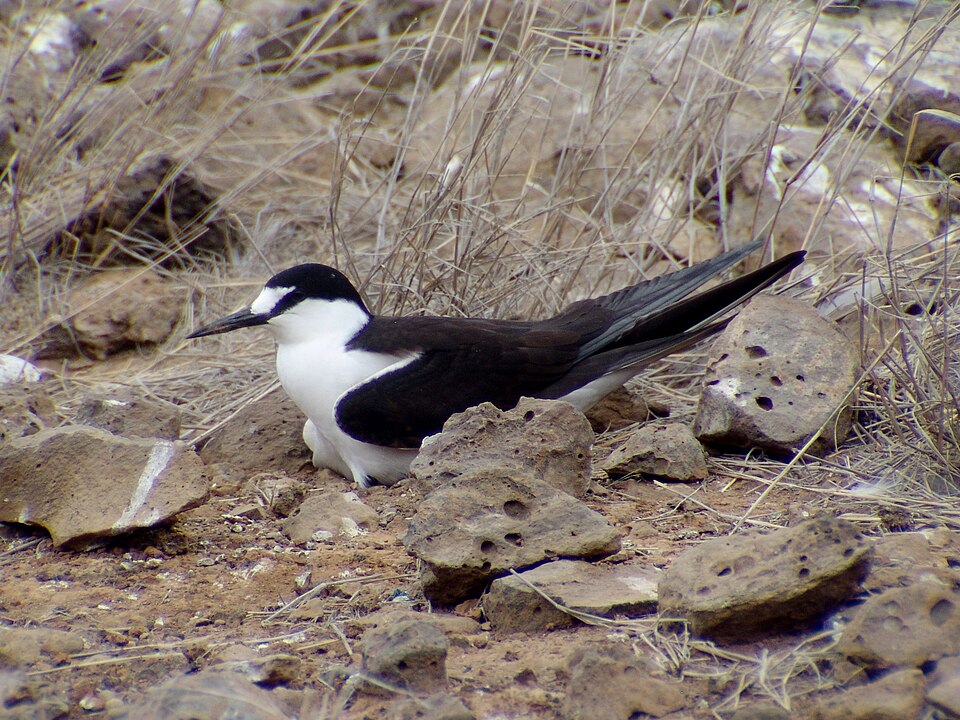 Sooty Tern
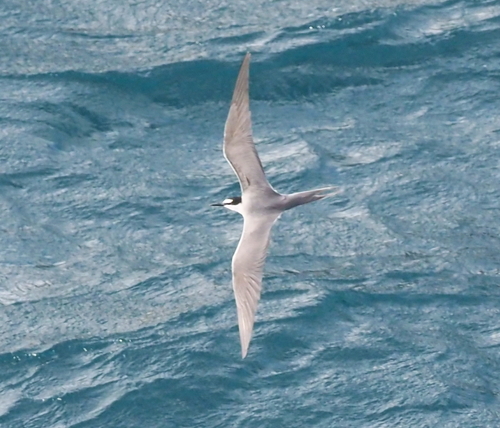 Grey-backed Tern
In short
The most reliable field mark to separate Sooty Tern from Grey-backed Tern is the color of the upperparts: Sooty Tern has black to very dark blackish-brown upperparts, while Grey-backed Tern has a distinctly grey back. Both species have white underparts and a white forehead, but Sooty Tern’s upperparts are much darker overall. Juveniles of Sooty Tern appear darker and more uniformly dusky above than Grey-backed Tern, which always shows a paler, grey-toned back. In flight or at rest, check the back color and the presence or absence of a pale neck collar (present in Grey-backed, absent in Sooty). Structural differences are subtle, so focus on plumage, especially in bright light.
Identification tips
- Back color is key: Sooty Tern always has black to very dark blackish-brown upperparts; Grey-backed Tern has a distinctly grey back. This is the most reliable field mark at all ages and in all seasons.
- Juvenile/immature contrast: Young Sooty Terns are very dark above with a scaly pattern and only the lower belly pale; Grey-backed Tern juveniles are always paler above, with a grey (not black) back. If the bird looks almost entirely dark above, it is a Sooty Tern.
- Forehead and face: Both have a white forehead, but Sooty Tern’s is broader and lacks a black eye line. Grey-backed Tern shows a black eye line from bill to nape, giving a 'spectacled' look.
- Neck collar: Sooty Tern never shows a pale neck collar; Grey-backed Tern may show a faint pale collar due to contrast between grey back and white neck. If you see a pale collar, it is not Sooty Tern.
- Tail shape: Both have moderately deeply forked tails, but this is not a reliable separator between these two species.
- Underparts: Both species have white underparts as adults, but Sooty Tern juveniles are darker below except for the lower belly.
- Upperwing in flight: Sooty Tern is much darker above in all plumages; Grey-backed Tern’s upperwing is paler, matching the grey mantle.
- Bill and legs: Both have black bills and legs; these features are not useful for separation.
- Size: Sooty Tern is medium-large, similar to Sandwich Tern; Grey-backed Tern is similar but possibly slightly smaller. Size overlap is substantial, so do not rely on this.
- Behavior: Both are highly pelagic, but Sooty Tern is more likely to be seen in large, noisy colonies. Grey-backed Tern is less numerous and less often encountered.
- Habitat: Both breed on tropical islands and are oceanic, but Sooty Tern is much more widespread and abundant.
- Voice: Sooty Tern has a distinctive loud call; no information is available for Grey-backed Tern, so do not use voice for separation unless Sooty Tern’s call is heard.
- Pitfall – lighting: In poor light, Grey-backed Tern’s back can look dark, but never as black as Sooty Tern. Always try to assess back color in good light.
- Pitfall – confusion with Bridled Tern: Both species can be confused with Bridled Tern, but Sooty Tern is darker and lacks a pale collar; Grey-backed Tern is paler above than both.
- Context: If seen far from land, both are possible, but Sooty Tern is far more likely in most tropical oceans.
Size
Both species are medium-large terns, but Sooty Tern is similar in size to Sandwich Tern (36–45 cm length, 82–94 cm wingspan) [wikipedia]. There are no direct size figures for Grey-backed Tern in the notes, but it is implied to be similar, possibly slightly smaller, as it is described as less robust than Sooty Tern in some references. In the field, size is not a reliable separator between these two, as overlap is substantial and both have long wings and tails.
Plumage
-
Juvenile/immature birds: Sooty Tern juveniles are very dark grey-black above and below, with narrow pale fringes on the upperpart feathers, giving a scaly look on the back and wings. The belly is whitish, but the rest of the underparts are dusky. Grey-backed Tern juveniles are not described in detail in the notes, but the key difference is that even young birds have a grey (not black) back, and lack the overall sooty darkness of Sooty Tern. If you see a scaly, very dark-backed tern with only the lower belly pale, it is Sooty Tern.
-
Adults: Sooty Tern adults have black to blackish-brown upperparts, a broad white forehead, and white underparts. The tail is moderately deeply forked and black with white outer edges. Grey-backed Tern adults have a grey back (never black), white underparts, and a black eye line running from the bill through the eye to the back of the head. Both have a white forehead, but Sooty Tern’s is broader and lacks the dark eye line. Sooty Tern never shows a pale neck collar, while Grey-backed Tern may show a faint pale collar effect due to the contrast between the grey back and white neck.
-
Flight views: Both species have long wings and tails, but the darkness of the upperwing and mantle is diagnostic: Sooty Tern is much darker above in all ages.
Behaviour
Both species are highly pelagic, spending most of their lives at sea and coming to land only to breed. Sooty Tern is noted for its extremely marine habits, rarely coming to land except for nesting, and can spend years continuously on the wing. Grey-backed Tern is also oceanic but is less well-studied; its general behavior is similar. Both pick fish from the sea surface. Sooty Tern is more likely to be seen in large, noisy colonies, while Grey-backed Tern is less common and less well-known in its breeding habits.
Habitat
Both species breed on tropical islands and are found over tropical oceans. Sooty Tern is extremely pelagic and is rarely seen inland except after storms; it breeds in large colonies on rocky or coral islands. Grey-backed Tern occupies similar habitats but is less numerous and less frequently encountered. Sooty Tern is more widespread and abundant, especially in the Atlantic and Indian Oceans, while Grey-backed Tern is less common and more localized.
Voice
Sooty Tern has a loud, piercing 'wide-a-wake' or 'ker-wack-a-wack' call, as well as a harsh alarm 'kvaark'. There are no vocalization details provided for Grey-backed Tern in the notes, so voice is not a reliable separator based on available information.